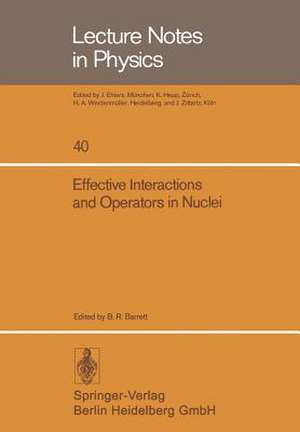
Effective Interactions and Operators in Nuclei
Editat de B. R. Barretten Limba Engleză Paperback – 5 sep 1975
Preț: 649.54 lei
Preț vechi: 764.17 lei
-15%
Puncte Express: 974
Carte tipărită la comandă
Livrare economică 14-28 noiembrie
Livrare prin curier în România Termenul estimat este afișat lângă disponibilitate.
Transport gratuit pentru acest produs Plată online sau ramburs, în funcție de opțiunile comenzii.
Retur gratuit în 14 zile Comandă securizată și suport în română.
Specificații
ISBN-13: 9783540074007
ISBN-10: 3540074007
Pagini: 356
Ilustrații: XII, 343 p.
Dimensiuni: 170 x 244 x 20 mm
Greutate: 0.62 kg
Ediția:1975
Editura: Springer
Locul publicării:Berlin, Heidelberg, Germany
ISBN-10: 3540074007
Pagini: 356
Ilustrații: XII, 343 p.
Dimensiuni: 170 x 244 x 20 mm
Greutate: 0.62 kg
Ediția:1975
Editura: Springer
Locul publicării:Berlin, Heidelberg, Germany
V-ar putea interesa
-
 AQA A Level Physics Revision GuideJim Breithaupt-15%Preț: 166.92 lei195.43 lei
 -
 The Pauli Exclusion PrincipleIlya G Kaplan-9%Preț: 865.52 lei951.13 lei
 -
 Wind Farm NoiseColin H Hansen-9%Preț: 919.58 lei1010.52 lei
 -
 Continuum Mechanics of Anisotropic MaterialsStephen C. CowinPreț: 391.42 lei
 -
 -9%Preț: 940.57 lei1033.60 lei
 -
 Heute Science Fiction, morgen Realität?Gerd GanteförPreț: 164.82 lei
 -
 Quantum ChromodynamicsWalter Greiner-23%Preț: 746.75 lei969.81 lei
 -
 Design in Nature: Learning from TreesClaus Mattheck-18%Preț: 859.03 lei1047.60 lei
 -
 Geoid DeterminationFernando Sansò-18%Preț: 1851.32 lei2257.72 lei
 -
 Advances in Meteorology, Climatology and Atmospheric PhysicsCostas G. Helmis-24%Preț: 1845.69 lei2428.54 lei
 -
 Atmospheric PhysicsUlrich Schumann-18%Preț: 1218.84 lei1486.39 lei
 -
 Atmospheric PhysicsJulio V. IribarnePreț: 374.23 lei
 -
 Atmospheric AerosolsOlivier Boucher-15%Preț: 681.10 lei801.29 lei
Public țintă
ResearchCuprins
Perturbation theory of effective Hamiltonians.- Folded diagram theory, time-dependent approach of Johnson and Baranger.- A time-dependent, diagrammatic analysis of effective interactions and operators.- Determination of effective matrix elements from experimental data.- How do we decide which unperturbed basis to use? What is the role of self-consistency?.- Computation of the reaction matrix, G.- Perturbation calculation in a double-partitioned Hilbert space.- The average effective interaction.- Algebraic structure of effective interactions and operators. Convergence properties of the perturbation expansions.- Is there a universal relationship connecting all two-body effective interactions?.- Relevant aspects of statistical spectroscopy.- Infinite partial summations.- Pade approximants and the calculation of effective interactions.- Shell model diagonalizations in an expanded space.- Density dependent interactions.- Calculation of other effective operators.- Theory versus theory as a test of the effective interaction.- Summary Talk: Where do we stand at the present time regarding the microscopic theory of effective interactions and operators?.