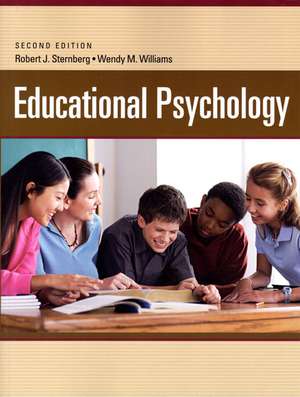
Educational Psychology
Autor Robert Sternberg, Robert J. Sternberg, Wendy M. Williamsen Limba Engleză Paperback – 20 ian 2009
În volumul Educational Psychology, abordarea interdisciplinară devine fundamentul pedagogiei moderne, împletind psihologia cognitivă, științele educației și managementul clasei. Descoperim aici o perspectivă care refuză simpla memorare, propunând în schimb un model de învățare activă bazat pe teoria triarhică a inteligenței dezvoltate de Robert J. Sternberg. Această ediție a doua rafinează echilibrul dintre rigoarea științifică și „arta” predării, oferind viitorilor pedagogi instrumente pentru a cultiva gândirea analitică, creativă și practică. Notăm cu interes modul în care autorii, Robert J. Sternberg și Wendy M. Williams, integrează interogația directă în fluxul narativ, forțând cititorul să proceseze informația dincolo de nivelul superficial. Față de lucrările anterioare ale autorului, precum What Is Intelligence?, unde accentul cădea pe definirea teoretică a constructului, acest manual transformă teoria în metodologie aplicată. Este o evoluție firească de la cercetarea fundamentală spre optimizarea succesului școlar, temă centrală și în Optimizing Student Success in School with the Other Three RS. Recomandăm acest titlu ca o alternativă solidă la Psychology Applied to Teaching de Jack Snowman pentru cursurile de psihologie educațională, cu avantajul unei structuri cognitive mai riguroase. În timp ce Snowman pune accent pe experiența de zi cu zi a profesorului, Robert J. Sternberg oferă un cadru conceptual care transformă inteligența dintr-o trăsătură statică într-o expertiză ce poate fi dezvoltată continuu. Ritmul este unul academic, dar extrem de bine structurat, facilitând tranziția de la student la profesionistul capabil să testeze și să aplice teorii complexe în mediul divers al școlii contemporane.
Preț: 1049.35 lei
Preț vechi: 1234.53 lei
-15%
Carte disponibilă
Livrare economică 11-25 noiembrie
Livrare express 27-31 octombrie pentru 71.81 lei
Specificații
ISBN-10: 0205626076
Pagini: 640
Dimensiuni: 216 x 276 x 35 mm
Greutate: 1.56 kg
Ediția:Nouă
Editura: Pearson
Locul publicării:Boston, United States
V-ar putea interesa
-
 -23%Preț: 872.40 lei1133.00 lei
 -
 Preț: 404.99 lei
 -
 Critical Thinking: An Exploration of Theory and PracticeJennifer MoonPreț: 412.71 lei
 -
 The Cambridge Handbook of LiteracyDavid R. Olson-11%Preț: 448.07 lei503.45 lei
 -
 Preț: 389.74 lei
 -
 Peer Support in ActionHelen Cowie-15%Preț: 661.14 lei777.81 lei
 -
 Education and Mind in the Knowledge AgeCarl Bereiter-15%Preț: 624.20 lei734.35 lei
 -
 Effective Learning in ClassroomsChris WatkinsPreț: 243.15 lei
 -
 Talking is for AllBetty Rudd-15%Preț: 665.59 lei783.05 lei
 -
 The Psychology of Gender, Second EditionAlice H. EaglyPreț: 328.29 lei
 -
 Success Comes in Cans: Learning Lessons for LifeKriss Akabusi-20%Preț: 118.45 lei148.80 lei
 -
 Environments for LearningEric JensenPreț: 172.59 lei
De ce să citești această carte
Această carte este esențială pentru studenții de la facultățile de psihologie și științele educației care doresc să depășească etapa de simpli receptori de informație. Cititorul câștigă o înțelegere profundă a modului în care funcționează învățarea, fiind ghidat de teoria triarhică a lui Sternberg. Este o resursă valoroasă pentru cei care urmăresc să devină profesori experți, capabili să adapteze strategiile de predare la nevoile cognitive diverse ale elevilor.
Despre autor
Robert J. Sternberg este un nume de referință în psihologia contemporană, ocupând în prezent funcția de decan al School of Arts and Sciences la Tufts University. Anterior, și-a desfășurat activitatea la Yale University, unde a condus Center for the Psychology of Abilities, Competencies, and Expertise. Cariera sa este marcată de o redefinire a conceptului de inteligență, pe care o privește nu ca pe un coeficient fix, ci ca pe o expertiză maleabilă și aflată în continuă dezvoltare. Această viziune revoluționară se reflectă în întreaga sa operă, punând bazele unor noi standarde în psihologia educațională și în cercetarea proceselor cognitive.
Cuprins
The "Thinking" Triangle
What Is An Expert Teacher?
What Do We Know About Expert Learners?
How Educational Psychology Helps Create Expert Teachers and Learners
I. HUMAN DEVELOPMENT
2. Cognitive Development
Cognitive Development: Concepts for Teaching
Piaget's Stage Theory of Cognitive Development
Vygotsky's Sociocultural Theory of Cognitive Development
Information Processing Theories: Examining Learning and Memory Skills
Three Major Approaches to Cognitive Development: A Comparison
Theory of Mind
Language Development
Brain Development
3. Personal, Gender, Social, and Moral Development
Why Understanding Personal, Gender, Social, and Moral Development Is Important to Teachers
Personal Development: Becoming Unique
Temperament
Sexual and Gender Development: Acquiring Gender Roles
Social Development: Learning to Interact with Others
Moral Development: Acquiring a Sense of Right and Wrong
Identifying, Understanding, and Managing Developmental Risks
II. HUMAN DIVERSITY
4. Individual Differences: Intelligence, Cognitive and Learning Styles, and Creativity
Why Understanding Individual Differences Is Important to Teachers
Understanding Individual Differences in Intelligence
Current Educational Controversies in Intelligence
Cognitive Styles and Learning Styles
Understanding Individual Differences in Creativity
5. Individual Differences: Exceptional Children
Why Understanding Exceptional Children Is Important to Teachers
Teaching Exceptional Children
Extremes of Intellectual Functioning: Giftedness.
Extremes of Intellectual Functioning: Mental Retardation
Challenges to Learning
6. Group Differences: Socioeconomic Status, Ethnicity, Gender, and Language
Why Understanding Group Differences Is Important to Teachers
Socioeconomic Diversity
Ethnic and Racial Diversity
Gender Diversity
Language Diversity
Multicultural Education
III. THINKING, LEARNING, AND MEMORY
7. Behavioral Approaches to Learning
Why Understanding Behavioral Learning Is Important to Teachers
Learning by Classical Conditioning
Learning by Operant Conditioning
Social Learning
Cognitive-Behavioral Modification
8. Cognitive Approaches to Learning
Why Understanding Cognitive Approaches to Learning Is Important to Teachers
The Standard Memory Model
Alternative Models of Memory
Retrieving Information
Constructivist Approaches.
9. Thinking: Concept Formation, Reasoning, and Problem Solving
Why Understanding Thinking Is Important to Teachers
Concept Formation
Reasoning
Problem Solving
Transfer
Decision Making
Teaching for Thinking
IV. MOTIVATION AND INSTRUCTION
10. Motivating Students
Why Understanding Motivation Is Important to Teachers
Intrinsic and Extrinsic Motivation
Four Ways to Understand Motivation
The Role of Arousal Level
The Role of Student Goals
The Role of Student Needs
The Role of Student Attributions and Beliefs
Motivating Challenging Students
11. Classroom Management
Why Understanding Classroom Management Is Important to Teachers
How Effective Teachers Manage Their Students
Developing and Implementing Rules and Procedures
Maintaining Control and Preventing Problems
Special Approaches to Classroom Management
12. Classroom Teaching
Why Understanding Classroom Teaching Is Important to Teachers.
Principles of Teacher-Centered Teaching
Principles of Student-Centered or Constructivist Teaching
V. ASSESSMENT
13. Standardized Testing
Why Understanding Standardized Testing Is Important to Teachers
What Are Standardized Tests?
Types of Standardized Tests
Assessing Test Quality
Interpreting Standardized Test Scores
Issues and Concerns in Standardized Testing
14. Classroom Assessments
Why Understanding Classroom Assessments Is Important to Teachers
Traditional Assessments
Authentic Assessment
Grading and Reporting
References
Name Index
Subject Index
Textul de pe ultima copertă
Renowned scholars, Sternberg and Williams help readers capitalize on their strengths by integrating questions into the text that encourage analytical, creative, and practical thinking. This framework, based on Sternberg’s triarchic theory of human intelligence, helps ensure that readers think deeply about what they are learning, rather than merely processing information at a superficial level.
In addition, Educational Psychology also:
Shows Readers How to Use Text Principles in the Classroom
- Expert Teacher Interviews illustrate the classroom application of chapter material.
- The Flexible Expert feature provides examples of solutions–analytical, creative, and practical–for daily challenges both students and teachers face in the classroom.
- Implications for Teaching illustrate the strategies expert teachers use in the classroom, using specific concepts of educational psychology.
- Thinking Questions–Thinking Analytically, Thinking Creatively, and Thinking Practically–appear throughout each chapter to encourage readers to think deeply about chapter concepts.
- Constructing Your Own Learning activities help readers understand constructivism by using the theory themselves to build upon what they have read in the text.
- Forum debates illustrate contested educational issues –such as homogenous versus heterogeneous grouping–and show that there are middle-ground positions between extreme views of the issues.
- Becoming an Expert: Questions and Problems, grouped by elementary, middle, and high school settings, invite readers to apply chapter concepts to the problems of classroom practice.
- Guidelines for providing support for gifted students and students with disabilities are presented in Chapter 5: Individual Differences.
- The educational implications of socioeconomic, cultural, gender and linguistic diversity are discussed in detail in Chapter 6: Group Differences.
Caracteristici noi
- Thoroughly revised with current, valid research to reflect the field of educational psychology as it currently exists
- Many more cross-cultural and multicultural examples to help teachers prepare for today’s classrooms
- Hundreds of new and updated references, based on valid & current research