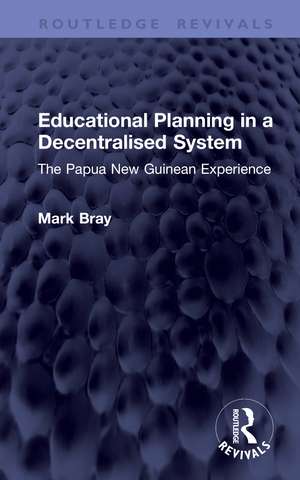
Educational Planning in a Decentralised System: The Papua New Guinean Experience: Routledge Revivals
Autor Mark Brayen Limba Engleză Hardback – oct 2026
With only three million people but 19 provincial governments and 20 ministers for Education, Papua New Guinea appeared at the time to have one of the most decentralised systems in the world. Within this framework, however, there were many contradictions and centralist strings. Originally published in 1984, Educational Planning in a Decentralised System is the first detailed account of decentralisation in the education sector in Papua New Guinea, presenting a clear analysis of the complexities of the system and the impact of decentralisation on inequalities, efficiency, and participation.
Din seria Routledge Revivals
-
 Preț: 331.97 lei
 - 9%
 Preț: 1329.58 lei
 - 9%
 Preț: 1332.92 lei
 -
 Preț: 334.61 lei
 - 9%
 Preț: 1329.13 lei
 -
 Preț: 340.35 lei
 -
 Preț: 331.26 lei
 -
 Preț: 330.56 lei
 - 9%
 Preț: 1328.58 lei
 - 9%
 Preț: 1650.78 lei
 -
 Preț: 331.62 lei
 - 9%
 Preț: 1353.30 lei
 -
 Preț: 332.63 lei
 -
 Preț: 314.21 lei
 - 8%
 Preț: 437.60 lei
 -
 Preț: 314.42 lei
 -
 Preț: 319.14 lei
 - 9%
 Preț: 1129.14 lei
 - 5%
 Preț: 303.54 lei
 - 9%
 Preț: 981.60 lei
 - 9%
 Preț: 1331.10 lei
 - 9%
 Preț: 1328.90 lei
 -
 Preț: 359.67 lei
 - 9%
 Preț: 6718.93 lei
 -
 Preț: 466.95 lei
 -
 Preț: 332.93 lei
 - 9%
 Preț: 1328.05 lei
 -
 Preț: 415.66 lei
 -
 Preț: 328.42 lei
 -
 Preț: 331.26 lei
 -
 Preț: 324.38 lei
 -
 Preț: 322.28 lei
 - 14%
 Preț: 680.54 lei
 -
 Preț: 332.96 lei
 - 14%
 Preț: 649.36 lei
 -
 Preț: 238.51 lei
 -
 Preț: 329.60 lei
 -
 Preț: 330.98 lei
 - 14%
 Preț: 988.50 lei
 - 11%
 Preț: 379.69 lei
 - 9%
 Preț: 1628.13 lei
 - 18%
 Preț: 983.06 lei
 - 9%
 Preț: 1330.09 lei
 -
 Preț: 366.47 lei
 - 9%
 Preț: 809.58 lei
 - 9%
 Preț: 967.93 lei
 -
 Preț: 425.61 lei
 - 9%
 Preț: 1329.44 lei
 - 9%
 Preț: 1328.58 lei
 - 9%
 Preț: 3516.85 lei
Preț: 813.24 lei
Preț vechi: 991.75 lei
-18% Nou
Puncte Express: 1220
Carte tipărită la comandă
Livrare economică 20 noiembrie-04 decembrie
Livrare prin curier în România Termenul estimat este afișat lângă disponibilitate.
Transport gratuit pentru acest produs Plată online sau ramburs, în funcție de opțiunile comenzii.
Retur gratuit în 14 zile Comandă securizată și suport în română.
Specificații
ISBN-13: 9781041386186
ISBN-10: 1041386184
Pagini: 174
Dimensiuni: 138 x 216 mm
Greutate: 0.35 kg
Ediția:1
Editura: Taylor & Francis
Colecția Routledge
Seria Routledge Revivals
Locul publicării:Oxford, United Kingdom
ISBN-10: 1041386184
Pagini: 174
Dimensiuni: 138 x 216 mm
Greutate: 0.35 kg
Ediția:1
Editura: Taylor & Francis
Colecția Routledge
Seria Routledge Revivals
Locul publicării:Oxford, United Kingdom
Public țintă
PostgraduateCuprins
Introduction 1. Theoretical issues and practical constraints: an international perspective 2. The political history of decentralisation in Papua New Guinea 3. Decentralisation and the education system 4. Decentralisation and the financial system 5. Decentralisation and inter-provincial inequalities 6. Diversity and conformity in the education system 7. Decentralisation and efficiency 8. Participation in educational decision-making 9. Conclusions: lessons from the Papua New Guinean experience
Recenzii
Reviews of the first publication:
‘Bray’s book offers a concise, clear, and compelling exposition of the process of decentralisation…offer[s] extremely important empirical and conceptual contributions to the study of educational decentralisation.’
— Comparative Education, Vol. 22, No. 2
‘This is a valuable contribution to the body of literature on educational planning.’
— Journal of Educational Administration, Vol. XXIII, No. 2
‘Bray has given all students of education’s role in the development process a useful case study of an important subject.’
— Pacific Affairs, Volume 58, Issue 4
‘Mark Bray is to be congratulated…for writing a clear, succinct, and eminently balanced account of Papua New Guinea’s experiment with decentralized educational planning…’
— Comparative Education Review, Volume 29, Number 4
‘Bray’s book offers a concise, clear, and compelling exposition of the process of decentralisation…offer[s] extremely important empirical and conceptual contributions to the study of educational decentralisation.’
— Comparative Education, Vol. 22, No. 2
‘This is a valuable contribution to the body of literature on educational planning.’
— Journal of Educational Administration, Vol. XXIII, No. 2
‘Bray has given all students of education’s role in the development process a useful case study of an important subject.’
— Pacific Affairs, Volume 58, Issue 4
‘Mark Bray is to be congratulated…for writing a clear, succinct, and eminently balanced account of Papua New Guinea’s experiment with decentralized educational planning…’
— Comparative Education Review, Volume 29, Number 4
Notă biografică
From 1981 to 1984, Mark Bray was employed by a National Department [Ministry] of Education project in Papua New Guinea. He was based at the University of Papua New Guinea, and provided in-service training in educational planning for officers at all levels of the system. This required considerable travel to all provinces, and he gained close acquaintance with the realities within the system.
Before moving to Papua New Guinea, Dr Bray taught in secondary schools in Kenya and Nigeria and at the University of Edinburgh. He had also been a consultant to the World Bank Fourth Primary Education Project in Pakistan, and had travelled extensively in both less developed and more developed countries.
Subsequently, Mark Bray moved to the University of Hong Kong where he currently holds the UNESCO Chair in Comparative Education. Between 2006 and 2010 he worked in Paris as Director of UNESCO’s International Institute for Educational Planning (IIEP).
Before moving to Papua New Guinea, Dr Bray taught in secondary schools in Kenya and Nigeria and at the University of Edinburgh. He had also been a consultant to the World Bank Fourth Primary Education Project in Pakistan, and had travelled extensively in both less developed and more developed countries.
Subsequently, Mark Bray moved to the University of Hong Kong where he currently holds the UNESCO Chair in Comparative Education. Between 2006 and 2010 he worked in Paris as Director of UNESCO’s International Institute for Educational Planning (IIEP).
Descriere
Originally published in 1984, Educational Planning in a Decentralised System is the first detailed account of decentralisation in the education sector in Papua New Guinea, presenting a clear analysis of the complexities of the system and the impact of decentralisation on inequalities, efficiency, and participation.