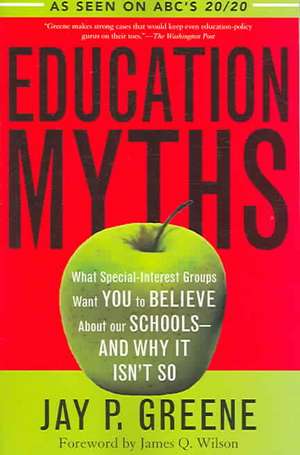
Education Myths: What Special Interest Groups Want You to Believe About Our Schools--And Why It Isn't So
Autor Jay P. Greeneen Limba Engleză Paperback – 9 aug 2006
In Education Myths: What Special Interest Groups Want You to Believe About Our Schools-And Why It Isn't So, Jay Greene and the researchers at the Manhattan Institute have gathered the evidence to show that much of what people believe about education policy is little more than a series of myths.
Greene takes on the conventional wisdom and closely examines eighteen myths advanced by the special interest groups dominating public education. In addition to the money myth, the class size myth, and the teacher pay myth, Greene debunks the special education myth (special ed programs burden public schools), the certification myth (certified or more experience teachers are more effective in the classroom), the graduation myth (nearly all students graduate from high school), the draining myth (choice harms public schools), the segregation myth (private schools are more racially segregated), and several more.
Greene's reasoned and accessible approach identifies the myth and then refutes it with relevant and reliable facts and figures-including the education establishment's own research. He believes our schools can be fixed and concludes the book with important recommendations that will achieve measurable and affordable success. This is essential reading for all those interested in quality public education and a wake-up call for undemanding taxpayers.
Preț: 110.27 lei
Preț vechi: 131.81 lei
-16%
Puncte Express: 165
Carte tipărită la comandă
Livrare economică 09-23 decembrie
Livrare prin curier în România Termenul estimat este afișat lângă disponibilitate.
Transport gratuit de la 400.00 lei Plată online sau ramburs, în funcție de opțiunile comenzii.
Retur gratuit în 14 zile Comandă securizată și suport în română.
Specificații
ISBN-13: 9780742549784
ISBN-10: 074254978X
Pagini: 273
Dimensiuni: 212 x 229 x 16 mm
Greutate: 0.38 kg
Editura: Bloomsbury Publishing
Colecția Rowman & Littlefield
Locul publicării:New York, United States
ISBN-10: 074254978X
Pagini: 273
Dimensiuni: 212 x 229 x 16 mm
Greutate: 0.38 kg
Editura: Bloomsbury Publishing
Colecția Rowman & Littlefield
Locul publicării:New York, United States
Cuprins
Part 1 Foreword
Part 2 Introduction
Part 3 Part I: Resources
Chapter 4 The Money Myth-"Schools perform poorly because they need more money."
Chapter 5 The Special Ed Myth-"Special education programs burden public schools, hindering their academic performance."
Chapter 6 The Myth of Helplessness-"Social problems like poverty cause students to fail; schools are helpless to prevent it."
Chapter 7 The Class Size Myth-"Schools should reduce class sizes; small classes would produce big improvements."
Chapter 8 The Certification Myth-"Certified or more experienced teachers are substantially more effective."
Chapter 9 The Teacher Pay Myth-"Teachers are badly underpaid."
Part 10 Part II: Outcomes
Chapter 11 The Myth of Decline-"Schools are performing much worse than they used to."
Chapter 12 The Graduation Myth-"Nearly all students graduate from high school."
Chapter 13 The College Access Myth-"Nonacademic barriers prevent a lot of minority students from attending college."
Part 14 Part III: Accountability
Chapter 15 The High Stakes Myth-"The results of high-stakes tests are not credible because they're distorted by cheating and teaching to the test.
Chapter 16 The Push-Out Myth-"Exit exams cause more students to drop out of high school."
Chapter 17 The Accountability Burden Myth-"Accountability systems impose large financial burdens on schools."
Part 18 Part IV: Choice
Chapter 19 The Inconclusive Research Myth-"The evidence on the effectiveness of vouchers is mixed and inconclusive."
Chapter 20 The Exeter Myth-"Private schools have higher test scores because they have more money and recruit high-performing students while expelling low-performing students."
Chapter 21 The Draining Myth-"School choice harms public schools."
Chapter 22 The Disabled Need Not Apply Myth-"Private schools won't serve disabled students."
Chapter 23 The Democratic Values Myth-"Private schools are less effective at promoting tolerance and civic participation."
Chapter 24 The Segregation Myth-"Private schools are more racially segregated than public schools."
Part 25 Conclusion
Part 26 Afterword
Part 2 Introduction
Part 3 Part I: Resources
Chapter 4 The Money Myth-"Schools perform poorly because they need more money."
Chapter 5 The Special Ed Myth-"Special education programs burden public schools, hindering their academic performance."
Chapter 6 The Myth of Helplessness-"Social problems like poverty cause students to fail; schools are helpless to prevent it."
Chapter 7 The Class Size Myth-"Schools should reduce class sizes; small classes would produce big improvements."
Chapter 8 The Certification Myth-"Certified or more experienced teachers are substantially more effective."
Chapter 9 The Teacher Pay Myth-"Teachers are badly underpaid."
Part 10 Part II: Outcomes
Chapter 11 The Myth of Decline-"Schools are performing much worse than they used to."
Chapter 12 The Graduation Myth-"Nearly all students graduate from high school."
Chapter 13 The College Access Myth-"Nonacademic barriers prevent a lot of minority students from attending college."
Part 14 Part III: Accountability
Chapter 15 The High Stakes Myth-"The results of high-stakes tests are not credible because they're distorted by cheating and teaching to the test.
Chapter 16 The Push-Out Myth-"Exit exams cause more students to drop out of high school."
Chapter 17 The Accountability Burden Myth-"Accountability systems impose large financial burdens on schools."
Part 18 Part IV: Choice
Chapter 19 The Inconclusive Research Myth-"The evidence on the effectiveness of vouchers is mixed and inconclusive."
Chapter 20 The Exeter Myth-"Private schools have higher test scores because they have more money and recruit high-performing students while expelling low-performing students."
Chapter 21 The Draining Myth-"School choice harms public schools."
Chapter 22 The Disabled Need Not Apply Myth-"Private schools won't serve disabled students."
Chapter 23 The Democratic Values Myth-"Private schools are less effective at promoting tolerance and civic participation."
Chapter 24 The Segregation Myth-"Private schools are more racially segregated than public schools."
Part 25 Conclusion
Part 26 Afterword
Recenzii
In Education Myths, Jay Greene pulls off an impressive feat: an examination of complicated education research that is both engaging and useful to the general reader. In doing so, he convincingly disproves 18 common beliefs about public education. It is a serious piece of applied policy research. Perhaps Greene's greatest achievement is to explain why we should be deeply disturbed at the performance of our public schools, but not despair over the prospect of improving them.
In recent years, few researchers [like Jay Greene] have consistently produced as much influential, and some would say heretical, research on topics roiling education.
With this clearly and powerfully written book, reformers everywhere will have the evidence and arguments they need to push aside the myths standing in front of the school house door.
This timely, plain-spoken, myth-demolishing book unmasks the self-interest, naiveté and well-intended gullibility that lead Americans to embrace eighteen seductive assumptions about education that turn out to be false-and that block the promising reforms that our schools and children urgently need.
A must read for the many people who, frequently with good intentions, enter the policy arena without the relevant facts.
Cleanly, deftly, succinctly, Jay Greene rips off the masks obscuring the realities of public education today.
Clears away the fog. Well-supported, powerful, and ultimately persuasive. A major contribution.
Greene, a senior fellow at the Manhattan Institute, a conservative think tank, challenges 18 popular assumptions in this accessible, data-driven polemic. His arguments stick close to the numbers compiled from numerous education studies, and, generally, Greene makes strong cases that would keep even education-policy gurus on their toes.
. . . the rigor, clarity, and energy with which the authors press their case make this book one the teachers unions do not want you to read.
Education Myths is a kind of 'freakonomics' for the education set.
. . . provocative. . .
The prolific Greene, who heads a new education research center at the University of Arkansas, is a key player on many of these issues.
Whatever readers may think of Greene's research, he provides an interesting perspective to the ongoing debates about what ails public schools and how to improve them.
In Education Myths, Jay P. Greene decisively refutes 18 myths that are routinely taken as facts by pundits and reporters. Mr. Greene's important book ensures that these potent education myths have been decisively refuted.
[Greene] makes a strong case for challenging assumptions in an era of limited resources.
Greene has a history of casting a skeptical eye on special-interest groups' assertions, thoroughly conducting his own research, and drawing conclusions based in economic theory.
...an important education reform book
[Jay P. Greene's] book provides data-driven research and analysis to refute each myth, as well as a substantial bibliography to encourage further fact finding. We are reminded to let the facts inform us, even though powerful special interest groups seek to maintain the mythology and defy logic and scientific basis.
In recent years, few researchers [like Jay Greene] have consistently produced as much influential, and some would say heretical, research on topics roiling education.
With this clearly and powerfully written book, reformers everywhere will have the evidence and arguments they need to push aside the myths standing in front of the school house door.
This timely, plain-spoken, myth-demolishing book unmasks the self-interest, naiveté and well-intended gullibility that lead Americans to embrace eighteen seductive assumptions about education that turn out to be false-and that block the promising reforms that our schools and children urgently need.
A must read for the many people who, frequently with good intentions, enter the policy arena without the relevant facts.
Cleanly, deftly, succinctly, Jay Greene rips off the masks obscuring the realities of public education today.
Clears away the fog. Well-supported, powerful, and ultimately persuasive. A major contribution.
Greene, a senior fellow at the Manhattan Institute, a conservative think tank, challenges 18 popular assumptions in this accessible, data-driven polemic. His arguments stick close to the numbers compiled from numerous education studies, and, generally, Greene makes strong cases that would keep even education-policy gurus on their toes.
. . . the rigor, clarity, and energy with which the authors press their case make this book one the teachers unions do not want you to read.
Education Myths is a kind of 'freakonomics' for the education set.
. . . provocative. . .
The prolific Greene, who heads a new education research center at the University of Arkansas, is a key player on many of these issues.
Whatever readers may think of Greene's research, he provides an interesting perspective to the ongoing debates about what ails public schools and how to improve them.
In Education Myths, Jay P. Greene decisively refutes 18 myths that are routinely taken as facts by pundits and reporters. Mr. Greene's important book ensures that these potent education myths have been decisively refuted.
[Greene] makes a strong case for challenging assumptions in an era of limited resources.
Greene has a history of casting a skeptical eye on special-interest groups' assertions, thoroughly conducting his own research, and drawing conclusions based in economic theory.
...an important education reform book
[Jay P. Greene's] book provides data-driven research and analysis to refute each myth, as well as a substantial bibliography to encourage further fact finding. We are reminded to let the facts inform us, even though powerful special interest groups seek to maintain the mythology and defy logic and scientific basis.