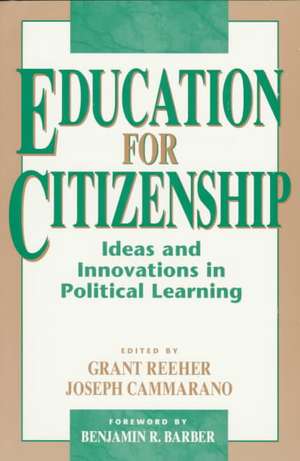
Education for Citizenship: Ideas and Innovations in Political Learning
Editat de Grant Reeher, Joseph Cammarano Cuvânt înainte de Benjamin R. Barber Contribuţii de William Ball, Richard Battistoni, Kimberley P. Canfield, James D. Chesney, William D. Coplin, Otto Feinstein, Linda L. Fowler, John F. Freie, Glen Halva-Neubauer, Naeem Inayatullah, Marc Lendler, Daniel W. O'Connell, Craig Rimmerman, Mark Ruperten Limba Engleză Paperback – 29 aug 1997
Preț: 302.45 lei
Preț vechi: 377.91 lei
-20%
Puncte Express: 454
Carte tipărită la comandă
Livrare economică 08-22 iunie
Specificații
ISBN-13: 9780847683666
ISBN-10: 0847683664
Pagini: 240
Dimensiuni: 148 x 226 x 18 mm
Greutate: 0.4 kg
Ediția:New.
Editura: Bloomsbury Publishing
Colecția Rowman & Littlefield
Locul publicării:New York, United States
ISBN-10: 0847683664
Pagini: 240
Dimensiuni: 148 x 226 x 18 mm
Greutate: 0.4 kg
Ediția:New.
Editura: Bloomsbury Publishing
Colecția Rowman & Littlefield
Locul publicării:New York, United States
V-ar putea interesa
-
 The Right to Private PropertyJeremy Waldron-30%Preț: 342.93 lei490.50 lei
 -
 -24%Preț: 512.81 lei677.60 lei
 -
 -31%Preț: 344.61 lei496.96 lei
 -
 Preț: 324.68 lei
 -
 Human Rights as Politics and IdolatryMichael IgnatieffPreț: 238.01 lei
 -
 Paul Robeson: The Artist as RevolutionaryGerald HornePreț: 122.88 lei
 -
 Television and the Public SpherePeter Dahlgren-15%Preț: 445.30 lei523.89 lei
 -
 Ken Saro-WiwaRoy DoronPreț: 148.53 lei
 -
 Preț: 223.17 lei
 -
 Taken Into Custody: The War Against Fathers, Marriage, and the FamilyStephen BaskervillePreț: 202.42 lei
 -
 It Was Never About a Hotdog and a CokeRodney L. HurstPreț: 114.65 lei
 -
 Human Rights in Russia: Citizens and the State from Perestroika to PutinProfessor Mary McAuley-26%Preț: 171.11 lei231.85 lei
 -
 Tear GasAnna FeigenbaumPreț: 133.87 lei
Cuprins
Chapter 1 Education for Citizenship: Some Themes from Recent Innovations and Questions for the Future
Chapter 2 Teaching American Politics Through Service: Reflections on a Pedagogical Strategy
Chapter 3 Service Learning as Civic Learning: Lessons We Can Learn from Our Students
Chapter 4 The Urban Agenda Project
Chapter 5 Citizenship Courses as Life-Changing Experiences
Chapter 6 Internships and Citizenship
Chapter 7 Enhancing Citizenship Through Active Learning: Simulations on the Policy Process
Chapter 8 Doing the Rights Thing: Tales of Citizenship and Free Speech
Chapter 9 Teaching the Art of Public Deliberation: National Issues Forums on Campus
Chapter 10 Democratizing the Classroom: The Individual Learning Contract
Chapter 11 Wading in the Deep: Supporting Emergent Anarchies
Chapter 12 Team-Taught Courses and Multidisciplinary Education for Citizenship
Chapter 13 Using the Internet to Enhance Classroom and Citizenship Information
Chapter 14 The Internet as a Tool for Student Citizenship
Chapter 2 Teaching American Politics Through Service: Reflections on a Pedagogical Strategy
Chapter 3 Service Learning as Civic Learning: Lessons We Can Learn from Our Students
Chapter 4 The Urban Agenda Project
Chapter 5 Citizenship Courses as Life-Changing Experiences
Chapter 6 Internships and Citizenship
Chapter 7 Enhancing Citizenship Through Active Learning: Simulations on the Policy Process
Chapter 8 Doing the Rights Thing: Tales of Citizenship and Free Speech
Chapter 9 Teaching the Art of Public Deliberation: National Issues Forums on Campus
Chapter 10 Democratizing the Classroom: The Individual Learning Contract
Chapter 11 Wading in the Deep: Supporting Emergent Anarchies
Chapter 12 Team-Taught Courses and Multidisciplinary Education for Citizenship
Chapter 13 Using the Internet to Enhance Classroom and Citizenship Information
Chapter 14 The Internet as a Tool for Student Citizenship
Recenzii
A very important volume for educators in its explicit emphasis on and powerful examples of the importance of education in a democratic society. It is also impressive in its handling of diversity and pluralism, bringing into focus the importance of heterogeneity in a truly democratic nation. The volume's emphasis on 'active learning' will also be appreciated by educators, making very clear that the values of citizenship and the responsibilities of democracy must be acquired and practiced in student activity, not in passive learning. I recommend the volume to all my educator colleagues.
Learning, above all civic learning, needs to be experiential as well as purely cognitive. Serving others is not just a form of do-goodism or feel-goodism, it is a road to social responsibility and citizenship. When linked closely to classroom learning ('education-based community service') it offers an ideal setting for bridging the gap between the classroom and the street, between the theory of democracy and its much more obstreperous practice.
The authors . . . discuss the techniques they use to not only teach about good citizenship but to actually elicit engaged citizenship behaviors from their students. In the process, they incorporate some of the best new teaching techniques into college-level courses. All of the authors take pains to present the background and rationale for the programs they describe. . . . Well written and edited.
The book is well-written and editeddddd
An engaging and useful collection of essays. . . . Political scientists who are interested in developing their students into responsible citizens can do well by reading through this practical guide. Together, the essays offer political scientists a wide range of ways to integrate citizenship-based projects and activities into their courses or their departments' curriculum. As such, Reeher and Cammarano should be commended for bringing together these timely perspectives into a single volume.
Learning, above all civic learning, needs to be experiential as well as purely cognitive. Serving others is not just a form of do-goodism or feel-goodism, it is a road to social responsibility and citizenship. When linked closely to classroom learning ('education-based community service') it offers an ideal setting for bridging the gap between the classroom and the street, between the theory of democracy and its much more obstreperous practice.
The authors . . . discuss the techniques they use to not only teach about good citizenship but to actually elicit engaged citizenship behaviors from their students. In the process, they incorporate some of the best new teaching techniques into college-level courses. All of the authors take pains to present the background and rationale for the programs they describe. . . . Well written and edited.
The book is well-written and editeddddd
An engaging and useful collection of essays. . . . Political scientists who are interested in developing their students into responsible citizens can do well by reading through this practical guide. Together, the essays offer political scientists a wide range of ways to integrate citizenship-based projects and activities into their courses or their departments' curriculum. As such, Reeher and Cammarano should be commended for bringing together these timely perspectives into a single volume.