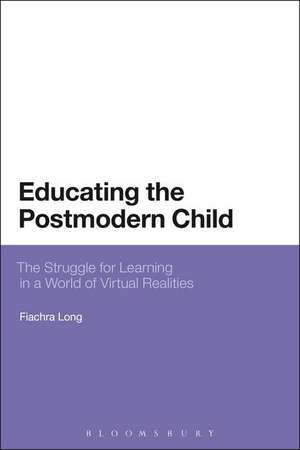
Educating the Postmodern Child: The Struggle for Learning in a World of Virtual Realities
Autor Dr Fiachra Longen Limba Engleză Hardback – 22 noi 2012
Issues considered include education, appearance, space, empowerment, globality, tactility, talent, and visibility. After setting the context, each chapter uses a phenomenological approach to describe experiences common across computer-literate children today. Chapters draw on sources in the history of ideas to critique the situation described, provide a rich combination of educational and philosophical theory and apply some speculative concepts to the situation of children.
Preț: 961.25 lei
Preț vechi: 1431.69 lei
-33%
Puncte Express: 1442
Carte tipărită la comandă
Livrare economică 24 octombrie-07 noiembrie
Livrare prin curier în România Termenul estimat este afișat lângă disponibilitate.
Transport gratuit pentru acest produs Plată online sau ramburs, în funcție de opțiunile comenzii.
Retur gratuit în 14 zile Comandă securizată și suport în română.
Specificații
ISBN-13: 9781441103871
ISBN-10: 1441103872
Pagini: 214
Ilustrații: black & white illustrations
Dimensiuni: 156 x 234 x 16 mm
Greutate: 0.48 kg
Ediția:New.
Editura: Bloomsbury Publishing
Colecția Bloomsbury Academic
Locul publicării:London, United Kingdom
ISBN-10: 1441103872
Pagini: 214
Ilustrații: black & white illustrations
Dimensiuni: 156 x 234 x 16 mm
Greutate: 0.48 kg
Ediția:New.
Editura: Bloomsbury Publishing
Colecția Bloomsbury Academic
Locul publicării:London, United Kingdom
V-ar putea interesa
-
 Understanding History TeachingChris Husbands-29%Preț: 169.57 lei239.27 lei
 -
 Preț: 341.29 lei
 -
 Knowmad SocietyJohn W. MoravecPreț: 141.30 lei
 -
 Blackwell Guide to the PhilosoAlison SmithPreț: 321.76 lei
 -
 The Passionate Mind of Maxine Greene: 'I am ... not yet'William F. Pinar-15%Preț: 458.95 lei539.94 lei
 -
 Does Religious Education Work?: A Multi-dimensional InvestigationProfessor James C. Conroy-33%Preț: 962.48 lei1432.46 lei
 -
 John DeweyProfessor Richard Pring-16%Preț: 276.68 lei328.85 lei
 -
 Michel FoucaultDr Lynn Fendler-16%Preț: 271.57 lei322.16 lei
 -
 Authority and the TeacherWilliam H. Kitchen-25%Preț: 198.81 lei265.39 lei
 -
 Educating the Reflective PractitionerDonald A. SchonPreț: 301.44 lei
 -
 Pedagogy of IndignationPaulo FreirePreț: 385.78 lei
 -
 Beyond Learning: Democratic Education for a Human FutureGert J. J. BiestaPreț: 403.72 lei
 -
 Teaching as the Practice of WisdomDavid Smith-17%Preț: 206.30 lei247.80 lei
 -
 The Magic of MetaphorNick OwenPreț: 131.80 lei
Cuprins
Acknowledgements
Series Editor Preface
Foreword
Part I: Context
1. Childhood and the Child
2. Child's Play
3. Empowering the Child in Postmodernity
Part II: Appearances
4. The Global Child
5. Talent
6. Tactility
7. Visibility
8. Invisibility
Part III: Education
9. Vapour Trails and Noise
10. The Ambassador's Secret
11. Mind Games and Philosophy
12. Conclusion
Bibliography
Index
Series Editor Preface
Foreword
Part I: Context
1. Childhood and the Child
2. Child's Play
3. Empowering the Child in Postmodernity
Part II: Appearances
4. The Global Child
5. Talent
6. Tactility
7. Visibility
8. Invisibility
Part III: Education
9. Vapour Trails and Noise
10. The Ambassador's Secret
11. Mind Games and Philosophy
12. Conclusion
Bibliography
Index
Recenzii
This exciting exploration of the world of the child in our time draws on Fiachra Long's immense erudition and on his many years' experience as a philosopher and teacher. Based on careful reading of historical and contemporary literature taken from many sources, Educating the Postmodern Child gives evidence of the author's personal engagement with the issues that he addresses. Fiachra Long succeeds in showing that scholarly inquiry can in fact be extraordinarily interesting. The volume therefore deserves to be read not only by those within the philosophical and educational communities but also by parents and by young people themselves.
Fiachra Long's elegant prose teases out the complexities of the postmodern child, offering unique insights and extending the field of childhood studies in new directions. This ground-breaking book challenges the consumer mind-set so prevalent in contemporary education and it cements the case for philosophy in education - a philosophy that can enable the young to navigate the borders between history and 'un-history', past and future, originality and community, private and public, and memory and experience as they try 'to find their own place in an old world'. The reconceptualization of childhood in this innovative book points to the need for scholars of education to engage in rigorous thinking about the fundamental purposes and practices of education.Written by a well-established scholar in an incisive, philosophical style, it is at once challenging and accessible. It will appeal to a wide audience from general readers to academic scholars in the fields of childhood, education, philosophy, sociology and cultural studies.
Fiachra Long's elegant prose teases out the complexities of the postmodern child, offering unique insights and extending the field of childhood studies in new directions. This ground-breaking book challenges the consumer mind-set so prevalent in contemporary education and it cements the case for philosophy in education - a philosophy that can enable the young to navigate the borders between history and 'un-history', past and future, originality and community, private and public, and memory and experience as they try 'to find their own place in an old world'. The reconceptualization of childhood in this innovative book points to the need for scholars of education to engage in rigorous thinking about the fundamental purposes and practices of education.Written by a well-established scholar in an incisive, philosophical style, it is at once challenging and accessible. It will appeal to a wide audience from general readers to academic scholars in the fields of childhood, education, philosophy, sociology and cultural studies.