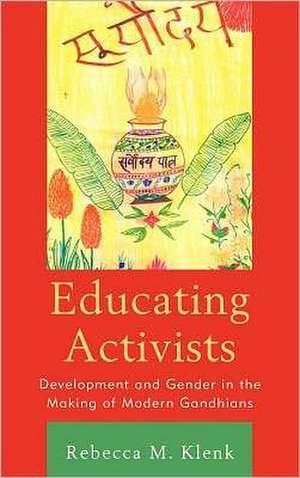
Educating Activists: Development and Gender in the Making of Modern Gandhians
Autor Rebecca Klenken Limba Engleză Hardback – 26 oct 2010
Preț: 659.73 lei
Preț vechi: 1053.85 lei
-37%
Puncte Express: 990
Carte tipărită la comandă
Livrare economică 16-30 noiembrie
Livrare prin curier în România Termenul estimat este afișat lângă disponibilitate.
Transport gratuit pentru acest produs Plată online sau ramburs, în funcție de opțiunile comenzii.
Retur gratuit în 14 zile Comandă securizată și suport în română.
Specificații
ISBN-13: 9780739137352
ISBN-10: 0739137352
Pagini: 264
Dimensiuni: 161 x 241 x 23 mm
Greutate: 0.56 kg
Ediția:New.
Editura: Bloomsbury Publishing
Colecția Lexington Books
Locul publicării:New York, United States
ISBN-10: 0739137352
Pagini: 264
Dimensiuni: 161 x 241 x 23 mm
Greutate: 0.56 kg
Ediția:New.
Editura: Bloomsbury Publishing
Colecția Lexington Books
Locul publicării:New York, United States
Cuprins
Chapter 1 Introduction
Part 2 I: Developed Women
Chapter 3 1: Educating Modern Gandhians: Lakshmi Ashram and its Mission
Chapter 4 2: "Who is the Developed Woman?"
Part 5 II: "Sarala Devi's Daughters"
Chapter 6 3: Lakshmi Ashram's First Generation
Chapter 7 4: Samaj Seva
Chapter 8 5: "What's All This Gandhi-Gandhi About?" Lakshmi Ashram's Second Generation
Part 9 III: Development, Place, and Possible Futures
Chapter 10 6: A Place on Fire
Part 2 I: Developed Women
Chapter 3 1: Educating Modern Gandhians: Lakshmi Ashram and its Mission
Chapter 4 2: "Who is the Developed Woman?"
Part 5 II: "Sarala Devi's Daughters"
Chapter 6 3: Lakshmi Ashram's First Generation
Chapter 7 4: Samaj Seva
Chapter 8 5: "What's All This Gandhi-Gandhi About?" Lakshmi Ashram's Second Generation
Part 9 III: Development, Place, and Possible Futures
Chapter 10 6: A Place on Fire
Recenzii
Engaging, nuanced, and beautifully written, Educating Activists is an exemplary study that demonstrates the power of ethnographic writing and method. Tracing the gendered experience of development in a Gandhian Ashram in Kumaon Himalayas, India over two generations, Educating Activists offers a critical and sophisticated reading of the cultural politics of development, its gendered articulations, and multiple and unintended consequences. Written with verve and clarity, it is a must-read for undergraduate and advanced students interested in critical development studies, feminist anthropology, and South Asian studies.
Rebecca Klenk's superb new book offers an inspiring and richly illustrated ethnography of education and development in contemporary India. Written with clarity and great purpose, Educating Activists opens up new perspectives on gender, agency and modernity. The book should be essential reading for South Asianists and deserves a much wider audience.
Rebecca Klenk's thoughtful ethnography of a Gandhian ashram in the rural Himalaya is replete with stories that question, destabilize, and deepen familiar narratives of empowerment and disempowerment, subservience and independence, and development and its critiques. Here at the grassroots of Uttarakhand, women define development against the grain not only as education or entrepreneurial spirit, but, more crucially, as personal integrity, self-reflection, and social change. Klenk's portrait of the ashram is respectful, nuanced, and keenly perceptive; most of all it has profound implications for a politics of hope.
In a study that pays close attention to the remarkable women in Lakshmi Ashram and is engaged in the most nuanced of theoretical debates in the anthropology of development, Rebecca Klenk draws on two decades of research with these rural Gandhians of the western Himalaya to show how they creatively reinterpret the Mahatma to find their own way to educate and inspire other women in their lives. This is transnational feminist anthropology at its finest.
Rebecca Klenk's superb new book offers an inspiring and richly illustrated ethnography of education and development in contemporary India. Written with clarity and great purpose, Educating Activists opens up new perspectives on gender, agency and modernity. The book should be essential reading for South Asianists and deserves a much wider audience.
Rebecca Klenk's thoughtful ethnography of a Gandhian ashram in the rural Himalaya is replete with stories that question, destabilize, and deepen familiar narratives of empowerment and disempowerment, subservience and independence, and development and its critiques. Here at the grassroots of Uttarakhand, women define development against the grain not only as education or entrepreneurial spirit, but, more crucially, as personal integrity, self-reflection, and social change. Klenk's portrait of the ashram is respectful, nuanced, and keenly perceptive; most of all it has profound implications for a politics of hope.
In a study that pays close attention to the remarkable women in Lakshmi Ashram and is engaged in the most nuanced of theoretical debates in the anthropology of development, Rebecca Klenk draws on two decades of research with these rural Gandhians of the western Himalaya to show how they creatively reinterpret the Mahatma to find their own way to educate and inspire other women in their lives. This is transnational feminist anthropology at its finest.