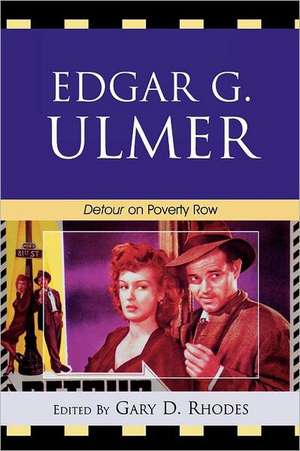
Edgar G. Ulmer: Detour on Poverty Row
Editat de Gary D. Rhodes Contribuţii de Stephen Broomer, Steffen Hantke, Graeme Harper, Kevin Heffernan, David Hogan, Reynold Humphries, Chris Justice, Scott Loren, Hugh S. Manon, Alison Peirse, Claudia Pummer, Marlisa Santos, Robert Singer, Phillip Sipiora, Tony Tracy, Dion Tubrett, Yannis Tzioumakis, Tony J. Williamsen Limba Engleză Paperback – 21 dec 2009
Structured in four sections, Part I examines various contexts important to Ulmer's career, such as his work at the Producers Releasing Corporation (PRC), and his work in exploitation films and ethnic cinema. Part II analyzes Ulmer's film noirs, featuring an emphasis on Detour (1945) and Murder Is My Beat (1955). Part III covers a variety of Ulmer's individual films, ranging from Bluebeard (1944) and Carnegie Hall (1947) to The Man from Planet X (1951) and Daughter of Dr. Jekyll (1957). Part IV concludes the volume with a case study of The Black Cat (1934), offering three different analyses of Ulmer's landmark horror film.
Preț: 347.25 lei
Preț vechi: 484.86 lei
-28%
Puncte Express: 521
Carte tipărită la comandă
Livrare economică 01-15 decembrie
Livrare prin curier în România Termenul estimat este afișat lângă disponibilitate.
Transport gratuit de la 400.00 lei Plată online sau ramburs, în funcție de opțiunile comenzii.
Retur gratuit în 14 zile Comandă securizată și suport în română.
Specificații
ISBN-13: 9780739125687
ISBN-10: 0739125680
Pagini: 335
Dimensiuni: 154 x 233 x 25 mm
Greutate: 0.5 kg
Editura: Bloomsbury Publishing
Colecția Lexington Books
Locul publicării:New York, United States
ISBN-10: 0739125680
Pagini: 335
Dimensiuni: 154 x 233 x 25 mm
Greutate: 0.5 kg
Editura: Bloomsbury Publishing
Colecția Lexington Books
Locul publicării:New York, United States
V-ar putea interesa
-
 Martin Scorsese: A BiographyVincent LoBrutto-16%Preț: 339.03 lei403.94 lei
 -
 Preț: 281.81 lei
 -
 -23%Preț: 823.46 lei1069.43 lei
 -
 Orson Welles: Six Films Analyzed, Scene by SceneRandy RasmussenPreț: 303.93 lei
 -
 Elmo WilliamsElmo WilliamsPreț: 232.06 lei
 -
 Preț: 225.29 lei
 -
 Preț: 265.86 lei
 -
 Art Directors in Cinema: A Worldwide Biographical DictionaryMichael L. StephensPreț: 379.28 lei
 -
 The Films of Woody Allen: Critical EssaysCharles L.P. Silet-33%Preț: 387.02 lei579.30 lei
 -
 The Brothers Grim: The Films of Ethan and Joel CoenErica Rowell-31%Preț: 381.40 lei553.67 lei
 -
 The Films of Robert WiseRichard C. Keenan-33%Preț: 401.51 lei598.18 lei
 -
 The Films of Sergio LeoneRobert C. Cumbow-32%Preț: 405.98 lei597.72 lei
 -
 -35%Preț: 468.92 lei719.47 lei
 -
 The Coen Brothers EncyclopediaLynnea Chapman King-32%Preț: 585.89 lei865.62 lei
 -
 Directed by Steven Spielberg: Poetics of the Contemporary Hollywood BlockbusterDr. Warren BucklandPreț: 235.11 lei
 -
 The Director's Cut: Picturing Hollywood in the 21st CenturyStephan Littger-40%Preț: 133.94 lei224.41 lei
 -
 -33%Preț: 421.12 lei627.05 lei
 -
 Conversations with Gus Van SantMario Falsetto-24%Preț: 365.19 lei482.74 lei
 -
 -23%Preț: 230.71 lei301.14 lei
 -
 -17%Preț: 348.26 lei418.75 lei
 -
 -33%Preț: 640.78 lei959.14 lei
 -
 Classical Myth in Alfred Hitchcock's Wrong Man and Grace Kelly FilmsMark William Padilla-36%Preț: 733.32 lei1151.07 lei
 -
 Gendered Frames, Embodied Cameras: Varda, Akerman, Cabrera, Calle, and MaïwennCybelle H. McFadden-23%Preț: 322.08 lei417.69 lei
 -
 Roman Polanski: The Cinema of a Cultural TravellerEwa Mazierska-25%Preț: 180.06 lei239.55 lei
 -
 The Cinema of Terrence Malick 2eHannah PattersonPreț: 212.58 lei
 -
 The Cinema of Lars von TrierCaroline BainbridgePreț: 208.81 lei
 -
 The Cinema of Jan Svankmajer 2ePeter HamesPreț: 177.49 lei
Cuprins
Chapter 1 Table of Contents
Chapter 2 Dedication
Chapter 3 Introduction
Part 4 I: Texts and Contexts
Chapter 5 1. Edgar G. Ulmer: The Low-End Independent FilmmakerPar Excellence
Chapter 6 2. Edgar G. Ulmer: The Godfather of Sexploitation?
Chapter 7 3. At the Border: Edgar G. Ulmer's The Singing Blacksmith (1938) and Cossacks in Exile (1939)
Part 9 II: Film Noir
Chapter 10 4. Dead Fathers and Other Detours: Ulmer's Noir
Chapter 11 5. See Spot: The Parametric Film Noirs of Edgar G. Ulmer
Chapter 12 6. Even the Pictures Lie: The Unreliable Narrator in the Film Noirs of Edgar G. Ulmer
Chapter 13 7. Edgar G. Ulmer's Homicidal Noirs: Psychosis and Possession in Strange Illusion, The Strange Woman, and Bluebeard
Chapter 14 8. All Wrong Turns: Tracking Subjectivity in Detour (1945)
Chapter 15 9. Masculinity and Masochism in Detour (1945)
Part 16 III: Individual Films
Chapter 17 10. Puppets and Painting: Authorship and Artistry in Edgar G. Ulmer's Bluebeard
Chapter 18 11. Beyond Citizen Kane: Ruthless as Radical Psychobiography
Chapter 19 12. "The Gateway to America": Assimilation and Art in Carnegie Hall (1947)
Chapter 20 13. Meeting The Man From Planet X (1951)
Chapter 21 14. Nothing to Hyde: Reading The Daughter of Dr. Jekyll (1957)
Chapter 22 15. Murder, Family, and Weird Science:The Amazing Transparent Man
Chapter 23 16. "A Sword and Sandal Gone Screwy" or, Edgar G. Ulmer's Journey to the Lost City-L'Atlantide
Part 24 IV: Case Study-The Black Cat (1934)
Chapter 25 17. Bauhaus of Horrors: Edgar G. Ulmer and The Black Cat
Chapter 26 18 The Devil's Contract: The Satisfaction of Self-Destruction in Edgar G. Ulmer's The Black Cat
Chapter 27 19 "Tremonstrous" Hopes and "Oke" Results: The 1934 Reception of The Black Cat
Chapter 2 Dedication
Chapter 3 Introduction
Part 4 I: Texts and Contexts
Chapter 5 1. Edgar G. Ulmer: The Low-End Independent FilmmakerPar Excellence
Chapter 6 2. Edgar G. Ulmer: The Godfather of Sexploitation?
Chapter 7 3. At the Border: Edgar G. Ulmer's The Singing Blacksmith (1938) and Cossacks in Exile (1939)
Part 9 II: Film Noir
Chapter 10 4. Dead Fathers and Other Detours: Ulmer's Noir
Chapter 11 5. See Spot: The Parametric Film Noirs of Edgar G. Ulmer
Chapter 12 6. Even the Pictures Lie: The Unreliable Narrator in the Film Noirs of Edgar G. Ulmer
Chapter 13 7. Edgar G. Ulmer's Homicidal Noirs: Psychosis and Possession in Strange Illusion, The Strange Woman, and Bluebeard
Chapter 14 8. All Wrong Turns: Tracking Subjectivity in Detour (1945)
Chapter 15 9. Masculinity and Masochism in Detour (1945)
Part 16 III: Individual Films
Chapter 17 10. Puppets and Painting: Authorship and Artistry in Edgar G. Ulmer's Bluebeard
Chapter 18 11. Beyond Citizen Kane: Ruthless as Radical Psychobiography
Chapter 19 12. "The Gateway to America": Assimilation and Art in Carnegie Hall (1947)
Chapter 20 13. Meeting The Man From Planet X (1951)
Chapter 21 14. Nothing to Hyde: Reading The Daughter of Dr. Jekyll (1957)
Chapter 22 15. Murder, Family, and Weird Science:The Amazing Transparent Man
Chapter 23 16. "A Sword and Sandal Gone Screwy" or, Edgar G. Ulmer's Journey to the Lost City-L'Atlantide
Part 24 IV: Case Study-The Black Cat (1934)
Chapter 25 17. Bauhaus of Horrors: Edgar G. Ulmer and The Black Cat
Chapter 26 18 The Devil's Contract: The Satisfaction of Self-Destruction in Edgar G. Ulmer's The Black Cat
Chapter 27 19 "Tremonstrous" Hopes and "Oke" Results: The 1934 Reception of The Black Cat
Recenzii
Gary D. Rhodes, a master at making out-of-the-way topics both accessible and appealing, performs a grand service with this savvy forum on the strange and necessary filmmaking career of Edgar G. Ulmer. From the martyred brilliance of The Black Cat through the unlikely finery of Bluebeard and Detour-with his own tangle of detours into ethnic cinema, symphonic soap opera, and drive-in schlockery-Ulmer comes into view for the first time as a compleat artist, perhaps the most influential forebear of the New Century's independent-cinema movement.
Few filmmakers have been as criminally underrated as Edgar G. Ulmer, doyen of Hollywood's more modest studios and an artist of rare, luminous talent. Four decades after his death his unique and idiosyncratic oeuvre receives proper and rightful consideration in Edgar G. Ulmer: Detour on Poverty Row-a book that probes into the genius behind Ulmer's shoestring offerings and finds it lurking there, in abundance.
These authors have interesting and sometimes challenging ideas and write about them well. Rhode's volume shows the hand of a strong editor with strong convictions, which are laid out in his introduction.
This volume fills an important gap in film studies, offering many insights into the work of a key auteur, the understudied Edgar G. Ulmer. Using Ulmer's many contributions as a lens, it shows the roles of the small independent film company and independent filmmaker in the Hollywood studio era. By taking us through Ulmer's work directing ethnic and minority films, his creative producing practices, and his signature efforts at fashioning a visual style that invariably transcended low budgets and creaky narratives, Gary Rhodes and his contributors have provided one of the most revealing assessments to date of alternative film practices in an era largely dominated by a classical narrative aesthetic. Detour on Poverty Row is a significant contribution to film history.
Few filmmakers have been as criminally underrated as Edgar G. Ulmer, doyen of Hollywood's more modest studios and an artist of rare, luminous talent. Four decades after his death his unique and idiosyncratic oeuvre receives proper and rightful consideration in Edgar G. Ulmer: Detour on Poverty Row-a book that probes into the genius behind Ulmer's shoestring offerings and finds it lurking there, in abundance.
These authors have interesting and sometimes challenging ideas and write about them well. Rhode's volume shows the hand of a strong editor with strong convictions, which are laid out in his introduction.
This volume fills an important gap in film studies, offering many insights into the work of a key auteur, the understudied Edgar G. Ulmer. Using Ulmer's many contributions as a lens, it shows the roles of the small independent film company and independent filmmaker in the Hollywood studio era. By taking us through Ulmer's work directing ethnic and minority films, his creative producing practices, and his signature efforts at fashioning a visual style that invariably transcended low budgets and creaky narratives, Gary Rhodes and his contributors have provided one of the most revealing assessments to date of alternative film practices in an era largely dominated by a classical narrative aesthetic. Detour on Poverty Row is a significant contribution to film history.