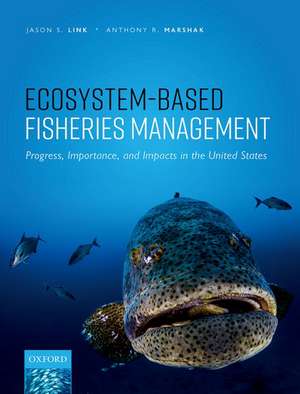
Ecosystem-Based Fisheries Management: Progress, Importance, and Impacts in the United States
Autor Jason S. Link, Anthony R. Marshaken Limba Engleză Hardback – 5 noi 2021
Problema fundamentală în gestionarea resurselor marine este abordarea fragmentată, axată pe specii individuale, care ignoră adesea interdependențele ecologice complexe și presiunile socioeconomice. Ecosystem-Based Fisheries Management rezolvă această lacună prin transformarea conceptului teoretic de management ecosistemic într-o realitate operațională măsurabilă. Subliniem rigoarea celor peste 90 de indicatori analizați — de la factori de guvernanță și indicatori economici, până la forțarea mediului și dinamica sistemelor ecologice — aplicați sistematic în 9 jurisdicții majore. Remarcăm că volumul semnat de Jason S. Link și Anthony R. Marshak nu este o simplă pledoarie teoretică, ci un audit masiv ce distilează date din mai multe decenii, acoperind regiuni diverse, de la apele tropicale la cele polare. Abordarea diferă de cea din Marine Ecosystem-Based Management de Janne B. Haugen prin faptul că este mai puțin axată pe explorarea conceptuală a interconectivității și mult mai mult pe evaluarea aplicabilității și a impactului real în teren. În timp ce alte lucrări, precum Ecosystem-Based Management for Marine Fisheries de Andrea Belgrano, pun accent pe tiparele macroscopice, lucrarea de față oferă un cadru tehnic dens, susținut de 250 de ilustrații color, esențiale pentru vizualizarea traiectoriilor de management. Considerăm că această lucrare reprezintă un instrument de lucru indispensabil pentru profesioniștii din pescuit, oferind lecții practice extrase dintr-un areal ce reprezintă 10% din oceanul planetar. Deși studiile de caz sunt centrate pe modelul american, metodologia de monitorizare a sustenabilității este direct transferabilă în orice context global de gestionare a resurselor vii.
Preț: 748.13 lei
Preț vechi: 1104.67 lei
-32%
Carte disponibilă
Livrare economică 21-26 mai
Specificații
ISBN-10: 019284346X
Pagini: 712
Ilustrații: 250 colour line figures and illustrations
Dimensiuni: 197 x 254 x 40 mm
Greutate: 1.77 kg
Editura: OUP OXFORD
Colecția OUP Oxford
Locul publicării:Oxford, United Kingdom
V-ar putea interesa
-
 Fishery Ecosystem DynamicsMichael J. Fogarty-33%Preț: 655.83 lei979.60 lei
 -
 Ecology of Aquatic ManagementChristopher Frid-22%Preț: 374.64 lei478.48 lei
 -
 Marine Fisheries EcologySimon Jennings-19%Preț: 445.03 lei549.42 lei
 -
 Fish Ecology, Evolution, and ExploitationKen H AndersenPreț: 343.41 lei
 -
 Electricity in Fish Research and ManagementW R C Beaumont-19%Preț: 577.66 lei713.15 lei
 -
 The Only Three Questions That Still CountKen FisherPreț: 159.01 lei
 -
 The New Nature of BusinessAndre HoffmannPreț: 110.69 lei
 -
 Can You Run the Economy?Joe MayesPreț: 117.89 lei
 -
 -9%Preț: 1168.06 lei1283.58 lei
 -
 Fishery ManagementJanice S Intilli-30%Preț: 1069.51 lei1531.59 lei
 -
 Harvesting the Seas: Excess Capacity in U.S. FisheriesDaniel P Molnar-30%Preț: 1928.16 lei2767.12 lei
 -
 -26%Preț: 1305.19 lei1752.43 lei
 -
 -26%Preț: 1193.24 lei1603.37 lei
 -
 The Age of ExtractionTim WuPreț: 102.60 lei
 -
 LET It HappenMau Espinosa-11%Preț: 80.35 lei90.70 lei
 -
 -14%Preț: 1916.44 lei2228.41 lei
 -
 Eat That Frog!, Fourth EditionBrian TracyPreț: 98.38 lei
De ce să citești această carte
Adresată profesioniștilor și cercetătorilor din biologia marină, această carte oferă instrumentele necesare pentru a trece de la politici abstracte la management bazat pe dovezi. Cititorul câștigă acces la o metodologie de evaluare cu peste 90 de indicatori concreți, esențială pentru oricine dorește să implementeze strategii de pescuit sustenabil care să reziste presiunilor climatice și economice actuale într-un format hardback durabil.
Despre autor
Jason S. Link și Anthony R. Marshak sunt specialiști recunoscuți în domeniul ecologiei marine și al politicilor de pescuit. Jason S. Link a contribuit semnificativ la dezvoltarea cadrelor de lucru pentru managementul ecosistemic în cadrul instituțiilor de profil, fiind o voce autoritară în transformarea sustenabilității teoretice în protocoale de lucru operaționale. Expertiza lor combinată se reflectă în abordarea multidisciplinară a volumului publicat de OUP OXFORD, care integrează biologia oceanografică, economia și științele guvernanței pentru a oferi o imagine completă asupra sănătății resurselor marine la scară globală.
Descriere
Recenzii
This book is highly recommended as a reference for a wide readership, especially fisheries and policy experts, to support the construction of more bridges between these worlds—that is essential for all of us.
Are we finally there? The writing has been on the wall for decades, EBFM is coming! But only now do Link and Marshak demonstrate that we actually can walk the walk, drawing eminently upon case studies to provide lessons for making EBFM operational. We have made progress, and Link and Marshak are at the forefront of the development as demonstrated through this book.
EBFM has been recognized as a necessary approach to balancing exploitation and ecosystem health for more than 20 years now. There is a lot written about its mixed implementation to date so having an objective assessment of true progress is refreshing and timely. The credentials of Marshak and Link lay considerable weight to the assessment, both have been major contributors bedding down and moving practical EBFM forward in America and more widely.
EBFM is an essential step in ensuring that fisheries are managed in a way to maintain ecosystems ability to continue to contribute to human well-being. Understanding what has been done in US fisheries to move towards EBFM is an important step to refining how to implement EBFM, and there is no one better able to tell this than Link and Marshak.
Ecosystem-based approaches to fisheries management are a keystone element to achieve the diverse goals that people have for ocean systems globally. In order to make progress in implementing ecosystem-based approaches, it is critical to evaluate the efforts to date, recognizing how social and environmental factors shape both the form and the outcomes of EBFM in different places around the world. Jason Link and Tony Marshak are at the frontier of this type of assessment.