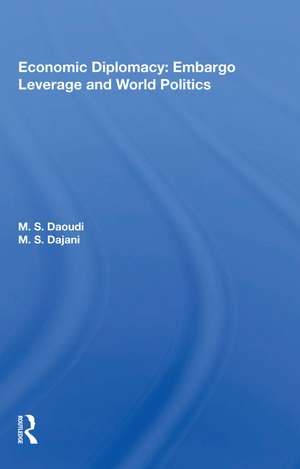
Economic Diplomacy: Embargo Leverage And World Politics
Autor M. S. Daoudien Limba Engleză Hardback – 9 apr 2020
Preț: 1119.70 lei
Preț vechi: 1365.49 lei
-18%
Puncte Express: 1680
Carte tipărită la comandă
Livrare economică 02-16 decembrie
Livrare prin curier în România Termenul estimat este afișat lângă disponibilitate.
Transport gratuit pentru acest produs Plată online sau ramburs, în funcție de opțiunile comenzii.
Retur gratuit în 14 zile Comandă securizată și suport în română.
Specificații
ISBN-13: 9780367006020
ISBN-10: 0367006022
Pagini: 272
Dimensiuni: 152 x 229 mm
Greutate: 0.66 kg
Ediția:1
Editura: Taylor & Francis
Colecția Routledge
Locul publicării:Oxford, United Kingdom
ISBN-10: 0367006022
Pagini: 272
Dimensiuni: 152 x 229 mm
Greutate: 0.66 kg
Ediția:1
Editura: Taylor & Francis
Colecția Routledge
Locul publicării:Oxford, United Kingdom
V-ar putea interesa
-
 Politics Medicine ChinaDavid M Lampton-18%Preț: 1068.92 lei1303.56 lei
 -
 -18%Preț: 1351.36 lei1647.99 lei
 -
 Property Threats and the Politics of Anti-StatismGabriel Ondetti-11%Preț: 661.78 lei743.58 lei
 -
 Crisis and InequalityMattias VermeirenPreț: 260.89 lei
 -
 Political Thought in Contemporary Shi'a IslamFarah W. Kawtharani-8%Preț: 568.38 lei617.80 lei
 -
 The Changing Ideology of HezbollahMassaab Al-Aloosy-15%Preț: 558.87 lei657.50 lei
 -
 AfricaRainer TetzlaffPreț: 272.37 lei
 -
 -18%Preț: 812.88 lei991.31 lei
Cuprins
Also of Interest -- Introduction -- The Leverage of Oil, 1956 -- The Leverage of Oil, 1967 -- The Growing Momentum of Arab Oil Leverage, 1959-1973 -- The Control of Oil, 1967-1973: Participation and Nationalization -- The Shift from the Nasser Era to the Faisal Era, 1967-1973 -- The Leverage of Oil, 1973/1974 -- Conclusions: Lessons of Oil Leverage -- Baghdad Oil Conference, 5 June 1967 -- Decision to Lift Oil Embargo, 1 September 1967 -- OAPEC Ministerial Council Statement on Production Cutbacks, 17 October 1973 -- Resolution to Impose Oil Embargo, 17 October 1973 -- Communiqué: Conference of Arab Oil Ministers, Kuwait, 4-5 November 1973 -- Resolution on Oil, Sixth Arab Summit Conference, Algiers, 28 November 19731 -- Resolution, Arab Oil Ministers, on Lifting Oil Embargo Against the U.S., Kuwait, 8 December 1973 -- Text of Decision to Lift Oil Embargo, 18 March 1974 -- Identifications of Officials
Descriere
The 1983 collapse of world oil prices revived memories of a time only a decade earlier when the price of a barrel of oil did not exceed three dollars. By the late 1970s, spot market prices had reached peaks of forty dollars a barrel. A major role in creating these new realities was played by the 1973/1974 Arab oil embargo, which formed the psychological, political, and market conditions for the dramatic price surge. This important study probes the embargo in detail, thoroughly examining its history, the motivations that caused it, and its ripple effect on world politics and the international economic order. The authors carefully examine the interruption of oil supplies to Western Europe during the 1956 Suez Canal crisis, the growing momentum of Arab oil leverage beginning with the First Arab Petroleum Congress in 1959, the decline of the oil companies' domination of the petroleum industry, and the Arab political environment between the 1967 Arab defeat and the 1973 Arab oil embargo. The book concludes with a chapter addressing the lessons to be learned from these recent embargoes.