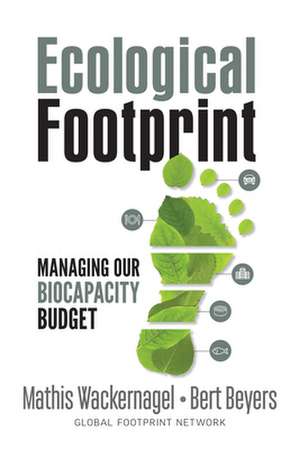
Ecological Footprint
Autor Mathis Wackernagel, Bert Beyers Traducere de Katharina Routen Limba Engleză Paperback – 3 sep 2019
This book is a loud wake-up call to everyone.
- CHRISTIANA FIGUERES, former Executive Secretary, UNFCCC
Looking for a science-based, practical tool to navigate your future on Earth? Here it is.
- PROF. JOHAN ROCKSTRÖM, Director, Potsdam Institute for Climate Impact Research
OUR ECONOMY is running a Bernie Madoff-style Ponzi scheme with the planet. We use future resources to run the present, using more than Earth can replenish. Like any such scheme, this works for a limited time, followed by a crash.
Avoiding ecological bankruptcy requires rigorous resource accounting - a challenging task, but doable with the right tools.
Ecological Footprint accounting, first introduced in the 1990s and continuously developed, continues to be the only metric that compares overall human demand on nature with what our planet can renew - its biocapacity - and distils this into one number: how many Earths we use.
Ecological Footprint provides a complete introduction, covering:
- Footprint and biocapacity accounting
- Data and key findings for countries
- Worldwide examples including businesses, cities, and countries
- Strategies for creating regenerative economies.
A momentous development, and one that all citizens of the planet should know about.
- RICHARD HEINBERG, author, The End of Growth and Peak Everything
Reveals both our alarming self-inflicted situation and the way forward.
- THOMAS E. LOVEJOY, Professor of Environmental Science and Policy, Institute for a Sustainable Earth, George Mason University
Mathis Wackernagel is co-creator of the Ecological Footprint and president of Global Footprint Network, based in Oakland, California. www.footprintnetwork.org.
Bert Beyers is a senior editor at one of Germany's largest radio stations, located in Hamburg.
Preț: 111.80 lei
Puncte Express: 168
Preț estimativ în valută:
19.77€ • 23.31$ • 17.28£
19.77€ • 23.31$ • 17.28£
Carte indisponibilă temporar
Doresc să fiu notificat când acest titlu va fi disponibil:
Se trimite...
Specificații
ISBN-13: 9780865719118
ISBN-10: 086571911X
Pagini: 288
Ilustrații: 40 Graphs; 40 Line drawings, black and white
Dimensiuni: 151 x 228 x 20 mm
Greutate: 0.44 kg
Editura: New Society Publishers
ISBN-10: 086571911X
Pagini: 288
Ilustrații: 40 Graphs; 40 Line drawings, black and white
Dimensiuni: 151 x 228 x 20 mm
Greutate: 0.44 kg
Editura: New Society Publishers
Cuprins
Prelude
Footprint - Why? (Introduction)
Part I: Footprint - The Tool
1. Area as Currency - How Much Biocapacity Does a Person Need?
2. Ecological Hinterland - How Much Biocapacity Does a City Need?
3. Croplands, Forests, and Oceans - How Much Biocapacity Do We Have?
4. One Planet - Ecological Limits and Then What?
5. Footprint as Compass - How Much Biocapacity Do We Need for a Good Life?
Part II: Footprint - Challenges Defining the 21st Century
6. End Overshoot! - Communication Is Key
7. Winners and Losers - Strategies for Countries to Consider
8. Footprint Scenarios - Ways out of Global Overshoot
Part III: Footprint - Case Studies
9. Footprint Calculations - Individuals, Cities, Countries, Products, and Companies
10. Footprint in Architecture and City Planning- BedZED, Masdar City, and Peter Seidel
11. China - A New Model of Development?
12. Africa - Protecting One's Resources
13. Footprint - A Conversation
Acknowledgments: Who is Powering All This?
Glossary
Notes
Index
About the Authors
About New Society Publishers
Footprint - Why? (Introduction)
Part I: Footprint - The Tool
1. Area as Currency - How Much Biocapacity Does a Person Need?
2. Ecological Hinterland - How Much Biocapacity Does a City Need?
3. Croplands, Forests, and Oceans - How Much Biocapacity Do We Have?
4. One Planet - Ecological Limits and Then What?
5. Footprint as Compass - How Much Biocapacity Do We Need for a Good Life?
Part II: Footprint - Challenges Defining the 21st Century
6. End Overshoot! - Communication Is Key
7. Winners and Losers - Strategies for Countries to Consider
8. Footprint Scenarios - Ways out of Global Overshoot
Part III: Footprint - Case Studies
9. Footprint Calculations - Individuals, Cities, Countries, Products, and Companies
10. Footprint in Architecture and City Planning- BedZED, Masdar City, and Peter Seidel
11. China - A New Model of Development?
12. Africa - Protecting One's Resources
13. Footprint - A Conversation
Acknowledgments: Who is Powering All This?
Glossary
Notes
Index
About the Authors
About New Society Publishers
Descriere
Ecological overshoot is shaping the 21st century. In Ecological Footprint, Mathis Wackernagel advises us to run our economies on regeneration, rather than by liquidating the planet. He explains the key tool for the job - Footprint and biocapacity accounting - and how it applies to companies, cities, and countries.