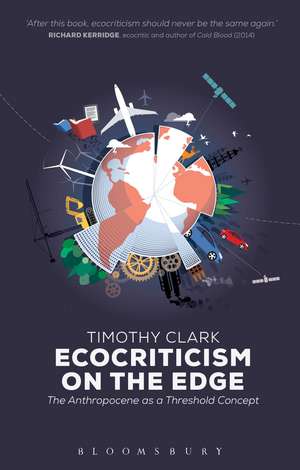
Ecocriticism on the Edge
Autor Timothy Clarken Limba Engleză Paperback – 24 sep 2015
Ecocriticism on the Edge explores the possibility of a new mode of critical practice, one fully engaged with the destructive force of the planetary environmental crisis. Timothy Clark argues that, in literary and cultural criticism, the "Anthropocene", which names the epoch in which human impacts on the planet's ecological systems reach a dangerous limit, also represents a threshold at which modes of interpretation that once seemed sufficient or progressive become, in this new counterintuitive context, inadequate or even latently destructive. The book includes analyses of literary works, including texts by Paule Marshall, Gary Snyder, Ben Okri, Henry Lawson, Lorrie Moore and Raymond Carver.
Preț: 183.05 lei
Preț vechi: 224.32 lei
-18%
Puncte Express: 275
Preț estimativ în valută:
32.40€ • 37.86$ • 28.13£
32.40€ • 37.86$ • 28.13£
Carte disponibilă
Livrare economică 30 ianuarie-13 februarie
Livrare express 15-21 ianuarie pentru 249.94 lei
Preluare comenzi: 021 569.72.76
Specificații
ISBN-13: 9781472505736
ISBN-10: 1472505735
Pagini: 232
Ilustrații: 7 halftones
Dimensiuni: 139 x 216 x 17 mm
Greutate: 0.33 kg
Editura: BLOOMSBURY ACADEMIC
Locul publicării:London, United Kingdom
ISBN-10: 1472505735
Pagini: 232
Ilustrații: 7 halftones
Dimensiuni: 139 x 216 x 17 mm
Greutate: 0.33 kg
Editura: BLOOMSBURY ACADEMIC
Locul publicării:London, United Kingdom
V-ar putea interesa
-
 Present Imperfect: Contemporary South African WritingAndrew van der Vlies-34%Preț: 504.88 lei762.69 lei
 -
 Anima and Africa: Jungian Essays on Psyche, Land, and LiteratureMatthew A. Fike-17%Preț: 344.46 lei416.73 lei
 -
 Blanchot and Literary CriticismDr. Mark Hewson-26%Preț: 730.94 lei988.34 lei
 -
 -17%Preț: 328.75 lei394.54 lei
 -
 Overcoming Matthew Arnold: Ethics in Culture and CriticismJames Walter Caufield-17%Preț: 327.31 lei393.78 lei
 -
 Literary Form as Postcolonial Critique: Epic ProportionsKatharine Burkitt-17%Preț: 327.31 lei393.78 lei
 -
 Fictions at Work: Language and Social Practice in FictionMary M. Talbot-29%Preț: 700.69 lei990.23 lei
 -
 The Singularity of LiteratureDerek Attridge-26%Preț: 359.55 lei485.34 lei
 -
 -30%Preț: 955.49 lei1355.72 lei
 -
 "Wooden Man"?Daniel Matias-27%Preț: 643.32 lei881.26 lei
 -
 H.D. and Modernist Religious Imagination: Mysticism and WritingDr Elizabeth Anderson-18%Preț: 262.85 lei318.66 lei
 -
 Irigaray, Incarnation and Contemporary Women's FictionDr Abigail Rine-18%Preț: 262.58 lei318.50 lei
 -
 T.E. Hulme and ModernismDr Oliver Tearle-18%Preț: 261.73 lei318.04 lei
 -
 -18%Preț: 261.44 lei317.88 lei
 -
 Ricoeur, Literature and ImaginationDr. Sophie Vlacos-17%Preț: 263.51 lei319.03 lei
 -
 Literature, Autonomy and CommitmentDr Aukje van Rooden-34%Preț: 580.85 lei880.67 lei
 -
 Mexican Literature in TheoryProf. Ignacio M. Sánchez Prado-17%Preț: 238.38 lei287.46 lei
 -
 Levinas and Twentieth-Century LiteratureDonald R. WehrsPreț: 444.27 lei
 -
 Leo Bersani: A Speculative IntroductionProf. Mikko Tuhkanen-18%Preț: 171.81 lei209.19 lei
 -
 Narrative Care: Biopolitics and the NovelDr. Arne De Boever-18%Preț: 261.44 lei317.88 lei
 -
 The Ancients and the PostmodernsFredric JamesonPreț: 116.81 lei
 -
 An Analysis of Karl Marx's CapitalMacat Team-21%Preț: 131.71 lei167.07 lei
 -
 -21%Preț: 130.91 lei166.61 lei
 -
 Postcolonial DeparturesHano Pipic-23%Preț: 463.23 lei601.59 lei
 -
 Preț: 495.49 lei
Cuprins
Acknowledgments
Preface
Chapter One: The Anthropocene -- Questions of Definition
Chapter Two: Imaging and Imagining the Whole Earth: The Terrestrial as Norm
Chapter Three: Emergent Unreadability: Rereading a Lyric by Gary Snyder
Chapter Four: Scale Framing
Chapter Five: Scale Framing: A Reading
Chapter Six: Postcolonial Ecocriticism and Dehumanizing Reading: An Australian Test-Case
Chapter Seven: Anthropocene Disorder
Chapter Eight: Denial: A Reading
Chapter Nine: The Tragedy that Climate Change is not 'Interesting'
Conclusion
Preface
Chapter One: The Anthropocene -- Questions of Definition
Chapter Two: Imaging and Imagining the Whole Earth: The Terrestrial as Norm
Chapter Three: Emergent Unreadability: Rereading a Lyric by Gary Snyder
Chapter Four: Scale Framing
Chapter Five: Scale Framing: A Reading
Chapter Six: Postcolonial Ecocriticism and Dehumanizing Reading: An Australian Test-Case
Chapter Seven: Anthropocene Disorder
Chapter Eight: Denial: A Reading
Chapter Nine: The Tragedy that Climate Change is not 'Interesting'
Conclusion
Recenzii
Clark is at his strongest when walking the reader through his multi-scalar examples of literary criticism, which are a highlight of the book. This book will be a particular asset to those teaching and researching eco-criticism.
[This book] represents a valuable contribution to the field of ecocriticism, especially because of its meta-theoretical insights.
It is a difficult task to do justice to all the valid points that Clark raises in his work.
I am very excited by this book. Clark shows a game-changing willingness to face the implications of environmental priorities, and develop new ways of reading based on those priorities. After this book, ecocriticism should never be the same again.
[This book] represents a valuable contribution to the field of ecocriticism, especially because of its meta-theoretical insights.
It is a difficult task to do justice to all the valid points that Clark raises in his work.
I am very excited by this book. Clark shows a game-changing willingness to face the implications of environmental priorities, and develop new ways of reading based on those priorities. After this book, ecocriticism should never be the same again.