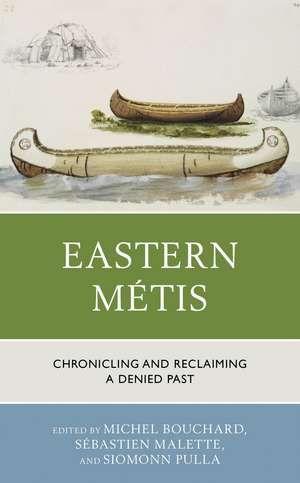
Eastern Métis: Chronicling and Reclaiming a Denied Past
Editat de Michel Bouchard, Sébastien Malette, Siomonn Pulla Contribuţii de Christine Elsey, Denis Gagnon, Katie K. MacLeod, Tiana Mager, Guillaume Marcotte, Emmanuel Michaux, Jo-Anne Muise Lawless, Seán O’Connell, Robert A. Papen, Étienne Rivarden Limba Engleză Paperback – 18 aug 2022
| Toate formatele și edițiile | Preț | Express |
|---|---|---|
| Paperback (1) | 246.81 lei 6-8 săpt. | |
| Bloomsbury Publishing – 18 aug 2022 | 246.81 lei 6-8 săpt. | |
| Hardback (1) | 660.42 lei 6-8 săpt. | |
| Bloomsbury Publishing – mar 2021 | 660.42 lei 6-8 săpt. |
Preț: 246.81 lei
Preț vechi: 332.20 lei
-26%
Puncte Express: 370
Preț estimativ în valută:
43.68€ • 51.05$ • 37.92£
43.68€ • 51.05$ • 37.92£
Carte tipărită la comandă
Livrare economică 20 februarie-06 martie
Preluare comenzi: 021 569.72.76
Specificații
ISBN-13: 9781793605450
ISBN-10: 1793605459
Pagini: 374
Ilustrații: 2 b/w illustrations;17 b/w photos; 4 tables;
Dimensiuni: 150 x 226 x 22 mm
Greutate: 0.5 kg
Editura: Bloomsbury Publishing
Colecția Lexington Books
Locul publicării:New York, United States
ISBN-10: 1793605459
Pagini: 374
Ilustrații: 2 b/w illustrations;17 b/w photos; 4 tables;
Dimensiuni: 150 x 226 x 22 mm
Greutate: 0.5 kg
Editura: Bloomsbury Publishing
Colecția Lexington Books
Locul publicării:New York, United States
Cuprins
Chapter 1: Symbolic Violence against the "Other Métis": The Making of a New Forgotten People in Canada
Chapter 2: Political Ontologies in Turmoil: Métis "Neo-Nationalism" and the "Other Métis"
Chapter 3: The Languages of the Métis in Canada
Chapter 4: Situating Nova Scotia Métis Identities in a Colonial Past
Chapter 5: The Acadian Métis on the Geographic and Social Margins
Chapter 6: Métissage and Métis Identity in the Gaspé Peninsula: From Its
Origins to the 1886 Paspébiac Riots
Chapter 7: Undercoat Communities: The Geohistorical Scaling of Métis Identity in the East
Chapter 8: "The Lowest Race of Any in Canada": Mitifs from the Fur Trade and the Voyageurs Parishes of St. Lawrence Valley
Chapter 9: Understanding the Impacts of a Transitional and Mixed Regional Economy on the Emergence of the Historic Métis of Mattawa
Chapter 10 : The Voyageur Métis of Penetanguishene: An Examination of the Ethnohistory of the Métis in Ontario
Chapter 11: The Story of French Canadian Métis Voyageur Joseph Dussa
Chapter 2: Political Ontologies in Turmoil: Métis "Neo-Nationalism" and the "Other Métis"
Chapter 3: The Languages of the Métis in Canada
Chapter 4: Situating Nova Scotia Métis Identities in a Colonial Past
Chapter 5: The Acadian Métis on the Geographic and Social Margins
Chapter 6: Métissage and Métis Identity in the Gaspé Peninsula: From Its
Origins to the 1886 Paspébiac Riots
Chapter 7: Undercoat Communities: The Geohistorical Scaling of Métis Identity in the East
Chapter 8: "The Lowest Race of Any in Canada": Mitifs from the Fur Trade and the Voyageurs Parishes of St. Lawrence Valley
Chapter 9: Understanding the Impacts of a Transitional and Mixed Regional Economy on the Emergence of the Historic Métis of Mattawa
Chapter 10 : The Voyageur Métis of Penetanguishene: An Examination of the Ethnohistory of the Métis in Ontario
Chapter 11: The Story of French Canadian Métis Voyageur Joseph Dussa
Recenzii
This is a challenging book that weighs in on the controversial and divisive debate of who has the right to claim capital "M" Métis status in Canada. The collection assembles essays by scholars of anthropology, sociology, law, history, linguistics, geography, and interdisciplinary studies, purporting to present historical and social evidence of the origins and continued existence of cohesive Métis communities in Ontario, Quebec, the Maritime provinces, and (despite the title) the Pacific Northwest region of Canada. Challenging the "nationalist trope" that only the Red River Métis of the northern Plains can claim Métis identity, this collection directly challenges the perspective of scholars like Jacqueline Peterson, Darryl Leroux, Adam Gaudry, and Jesse Thistle, not to mention the established Canadian legal view asserting that other claims to Métis status are little more than "race shifting"-a tactical use of long-ago racial mixing to reimagine a "Métis" identity and thus assert treaty rights. This book by no means settles the debate, but is nonetheless a thought-provoking contribution to the complicated topic of mixed Indigenous-settler identity, which will undoubtedly continue to spark controversy and inspire further study. Recommended. Advanced undergraduates through faculty.
Eastern Métis: Chronicling and Reclaiming a Denied Past is long overdue and opens up important new understandings of our shared pasts.
Eastern Métis: Chronicling and Reclaiming a Denied Past is long overdue and opens up important new understandings of our shared pasts.