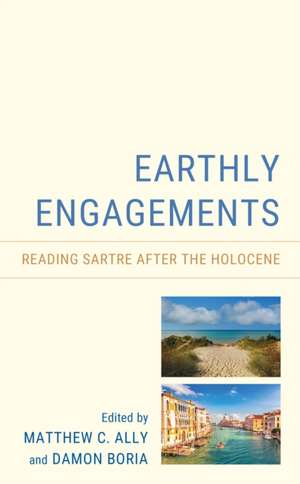
Earthly Engagements: Reading Sartre after the Holocene
Editat de Matthew C. Ally, Damon Boria Contribuţii de Ronald Aronson, Joe Balay, Kiki Berk, Michael Butler, Elizabeth Butterfield, Kimberly Engels, Simon Gusman, Paul Gyllenhammer, Arjen Kleinherenbrink, Craig Matarrese, William L. McBride, Dane Sawyer, Austin Hayden Smidt, Joshua Tepleyen Limba Engleză Hardback – 16 mar 2023
Preț: 570.20 lei
Preț vechi: 857.13 lei
-33%
Puncte Express: 855
Preț estimativ în valută:
100.91€ • 117.94$ • 87.61£
100.91€ • 117.94$ • 87.61£
Carte tipărită la comandă
Livrare economică 19 februarie-05 martie
Preluare comenzi: 021 569.72.76
Specificații
ISBN-13: 9781793638687
ISBN-10: 1793638683
Pagini: 350
Ilustrații: 5 b/w photos;
Dimensiuni: 157 x 236 x 25 mm
Greutate: 0.64 kg
Editura: Bloomsbury Publishing
Colecția Lexington Books
Locul publicării:New York, United States
ISBN-10: 1793638683
Pagini: 350
Ilustrații: 5 b/w photos;
Dimensiuni: 157 x 236 x 25 mm
Greutate: 0.64 kg
Editura: Bloomsbury Publishing
Colecția Lexington Books
Locul publicării:New York, United States
Cuprins
Contents
Foreword
Introduction by Matthew C. Ally & Damon Boria
Part I. Sartre and Ecology
Chapter 1. "Sartre and Problems in the Philosophy of Ecology - with a Thirty-Year Update" by William L. McBride
Part II. Art and Phenomenology
Chapter 2. "Soundscape Ecology and a Sartrean Phenomenology of Listening" by Craig Matarrese
Chapter 3. "The Ecological Gaze: Re-Reading Sartre through Guido van Helten's No Exit Murals" by Joe Balay
Part III. Ethics
Chapter 4. "Three Sartrean Motivations for Environmentalism" by Kiki Berk and Joshua Tepley
Chapter 5. "I Am What I Buy: Bad Faith and Consumer Culture" by Elizabeth Butterfield
Chapter 6. "Buying Green: A Trap for Fools, or, Sartre on Ethical Consumerism" by Michael Butler
Part IV. Dialectics and Politics
Chapter 7. "Heralding Kairos: The Depths of Seriality and Creating Earth as a Work of Art" by Austin Hayden Smidt
Chapter 8. "Counter-Finality and the Living World" by Paul Gyllenhammer
Chapter 9. "Hyperobjects and the Practico-Inert:
Foreword
Introduction by Matthew C. Ally & Damon Boria
Part I. Sartre and Ecology
Chapter 1. "Sartre and Problems in the Philosophy of Ecology - with a Thirty-Year Update" by William L. McBride
Part II. Art and Phenomenology
Chapter 2. "Soundscape Ecology and a Sartrean Phenomenology of Listening" by Craig Matarrese
Chapter 3. "The Ecological Gaze: Re-Reading Sartre through Guido van Helten's No Exit Murals" by Joe Balay
Part III. Ethics
Chapter 4. "Three Sartrean Motivations for Environmentalism" by Kiki Berk and Joshua Tepley
Chapter 5. "I Am What I Buy: Bad Faith and Consumer Culture" by Elizabeth Butterfield
Chapter 6. "Buying Green: A Trap for Fools, or, Sartre on Ethical Consumerism" by Michael Butler
Part IV. Dialectics and Politics
Chapter 7. "Heralding Kairos: The Depths of Seriality and Creating Earth as a Work of Art" by Austin Hayden Smidt
Chapter 8. "Counter-Finality and the Living World" by Paul Gyllenhammer
Chapter 9. "Hyperobjects and the Practico-Inert:
Recenzii
Given its identification with humanism and its strict separation of consciousness from nature, Sartrean existentialism has been easily dismissed by some as having no relevance for environmental philosophy. The 13 essays Ally and Boria gathered challenge this reading, arguing from various perspectives that a Sartrean eco-existentialism is not a contradiction in terms. Although some essays explicitly defend Sartre from the charge that his conceptions of nature and consciousness are dualistic, others bring Sartre's descriptions of the Other, counter finality, praxis, and the practico-inert to bear on contemporary philosophical discussions in environmental ethics. [The] essays make a plausible case for the relevance of existentialist thought in grasping the nature and implications of the Anthropocene. Of interest to scholars and students of environmental philosophy. Highly recommended. Lower-division undergraduates through faculty.
One could be forgiven for assuming that Sartre, who died in 1980, would have little to teach us in our struggle to understand, and to combat, the current ecological crisis. But one would, nonetheless, be sorely mistaken, as this outstanding collection makes abundantly clear. Matthew Ally and Damon Boria have assembled an all-star roster of writers, who illuminate the crisis from a variety of angles, while making use of a staggering number of Sartrean concepts, theories, and arguments. Anyone interested either in environmental issues or in Sartre will find much of interest here, most of which one cannot find elsewhere.
To have a collection of essays on Sartre and ecology is both quite unexpected and deeply welcome. Sartre was as "urbane," and in that sense "bourgeois," a figure as one will find in philosophy. Did Sartre ever spend time in a woodlands hut, as did Heidegger and Wittgenstein? --seems doubtful. And yet both biological and geological nature play a large role in Sartre's thinking, from rocks to trees, and of course La Nausee takes place in "Mud Town." In almost every case, the natural objects in Sartre's work, always found in urban settings, stand in for concepts, adding up to a bruteness of being that is nausea-inducing. The metaphysical upshot of these object-concepts is part of an anti-Platonic philosophical program, which, oddly and strikingly, results in the same sense of alienation from reality that we see in Plato. There is no recourse to the forms in Sartre, however, and neither is there a going back behind Plato, as Heidegger proposed, to find the sense of dwelling. One has to do a very different kind of work, in other words, to bring these object-concepts in communication with an ecological perspective. This perspective is now unfolding in a time, a proposed epoch even, called the "Anthropocene," and this is right up Sartre's alley, for, in a deep sense--one that could be seen, in fact, in both a complementary and somewhat antagonistic relationship with deep ecology, Sartre's understanding of consciousness is such that humanity has always been in the Anthropocene. Our world is always our human world. But yes, a different and indeed a very difficult kind of work--a work for which Sartre offers a wide array of conceptual tools, from both the early (phenomenological) and later ("Marxist," however one understands this) periods of his work (with existential humanism throughout), from nothingness to the practico-inert and seriality. The authors in this collection apply these tools brilliantly--as one would expect, for they are among the best Sartre scholars in the world today. They "crack the ecology code" on numerous levels, many of these, again, unexpected, from soundscape music to the Native American metaphysics of Vine Deloria and the Buddhist sense of emptiness; to the question of seriality that Sartre applied in his somewhat infamous essay, "Elections: A Trap for Fools" now applied to "green consumerism"; to Timothy Morton's deployment of object-oriented ontology to create "dark ecology." No author here lets Sartre off easy, either--it is very clear that the path from Sartre's overwhelmingly urban world to what in many ways is frightening and disturbing, inhuman reality, nature (which, at least to begin with, annihilates the little scraps of meaning that we have managed to assemble in our lives); in pressing Sartre toward this reality, using his own tools, Matthew C. Ally and Damon Boria have brought together something very special.
One could be forgiven for assuming that Sartre, who died in 1980, would have little to teach us in our struggle to understand, and to combat, the current ecological crisis. But one would, nonetheless, be sorely mistaken, as this outstanding collection makes abundantly clear. Matthew Ally and Damon Boria have assembled an all-star roster of writers, who illuminate the crisis from a variety of angles, while making use of a staggering number of Sartrean concepts, theories, and arguments. Anyone interested either in environmental issues or in Sartre will find much of interest here, most of which one cannot find elsewhere.
To have a collection of essays on Sartre and ecology is both quite unexpected and deeply welcome. Sartre was as "urbane," and in that sense "bourgeois," a figure as one will find in philosophy. Did Sartre ever spend time in a woodlands hut, as did Heidegger and Wittgenstein? --seems doubtful. And yet both biological and geological nature play a large role in Sartre's thinking, from rocks to trees, and of course La Nausee takes place in "Mud Town." In almost every case, the natural objects in Sartre's work, always found in urban settings, stand in for concepts, adding up to a bruteness of being that is nausea-inducing. The metaphysical upshot of these object-concepts is part of an anti-Platonic philosophical program, which, oddly and strikingly, results in the same sense of alienation from reality that we see in Plato. There is no recourse to the forms in Sartre, however, and neither is there a going back behind Plato, as Heidegger proposed, to find the sense of dwelling. One has to do a very different kind of work, in other words, to bring these object-concepts in communication with an ecological perspective. This perspective is now unfolding in a time, a proposed epoch even, called the "Anthropocene," and this is right up Sartre's alley, for, in a deep sense--one that could be seen, in fact, in both a complementary and somewhat antagonistic relationship with deep ecology, Sartre's understanding of consciousness is such that humanity has always been in the Anthropocene. Our world is always our human world. But yes, a different and indeed a very difficult kind of work--a work for which Sartre offers a wide array of conceptual tools, from both the early (phenomenological) and later ("Marxist," however one understands this) periods of his work (with existential humanism throughout), from nothingness to the practico-inert and seriality. The authors in this collection apply these tools brilliantly--as one would expect, for they are among the best Sartre scholars in the world today. They "crack the ecology code" on numerous levels, many of these, again, unexpected, from soundscape music to the Native American metaphysics of Vine Deloria and the Buddhist sense of emptiness; to the question of seriality that Sartre applied in his somewhat infamous essay, "Elections: A Trap for Fools" now applied to "green consumerism"; to Timothy Morton's deployment of object-oriented ontology to create "dark ecology." No author here lets Sartre off easy, either--it is very clear that the path from Sartre's overwhelmingly urban world to what in many ways is frightening and disturbing, inhuman reality, nature (which, at least to begin with, annihilates the little scraps of meaning that we have managed to assemble in our lives); in pressing Sartre toward this reality, using his own tools, Matthew C. Ally and Damon Boria have brought together something very special.