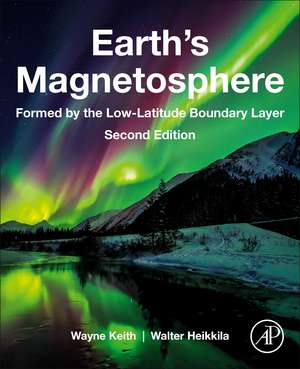
Earth's Magnetosphere: Formed by the Low-Latitude Boundary Layer
Autor Wayne Keith, Walter Heikkilaen Limba Engleză Paperback – 26 noi 2020
- Offers an historical perspective of early magnetospheric research, combined with progress up to the present
- Describes observations from various spacecraft in a variety of regions, with explanations and discussions of each
- Includes chapters on prompt particle acceleration to high energies, plasma transfer event, and the low latitude boundary layer
Preț: 823.00 lei
Preț vechi: 1089.22 lei
-24%
Puncte Express: 1235
Carte tipărită la comandă
Livrare economică 30 noiembrie-14 decembrie
Livrare prin curier în România Termenul estimat este afișat lângă disponibilitate.
Transport gratuit pentru acest produs Plată online sau ramburs, în funcție de opțiunile comenzii.
Retur gratuit în 14 zile Comandă securizată și suport în română.
Specificații
ISBN-13: 9780128181607
ISBN-10: 0128181605
Pagini: 642
Dimensiuni: 191 x 235 mm
Greutate: 1.08 kg
Ediția:2
Editura: ELSEVIER SCIENCE
ISBN-10: 0128181605
Pagini: 642
Dimensiuni: 191 x 235 mm
Greutate: 1.08 kg
Ediția:2
Editura: ELSEVIER SCIENCE
V-ar putea interesa
-
 The Earth's Magnetic FieldWilliam Lowrie-15%Preț: 207.29 lei244.14 lei
 -
 Geophysics: A Very Short IntroductionWilliam Lowrie-20%Preț: 56.95 lei70.96 lei
 -
 Magnetism: A Very Short IntroductionStephen J. Blundell-19%Preț: 57.18 lei70.82 lei
 -
 Gemini and Mercury RemasteredAndy SaundersPreț: 408.99 lei
 -
 The Current Status and Future Direction of High-Magnetic-Field Science and Technology in the United StatesNational Academies of Sciences Engineering and MedicinePreț: 196.75 lei
 -
 The Next Decade of Discovery in Solar and Space PhysicsCommittee on a Decadal Survey for Solar and Space Physics 2024-2033-14%Preț: 592.76 lei689.25 lei
 -
 Self-Exciting Fluid DynamosKeith Moffatt-11%Preț: 475.79 lei534.60 lei
 -
 Magnetotails in the Solar SystemAndreas Keiling-23%Preț: 1084.86 lei1408.90 lei
 -
 Helicities in Geophysics, Astrophysics, and BeyondKirill Kuzanyan-23%Preț: 1057.95 lei1373.96 lei
 -
 The Starspotter's GuideSheila Kanani-29%Preț: 101.75 lei142.83 lei
 -
 -26%Preț: 1723.91 lei2344.01 lei
 -
 The Spinning MagnetAlanna MitchellPreț: 73.36 lei
 -
 Introduction to GeophysicsChristoph Clauser-19%Preț: 631.95 lei780.17 lei
 -
 Problems of Geocosmos-2022Andrei Kosterov-18%Preț: 1449.35 lei1767.50 lei
 -
 Magnetospheric MHD Oscillations – A Linear TheoryAS Leonovich-14%Preț: 839.43 lei976.08 lei
 -
 The EarthManfred GottwaldPreț: 230.81 lei
 -
 The Dynamic MagnetosphereWilliam Liu-15%Preț: 687.69 lei809.05 lei
 -
 Earth's Magnetic FieldClaudia Stolle-18%Preț: 1458.84 lei1779.07 lei
Public țintă
Geophysicists, space scientistsCuprins
1. Historical introduction2. Kirchhoff’s Laws3. Helmholtz’s theorem4. Magnetohydrodynamic equations5. Poynting’s energy conservation theorem6. Magnetopause7. High-altitude cusps8. Inner Magnetosphere9. Low-latitude boundary layer10. Driving the plasma sheet11. Magnetospheric substorms12. Epilogue
Notă biografică
Wayne Keith obtained a PhD in Space Physics from Rice University, during which time he also completed research at Southwest Research Institute in San Antonio. He became a research associate at the NASA Goddard Space Flight Center before moving on to full time teaching at McMurry University. He participated in the design, assembly, testing, calibration, data processing, and analysis of two magnetospheric plasma instruments (MEDUSA on Astrid-2, and MEDUSA-2 on Munin) and was also involved in data processing and analysis for multiple instruments on Cluster-2. His primary research interests are the magnetospheric cusps and data visualization.