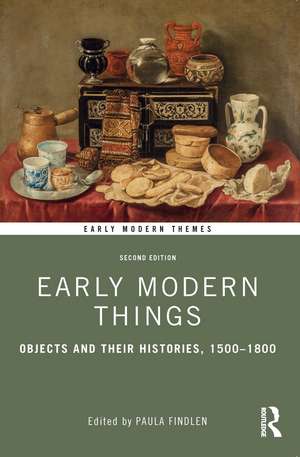
Early Modern Things: Objects and their Histories, 1500-1800: Early Modern Themes
Editat de Paula Findlenen Limba Engleză Paperback – 2 mar 2021
Now in its second edition, this book taps a rich vein of recent scholarship to explore a variety of approaches to the material culture of the early modern world (c. 1500–1800). Divided into seven parts, the book explores the ambiguity of things, representing things, making things, encountering things, empires of things, consuming things, and the power of things. This edition includes a new preface and three new essays on ‘encountering things’ to enrich the volume. These look at cabinets of curiosities, American pearls, and the material culture of West Central Africa. Spanning across the early modern world from Ming dynasty China and Tokugawa Japan to Siberia and Georgian England, from the Kingdom of the Kongo and the Ottoman Empire to the Caribbean and the Spanish Americas, the authors provide a generous set of examples in how to study the circulation, use, consumption, and, most fundamentally, the nature of things themselves.
Drawing on a broad range of disciplinary perspectives and lavishly illustrated, this updated edition of Early Modern Things is essential reading for all those interested in the early modern world and the history of material culture.


Preț: 456.39 lei
Puncte Express: 685
Carte disponibilă
Livrare economică 03-17 noiembrie
Livrare express 20-24 octombrie pentru 63.62 lei
Livrare prin curier în România Termenul estimat este afișat lângă disponibilitate.
Transport gratuit pentru acest produs Plată online sau ramburs, în funcție de opțiunile comenzii.
Retur gratuit în 14 zile Comandă securizată și suport în română.
Specificații
ISBN-13: 9781138483149
ISBN-10: 1138483141
Pagini: 492
Ilustrații: 11 Tables, black and white; 84 Halftones, black and white; 95 Illustrations, black and white
Dimensiuni: 156 x 234 x 35 mm
Greutate: 1.12 kg
Ediția:2 ed
Editura: Taylor & Francis
Colecția Routledge
Seria Early Modern Themes
Locul publicării:Oxford, United Kingdom
ISBN-10: 1138483141
Pagini: 492
Ilustrații: 11 Tables, black and white; 84 Halftones, black and white; 95 Illustrations, black and white
Dimensiuni: 156 x 234 x 35 mm
Greutate: 1.12 kg
Ediția:2 ed
Editura: Taylor & Francis
Colecția Routledge
Seria Early Modern Themes
Locul publicării:Oxford, United Kingdom
Public țintă
Postgraduate and UndergraduateCuprins
Preface to the second edition: early modern things revisited Introduction: Early modern things: objects in motion, 1500–1800 Part I: The ambiguity of things 1.Surface Ttnsion: objectifying ginseng in Chinese early modernity 2. Going to the birds: animals as things and beings in early modernity 3. The restless clock Part II: Representing things 4. Stil-Staende Dingen: picturing objects in the Dutch Golden Age 5. 'Things seen and unseen': the material culture of early modern inventories and their representation of domestic interiors 6. Costume and character in the Ottoman Empire: dress as social agent in Nicolay’s Navigations Part III: Making things 7. Making things: techniques and books in early modern Europe 8. Capricious demands: artisanal goods, business strategies, and consumer behavior in seventeenth-century Florence Part IV: Encountering things 9. Catalogical encounters: worldmaking in early modern cabinets of curiosities 10. Unruly objects: baroque fantasies and early modern realities 11. The taste of others: finery, the slave trade, and Africa’s place in the traffic in early modern things Part V: Empires of things 12. Locating rhubarb: early modernity's relevant obscurity 13. The world in a shilling: silver coins and the challenge of political economy in the early modern Atlantic world 14. Anatolian timber and Egyptian grain: things that made the Ottoman Empire Part VI: Consuming things 15. The Tokugawa storehouse: Ieyasu’s encounters with things 16. Porcelain for the poor: the material culture of tea and coffee consumption in eighteenth-century Amsterdam 17. Fashioning difference in Georgian England: furniture for him and for her Epilogue: the power of things 18. Denaturalizing things: a comment 19. Something new: a comment 20. Identities through things: a comment
Notă biografică
Paula Findlen is Ubaldo Pierotti Professor of Italian History and Director of the Suppes Center for the History and Philosophy of Science and Technology at Stanford University, USA. Her previous works include Possessing Nature: Museums, Collecting, and Scientific Culture in Early Modern Italy (1994), and, most recently Empires of Knowledge: Scientific Networks in the Early Modern World (2019), Leonardo’s Library (2019), and The Renaissance of Letters (2020). She is a Fellow of the American Academy of Arts and Sciences.
Recenzii
"A cornucopia: a rich and valuable collection that ranges far and wide in its analysis of the dynamic and diverse powers – symbolic, material, economic, political and religious – of things in the early-modern world. These essays raise important questions about taking objects seriously for historians of any era."
John Brewer, California Institute of Technology, USA
John Brewer, California Institute of Technology, USA
Descriere
This book supplies fresh and provocative insights into how objects – ordinary and extraordinary, secular and sacred, natural and man-made – came to define some of the key developments of the early modern world. It is essential reading for all those interested in the early modern world and the history of material culture.