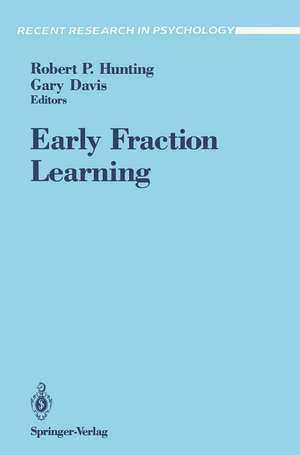
Early Fraction Learning: Recent Research in Psychology
Editat de Robert P. Hunting, Gary Davisen Limba Engleză Paperback – oct 1991
Din seria Recent Research in Psychology
- 15%
 Preț: 611.12 lei
 - 15%
 Preț: 617.72 lei
 - 15%
 Preț: 612.23 lei
 - 15%
 Preț: 607.96 lei
 - 15%
 Preț: 617.66 lei
 - 15%
 Preț: 607.96 lei
 -
 Preț: 367.68 lei
 -
 Preț: 395.69 lei
 - 20%
 Preț: 648.68 lei
 - 15%
 Preț: 622.29 lei
 - 15%
 Preț: 620.55 lei
 - 15%
 Preț: 614.41 lei
 - 15%
 Preț: 624.63 lei
 - 15%
 Preț: 628.10 lei
 - 15%
 Preț: 617.57 lei
 - 15%
 Preț: 610.18 lei
 - 15%
 Preț: 613.18 lei
 - 15%
 Preț: 614.90 lei
 - 18%
 Preț: 727.33 lei
 - 15%
 Preț: 612.68 lei
 - 15%
 Preț: 617.39 lei
 - 15%
 Preț: 611.12 lei
 - 18%
 Preț: 910.11 lei
 - 15%
 Preț: 609.08 lei
 - 15%
 Preț: 637.31 lei
 -
 Preț: 365.31 lei
 - 15%
 Preț: 613.00 lei
 -
 Preț: 384.77 lei
 - 15%
 Preț: 608.59 lei
 - 20%
 Preț: 476.02 lei
 - 5%
 Preț: 737.45 lei
 - 18%
 Preț: 914.06 lei
 - 15%
 Preț: 609.71 lei
 - 15%
 Preț: 612.55 lei
 -
 Preț: 364.31 lei
 -
 Preț: 365.31 lei
 - 15%
 Preț: 615.84 lei
 - 15%
 Preț: 609.53 lei
 - 15%
 Preț: 609.71 lei
 - 15%
 Preț: 619.29 lei
 - 15%
 Preț: 609.71 lei
 - 15%
 Preț: 607.04 lei
 - 15%
 Preț: 610.63 lei
 - 15%
 Preț: 610.63 lei
 - 15%
 Preț: 606.24 lei
 - 15%
 Preț: 613.94 lei
 - 15%
 Preț: 612.68 lei
Preț: 613.80 lei
Preț vechi: 722.11 lei
-15%
Puncte Express: 921
Carte tipărită la comandă
Livrare economică 23 noiembrie-07 decembrie
Livrare prin curier în România Termenul estimat este afișat lângă disponibilitate.
Transport gratuit pentru acest produs Plată online sau ramburs, în funcție de opțiunile comenzii.
Retur gratuit în 14 zile Comandă securizată și suport în română.
Specificații
ISBN-13: 9780387976419
ISBN-10: 0387976418
Pagini: 236
Ilustrații: XVII, 236 p. 1 illus.
Dimensiuni: 155 x 235 x 14 mm
Greutate: 0.36 kg
Ediția:1991
Editura: Springer
Colecția Springer
Seria Recent Research in Psychology
Locul publicării:New York, NY, United States
ISBN-10: 0387976418
Pagini: 236
Ilustrații: XVII, 236 p. 1 illus.
Dimensiuni: 155 x 235 x 14 mm
Greutate: 0.36 kg
Ediția:1991
Editura: Springer
Colecția Springer
Seria Recent Research in Psychology
Locul publicării:New York, NY, United States
V-ar putea interesa
-
 -27%Preț: 193.11 lei265.41 lei
 -
 Psychology and EducationSusan BenthamPreț: 409.16 lei
 -
 Towards a Comprehensive Theory of Human LearningPeter Jarvis-15%Preț: 456.83 lei537.45 lei
 -
 Preț: 404.99 lei
 -
 Critical Thinking: An Exploration of Theory and PracticeJennifer MoonPreț: 412.71 lei
 -
 Peer Support in ActionHelen Cowie-15%Preț: 661.14 lei777.81 lei
 -
 Education and Mind in the Knowledge AgeCarl Bereiter-15%Preț: 624.20 lei734.35 lei
 -
 Ready-To-Use Self Esteem Activities for Young ChildrenJean R FeldmanPreț: 224.35 lei
 -
 Effective Learning in ClassroomsChris WatkinsPreț: 243.15 lei
 -
 Cracking the Hard ClassBill RogersPreț: 396.18 lei
 -
 Attention SeekingNigel Mellor-15%Preț: 615.54 lei724.16 lei
 -
 Talking is for AllBetty Rudd-15%Preț: 665.59 lei783.05 lei
 -
 Environments for LearningEric JensenPreț: 172.59 lei
Public țintă
ResearchCuprins
1. Introduction.- References.- 2. Pre-fraction Concepts of Preschoolers.- Method.- Results.- Discussion.- References.- 3. Dimensions of Young Children’s Conceptions of the Fraction One Half.- Theory.- Method.- Results.- Discussion.- References.- 4. The Social Origins of Pre-fraction Knowledge in Three Year Olds.- Method.- Results.- General Discussion.- References.- 5. Higher Order Thinking in Young Children’s Engagements with a Fraction Machine.- The Copy Cat Fraction Machine.- Copy Cat Performance.- Counting Performance.- Relationships Between Copy Cat Performance and Counting.- The Case of Jayme and One-third.- 6. Fractions as Operators and as Cloning Machines.- The Rational Numbers as Operators.- Fraction Algorithms and Abstract Symbolism.- A More General Construction of Fields of Fractions via Operators.- References.- 7. Preschoolers’ Knowledge of Counting and Sharing in Discrete Quantity Settings.- Counting.- The Theory of Counting Types.- Sharing in Discrete Quantity Settings.- The Link Between Counting and Sharing.- The Counting Tasks.- The Sharing Tasks.- Classification Criteria.- Counting Tasks.- Sharing Tasks.- Observed Frequencies for Counting and Sharing.- Poor Counters but Good Sharers.- Good Counters but Weak Sharers.- 8. Preschoolers’ Spontaneous Partitioning of Discrete Items.- References.- 9. Cognitive Issues about Dealing.- Dealing and Counting.- Commentary on Tom’s Responses.- Cognitive and Problem Solving Aspects of Tom’s Responses.- General Discussion.- References.- 10. Sharing by Dealing as Problem Solving.- A Sharing Problem.- Children’s Strategies.- Conclusions.- References.- 11. Cognitive Research on Early Fraction Learning Applied to Classrooms: Two Experiments.- I. An Experiment in Teacher-focused Curriculum Change.- II. Applyingthe Didactic Framework.- References.- Appendix: Fractions and Sharing Interview.- 12. The Interaction of Thought, Words, and Deeds in Children’s Early Fraction Learning.- The Problem.- What the Interviews Revealed.- Concluding Comments.- References.- 13. On Clinical Methods for Studying Young Children’s Mathematics.- Examples of Recent Adaptations.- Artifacts of the Clinical Interview.- References.- 14. A Fraction of Epistemology.- Relations and Reality.- Order and Symmetry Breaking.- Reflection, Disequilibrium, and the Transition to Order.- Information and Action.- The Idea of a Concept.- References.