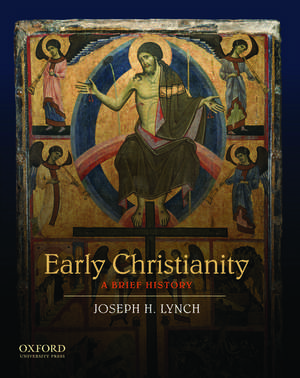
Early Christianity: A Brief History
Autor Joseph H. Lynchen Limba Engleză Paperback – 26 feb 2009
Preț: 367.81 lei
Preț vechi: 465.90 lei
-21%
Puncte Express: 552
Carte tipărită la comandă
Livrare economică 26 noiembrie-02 decembrie
Livrare express 20-24 octombrie pentru 155.02 lei
Livrare prin curier în România Termenul estimat este afișat lângă disponibilitate.
Transport gratuit de la 400.00 lei Plată online sau ramburs, în funcție de opțiunile comenzii.
Retur gratuit în 14 zile Comandă securizată și suport în română.
Specificații
ISBN-13: 9780195138030
ISBN-10: 0195138031
Pagini: 288
Ilustrații: 10 black and white half tone and 8 line illustrations
Dimensiuni: 188 x 231 x 15 mm
Greutate: 0.55 kg
Editura: Oxford University Press
Colecția OUP USA
Locul publicării:New York, United States
ISBN-10: 0195138031
Pagini: 288
Ilustrații: 10 black and white half tone and 8 line illustrations
Dimensiuni: 188 x 231 x 15 mm
Greutate: 0.55 kg
Editura: Oxford University Press
Colecția OUP USA
Locul publicării:New York, United States
V-ar putea interesa
-
 Cities of GodRodney StarkPreț: 102.89 lei
 -
 Preț: 112.63 lei
 -
 -28%Preț: 483.17 lei671.34 lei
 -
 -24%Preț: 721.31 lei944.81 lei
 -
 -28%Preț: 418.77 lei584.75 lei
 -
 -22%Preț: 470.44 lei599.52 lei
 -
 Crisis of Doubt: Honest Faith in Nineteenth-Century EnglandTimothy Larsen-11%Preț: 352.47 lei397.95 lei
 -
 -22%Preț: 444.46 lei566.42 lei
 -
 -25%Preț: 387.87 lei516.75 lei
 -
 Timeline Charts of the Western ChurchSusan Lynn PetersonPreț: 167.45 lei
 -
 The Confession of Saint PatrickJohn SkinnerPreț: 52.04 lei
 -
 In the BeginningAlister McgrathPreț: 126.75 lei
 -
 The Faith of the Early Fathers: Volume 2William A. JurgensPreț: 212.99 lei
 -
 Roman Catholicism and Modern Science: A HistoryDr Don O'Leary-15%Preț: 197.79 lei233.90 lei
 -
 RevelationsLevyPreț: 201.53 lei
 -
 Corpus HermeticumHermes TrismegistosPreț: 146.61 lei
Notă biografică
Joe R. Engle Designated Professor of the History of Christianity, Department of History, The Ohio State University
Cuprins
- Each chapter ends with Further Reading (both Ancient Sources and Modern Works).
- Chapter 1: Jesus
- Non-Christian Sources about Jesus
- Christian Sources about Jesus
- Jesus
- PART I: THE CONTEXTS OF EARLY CHRISTIANITY
- Timeline for First-Century Christianity
- Chapter 2: The Jewish Context of the Jesus Movement
- The Jews and Hellenization
- The Temple
- Synagogues
- Ordinary Judaism in Palestine
- Diaspora ("Dispersion')
- Roman Rule and the Jews
- Chapter 3: The Greek and Roman Context of Early Christianity
- Official Cults
- Voluntary Cults
- Philosophies
- Chapter 4: The Jesus Movement in the First Century
- Jewish Christianity
- Gentile Christianities
- PART II: CHRISTIANITY IN THE SECOND AND THIRD CENTURIES
- Timeline for the Second and Third Centuries
- A Note on Naming Christian Groups
- Chapter 5: Christian Diversity in the Second and Third Centuries
- Second-Century Diversity
- Chapter 6: The Emergence of a Proto- Orthodox Christian Consensus: Bishop, Creed and Canon of Scripture
- One Bishop, Elders and Deacons/Deaconesses
- Creeds and Rules of Faith
- The Canon of Scripture
- A Case Study: The New Prophecy
- Chapter 7: Roman Society and the Christians
- Roman Law and the Christians
- The "Crowd" and the Christians
- The First Phase of Persecution (about 29 to about 250)
- The Second Phase of Persecution (250-260)
- Chapter 8: Christian Intellectuals
- Justin Martyr (about 100-about 165)
- Origen (About 185-251)
- Chapter 9: Proto-Orthodox Christian Communities in the Third Century
- The Baptized Faithful
- The Catechumens ("Those under instructions")
- Penitents, Apostates, Excommunicates
- Christian Buildings Before Constantine
- Christian Art Before Constantine
- Worship Before Constantine
- PART III: THE CREATION OF A CHRISTIAN EMPIRE
- Timeline of Later Christianity
- Chapter 10: Diocletian, the Great Persecution and the Conversion of Constantine
- The Emperor Diocletian (ruled 284-305)
- Constantine (ruled 306-337)
- Chapter 11: The Christian Empire and the Imperial Church
- Julian the "Apostate" (361-363)
- The Dynasty of Theodosius I (379-455)
- Chapter 12: The Government of the Church
- The Local Bishop
- The Bishops in Council
- The Apostolic Bishoprics
- The Bishop of Rome
- The Emperor
- The Eastern Empire: Continuity
- The Western Empire: Discontinuity
- Chapter 13: The Trinitarian Controversy
- Schisms
- The Origins of the Trinitarian Controversy
- The Survival of Arianism
- Chapter 14: Jesus, the God/Man
- Nestorianism
- Monophysitism
- The Council of Chalcedon (451)
- PART IV: LIFE IN THE CHRISTIAN EMPIRE
- Timeline for Later Christianity
- Chapter 15: Worship and Piety in the Christian Empire
- Liturgy
- Church Buildings
- Christian Time: The Liturgical Calendar
- The Holy Dead
- Pilgrimage
- Chapter 16: The Ascetic Movement
- Anthony (about 251-356)
- Pachomius (290-345)
- Basil of Caesarea (about 329-379)
- Monasticism in the West
- Benedict of Nursia (about 480-about 545)
- Criticism of Ascetics
- The Impact of Asceticism Within Christianity
- A Case Study: Clergy, Laity and Sexual Activity
- Chapter 17: Fourth- and Fifth-Century Christian Thinkers
- Ambrose (339-397)
- Jerome (about 347-419)
- Gregory of Nyssa (between 311 and 340-about 395)
- Augustine of Hippo (354-430)
- Chapter 18: Conversion and Christianization
- Conversion before the Fourth Century
- Conversion after Constantine
- Christianization after Constantine
- The Eastern Empire
- The Western Empire
- The Conversion of the Franks
- Armenia
- Axum/Ethiopia
- Ireland
- Chapter 19: The Eastern and Western Churches Go Their Separate Ways
- Bishop Gregory of Tours (573-593/594)
- Pope Gregory I the Great (590-604)
- John the Almsgiver, Patriarch of Alexandria (610-about 619)
- Chapter 20: Epilogue: Muhammad and Islam