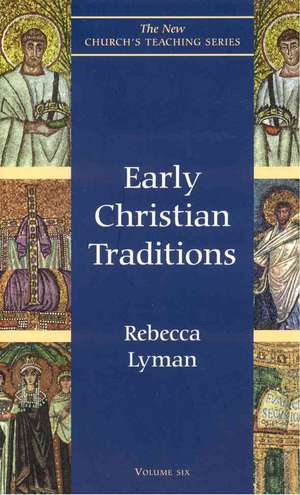
Early Christian Traditions: New Church's Teaching Series, cartea 6
Autor Rebecca Lymanen Limba Engleză Paperback – 25 ian 1999
Early Christian Traditions offers perceptive insights into the early church's intense conflicts that reveal the often thin line between orthodoxy and heresy, between true and false teachers, and among the many competing versions of Christianity. Lyman describes the early church's "family quarrels"-Gnosticism, Donatism, Arianism-as well as the theological, political, and linguistic issues that went into the making of the great creeds and established the apostolic tradition.





Preț: 101.59 lei
Puncte Express: 152
Carte tipărită la comandă
Livrare economică 05-19 decembrie
Livrare prin curier în România Termenul estimat este afișat lângă disponibilitate.
Transport gratuit de la 400.00 lei Plată online sau ramburs, în funcție de opțiunile comenzii.
Retur gratuit în 14 zile Comandă securizată și suport în română.
Specificații
ISBN-13: 9781561011612
ISBN-10: 1561011614
Pagini: 192
Dimensiuni: 140 x 216 x 11 mm
Greutate: 0.28 kg
Editura: COWLEY PUBN
Colecția New Church's Teaching Series
Seria New Church's Teaching Series
Locul publicării:New York, United States
ISBN-10: 1561011614
Pagini: 192
Dimensiuni: 140 x 216 x 11 mm
Greutate: 0.28 kg
Editura: COWLEY PUBN
Colecția New Church's Teaching Series
Seria New Church's Teaching Series
Locul publicării:New York, United States
Cuprins
Chapter 1 Anglican Identity and Christian Traditions
Chapter 2 The World of the Early Church: Romans, Jews, and Christians
Chapter 3 Apostolic Christianity: The Gnostic Controversies
Chapter 4 Christianity and Social Crisis: Persecution, Unity, and Holiness
Chapter 5 Imperial Christianity: The Desert and the City
Chapter 6 Who is Jesus? Early Images of Christ
Chapter 7 Who is God? Trinitarian Orthodoxy from Nicaea to Augustine
Chapter 8 The Church in Late Antiquity: Saints and Sinners in the City of God
Part 9 Resources
Part 10 Questions for Discussion
Chapter 2 The World of the Early Church: Romans, Jews, and Christians
Chapter 3 Apostolic Christianity: The Gnostic Controversies
Chapter 4 Christianity and Social Crisis: Persecution, Unity, and Holiness
Chapter 5 Imperial Christianity: The Desert and the City
Chapter 6 Who is Jesus? Early Images of Christ
Chapter 7 Who is God? Trinitarian Orthodoxy from Nicaea to Augustine
Chapter 8 The Church in Late Antiquity: Saints and Sinners in the City of God
Part 9 Resources
Part 10 Questions for Discussion
Recenzii
As I was into the third (of eight) chapters [of Rebecca Lyman's book] I had this strange (Holy Spirit type) feeling that this would be a wonderful book for anyone who has previously completed year three of EFM and would like to revisit the material from a different perspective.
Like other books in the series, this is a highly accessible volume, clearly and gracefully presented. It's accompanied by useful questions for discussion and pertinent suggestions for further reading. Lyman wears her considerable scholarship comfortably, even invitingly. For the general reader, hers is an engaging introduction to the inescapable paradoxes of faith lived out in action, as experienced by our foremothers and fathers.
This volume provides not only an excellent introduction to the early church but also an answer to the question of why Anglicans at the dawn of the twenty-first century should be interested in the first five Christian centuries. The author avoids the name, date, battle (or, in this case, dogma) approach to history. She sets Christianity in its context in the ancient world and gives us insights to it both as a persecuted sect and an imperial religion.
Lyman quite aptly describes her book as an 'historical appetizer.' As such, it works best as a jumping off point for further discussion and reading in the early history of the Church. Lyman writes, 'Understanding our past is essential to dreaming our future.' In this book she has invited her readers to take a first step in such an understanding that will lead to vital, Spirit-filled dreams.
The era of the early Christians is one that perhaps we don't think of often. . . . Early Christian Traditions presents a readable and valuable introduction to this period of history.
Lyman aims to give her readers an introduction to the people, places and traditions which are common to all Christian denominations. A useful, all-round evaluation of Christian history, this book would be a useful resource for anyone beginning to study the establishment of the church in the first centuries after Christ.
Rebecca Lyman's Early Christian Traditions should be especially useful to those . . . who know that the early Church is important to Anglicanism but not quite why or how. Lyman's book is a thoughtful, accurate and highly readable introduction. It reflects the best recent scholarship by giving attention to matters such as diversity in early Christian thought and practice, the roles of women, and the ongoing interdependence of Christianity and Judaism, as well as to familiar issues of creed, liturgy and order.
This book offers a useful and concise history of the dynamics, issues and activities of the early church.
Like other books in the series, this is a highly accessible volume, clearly and gracefully presented. It's accompanied by useful questions for discussion and pertinent suggestions for further reading. Lyman wears her considerable scholarship comfortably, even invitingly. For the general reader, hers is an engaging introduction to the inescapable paradoxes of faith lived out in action, as experienced by our foremothers and fathers.
This volume provides not only an excellent introduction to the early church but also an answer to the question of why Anglicans at the dawn of the twenty-first century should be interested in the first five Christian centuries. The author avoids the name, date, battle (or, in this case, dogma) approach to history. She sets Christianity in its context in the ancient world and gives us insights to it both as a persecuted sect and an imperial religion.
Lyman quite aptly describes her book as an 'historical appetizer.' As such, it works best as a jumping off point for further discussion and reading in the early history of the Church. Lyman writes, 'Understanding our past is essential to dreaming our future.' In this book she has invited her readers to take a first step in such an understanding that will lead to vital, Spirit-filled dreams.
The era of the early Christians is one that perhaps we don't think of often. . . . Early Christian Traditions presents a readable and valuable introduction to this period of history.
Lyman aims to give her readers an introduction to the people, places and traditions which are common to all Christian denominations. A useful, all-round evaluation of Christian history, this book would be a useful resource for anyone beginning to study the establishment of the church in the first centuries after Christ.
Rebecca Lyman's Early Christian Traditions should be especially useful to those . . . who know that the early Church is important to Anglicanism but not quite why or how. Lyman's book is a thoughtful, accurate and highly readable introduction. It reflects the best recent scholarship by giving attention to matters such as diversity in early Christian thought and practice, the roles of women, and the ongoing interdependence of Christianity and Judaism, as well as to familiar issues of creed, liturgy and order.
This book offers a useful and concise history of the dynamics, issues and activities of the early church.