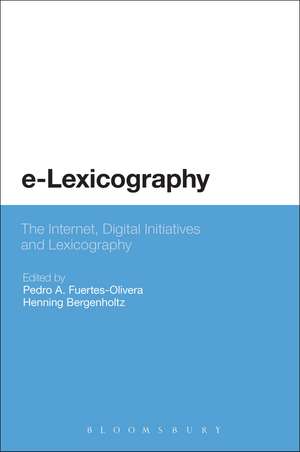
e-Lexicography: The Internet, Digital Initiatives and Lexicography
Editat de Pedro A. Fuertes-Olivera, Professor Henning Bergenholtzen Limba Engleză Paperback – 28 mar 2013
Since COBUILD in the 1980s, lexicographers have found it essential to engage with and utilize electronic computational tools. Internet dictionaries, online reference tools and even search engine optimization demand a knowledge of electronic lexicography and force a reassessment of the field. This volume looks at, amongst other topics:
Polyfunctional versus monofunctional dictionary tools
Developing theories of lexicography for electronic mediums
Distinguishing between the database and the dictionary
Online dictionaries not as data repositories but as sophisticated search engines
This volume will appeal to scholars inlexicography and to practicing lexicographers.
Preț: 289.00 lei
Puncte Express: 434
Carte tipărită la comandă
Livrare economică 07-21 decembrie
Livrare prin curier în România Termenul estimat este afișat lângă disponibilitate.
Transport gratuit de la 400.00 lei Plată online sau ramburs, în funcție de opțiunile comenzii.
Retur gratuit în 14 zile Comandă securizată și suport în română.
Specificații
ISBN-13: 9780567194374
ISBN-10: 056719437X
Pagini: 356
Ilustrații: black & white illustrations
Dimensiuni: 152 x 232 x 22 mm
Greutate: 0.54 kg
Editura: Bloomsbury Publishing
Colecția Bloomsbury Academic
Locul publicării:London, United Kingdom
ISBN-10: 056719437X
Pagini: 356
Ilustrații: black & white illustrations
Dimensiuni: 152 x 232 x 22 mm
Greutate: 0.54 kg
Editura: Bloomsbury Publishing
Colecția Bloomsbury Academic
Locul publicării:London, United Kingdom
V-ar putea interesa
-
 Choose the Right WordS I HayakawaPreț: 166.22 lei
 -
 Canadian Oxford DictionaryKatherine Barber-23%Preț: 487.18 lei632.70 lei
 -
 Lexicography and the OED: Pioneers in the Untrodden ForestLynda Mugglestone-28%Preț: 353.48 lei492.14 lei
 -
 English Dictionaries, 800-1700: The Topical TraditionWerner Hüllen-26%Preț: 380.29 lei514.98 lei
 -
 The Gaelic-English DictionaryColin B.D. Mark-15%Preț: 651.44 lei766.40 lei
 -
 The Complete Rhyming DictionaryClement WoodPreț: 59.64 lei
 -
 The Devil's DictionaryAmbrose BiercePreț: 49.42 lei
 -
 Chambers Dictionary of EtymologyChambers-22%Preț: 283.49 lei364.57 lei
 -
 Dr Johnson's Dictionary: The Book that Defined the WorldHenry Hitchings-26%Preț: 68.56 lei92.83 lei
 -
 Merriam-Webster's Pocket DictionaryMerriam-WebsterPreț: 35.92 lei
 -
 Merriam-Webster's Notebook DictionaryMerriam-WebsterPreț: 41.00 lei
 -
 Preț: 182.05 lei
 -
 -9%Preț: 125.43 lei137.53 lei
 -
 The Merriam-Webster Dictionary of Synonyms and AntonymsMerriam-Webster-13%Preț: 26.34 lei30.33 lei
Cuprins
Preface
Notes on Contributors
Introduction: The Construction of Internet Dictionaries Pedro A. Fuertes-Olivera and Henning Bergenholtz
1. Learning, Unlearning and Innovation in the Planning of Electronic Dictionaries Rufus H. Gouws
2. Access to and Presentation of Needs-Adapted Data in Monofunctional Internet Dictionaries Henning Bergenholtz
3. Lexicographical and Other e-Tools for Consultation Purposes: Towards the Individualization of Needs Satisfaction Sven Tarp
4. Filtering and Adapting Data and Information in the Online Environment in Response to User Needs Theo Bothma
5. A Multi-layer Architecture for "Pluri-Monofunctional" Dictionaries Dennis Spohr
6. Change of Paradigm: From Linguistics to Information Science and from Dictionaries to Lexicographic Information Tools Patrick Leroyer
7. From Data to Dictionary Sandro Nielsen and Richard Almind
8. Internet Dictionaries for Cognitive and Communicative Functions: El Diccionario Inglés-Español de Contabilidad, Pedro A. Fuertes-Olivera and Marta Niño-Amo
9. A Dictionary is a Tool, a Good Dictionary is a Monofunctional Tool Henning Bergenholtz amd Inger Bergenholtz
10. The Technical Realization of Three Monofunctional Phrasal Verb Dictionaries Birger Andersen and Richard Almind
11. Online Dictionaries of English Robert Lew
12. E-Dictionaries in the Information Age: The Lexical Constellation Model (LCM) and the Definitional Construct, Aquilino Sánchez and Pascual Cantos
13. Modelling Interactive Reading, Translation and Writing Assistants Serge Verlinde
14. Electronic Dictionaries as Tools: Towards an Assessment of Usability Ulrich Heid
15. Conclusions: Ten Key Issues in e-Lexicography for the Future, Eva Samaniego Fernández and Beatriz Pérez Cabello de Alba
References
Index
Notes on Contributors
Introduction: The Construction of Internet Dictionaries Pedro A. Fuertes-Olivera and Henning Bergenholtz
1. Learning, Unlearning and Innovation in the Planning of Electronic Dictionaries Rufus H. Gouws
2. Access to and Presentation of Needs-Adapted Data in Monofunctional Internet Dictionaries Henning Bergenholtz
3. Lexicographical and Other e-Tools for Consultation Purposes: Towards the Individualization of Needs Satisfaction Sven Tarp
4. Filtering and Adapting Data and Information in the Online Environment in Response to User Needs Theo Bothma
5. A Multi-layer Architecture for "Pluri-Monofunctional" Dictionaries Dennis Spohr
6. Change of Paradigm: From Linguistics to Information Science and from Dictionaries to Lexicographic Information Tools Patrick Leroyer
7. From Data to Dictionary Sandro Nielsen and Richard Almind
8. Internet Dictionaries for Cognitive and Communicative Functions: El Diccionario Inglés-Español de Contabilidad, Pedro A. Fuertes-Olivera and Marta Niño-Amo
9. A Dictionary is a Tool, a Good Dictionary is a Monofunctional Tool Henning Bergenholtz amd Inger Bergenholtz
10. The Technical Realization of Three Monofunctional Phrasal Verb Dictionaries Birger Andersen and Richard Almind
11. Online Dictionaries of English Robert Lew
12. E-Dictionaries in the Information Age: The Lexical Constellation Model (LCM) and the Definitional Construct, Aquilino Sánchez and Pascual Cantos
13. Modelling Interactive Reading, Translation and Writing Assistants Serge Verlinde
14. Electronic Dictionaries as Tools: Towards an Assessment of Usability Ulrich Heid
15. Conclusions: Ten Key Issues in e-Lexicography for the Future, Eva Samaniego Fernández and Beatriz Pérez Cabello de Alba
References
Index
Recenzii
This is an excellent collection of papers, which not only represents the state of the art of an emerging new field of "e-Lexicography", but also provides excellent examples of how theory and practice should go hand in hand to build a rigorous new research paradigm.
This book makes abundantly clear that the dictionaries as we know them are indeed a thing of the past. Exciting pointers to the future of our discipline are explored by a string of respected scholars, and unlike similar studies, a serious attempt is made at also embedding the (future) discipline into a theoretical framework. For this reason alone, this book must be on every lexicographer's desk.
All individual contributions are self-contained, with separate Notes/ Websites andmany cross-references to other chapters and with bibliographical referencesintegrated into a combined bibliography... and a useful overall subject index... [the book] has left me quite impressed, and I recommend it to you.
This book makes abundantly clear that the dictionaries as we know them are indeed a thing of the past. Exciting pointers to the future of our discipline are explored by a string of respected scholars, and unlike similar studies, a serious attempt is made at also embedding the (future) discipline into a theoretical framework. For this reason alone, this book must be on every lexicographer's desk.
All individual contributions are self-contained, with separate Notes/ Websites andmany cross-references to other chapters and with bibliographical referencesintegrated into a combined bibliography... and a useful overall subject index... [the book] has left me quite impressed, and I recommend it to you.