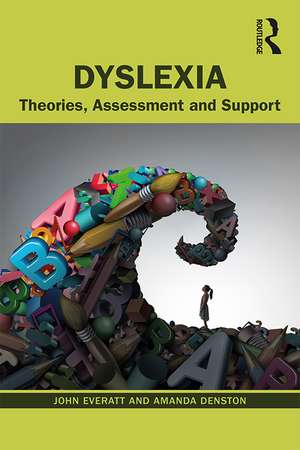
Dyslexia: Theories, Assessment and Support
Autor John Everatt, Amanda Denstonen Limba Engleză Paperback – 11 noi 2019
This book is ideal reading for those taking courses on dyslexia or literacy learning difficulties within education, psychology and related disciplines. It will be of great interest to specialist teachers, special education staff, educational psychologists and those in related occupations.
Preț: 221.63 lei
Puncte Express: 332
Carte indisponibilă temporar
Livrare prin curier în România Termenul estimat este afișat lângă disponibilitate.
Transport gratuit de la 400.00 lei Plată online sau ramburs, în funcție de opțiunile comenzii.
Retur gratuit în 14 zile Comandă securizată și suport în română.
Specificații
ISBN-13: 9781138636262
ISBN-10: 1138636266
Pagini: 218
Ilustrații: 16
Dimensiuni: 129 x 198 x 10 mm
Greutate: 0.24 kg
Ediția:1
Editura: Taylor & Francis
Colecția Routledge
Locul publicării:Oxford, United Kingdom
ISBN-10: 1138636266
Pagini: 218
Ilustrații: 16
Dimensiuni: 129 x 198 x 10 mm
Greutate: 0.24 kg
Ediția:1
Editura: Taylor & Francis
Colecția Routledge
Locul publicării:Oxford, United Kingdom
V-ar putea interesa
-
 Neuroepidemiology in Tropical HealthPierre-Marie Preux-23%Preț: 533.65 lei697.52 lei
 -
 The Complex Connection between Cannabis and SchizophreniaMichael T. Compton-25%Preț: 409.42 lei543.09 lei
 -
 Noradrenergic Signaling and AstrogliaNina Vardjan-24%Preț: 524.00 lei691.31 lei
 -
 -29%Preț: 416.23 lei589.34 lei
 -
 Neuroscience Basics: A Guide to the Brain's Involvement in Everyday ActivitiesJennifer L. Larimore-25%Preț: 276.65 lei370.61 lei
 -
 -22%Preț: 534.12 lei686.96 lei
 -
 -35%Preț: 868.02 lei1341.99 lei
 -
 Nonmotor Parkinson's: The Hidden Face: The Many Hidden FacesK. Ray Chaudhuri-18%Preț: 1046.15 lei1277.84 lei
 -
 -5%Preț: 64.97 lei68.39 lei
 -
 Advancing Artificial Intelligence through Biological Process ApplicationsAna B. Porto Pazos-5%Preț: 1483.69 lei1561.78 lei
 -
 Neuroanatomy Research AdvancesCian E Flynn-23%Preț: 1528.13 lei1997.22 lei
 -
 -5%Preț: 1194.04 lei1256.89 lei
 -
 -5%Preț: 1585.82 lei1669.28 lei
 -
 Handbook of Neuropsychiatry ResearchRebecca S Davies-23%Preț: 562.17 lei729.76 lei
 -
 Hallucinations: Types, Stages & TreatmentsMeredith S Payne-23%Preț: 1450.66 lei1873.78 lei
 -
 -23%Preț: 561.28 lei729.19 lei
 -
 Jefferson Headache ManualWilliam B. Young-5%Preț: 477.36 lei502.47 lei
 -
 Förderung von Menschen im Wachkoma der Phase FDorothea J. Thimm-5%Preț: 396.56 lei417.43 lei
 -
 Das Restless-Legs-Syndrom: Ein Überblick für Ärzte aller FachrichtungenVeronika Schneider-5%Preț: 111.52 lei117.39 lei
Public țintă
General and UndergraduateCuprins
PART 1: Introduction to the skills of reading and writing
Background to the book
The skill of reading and writing
Reading and writing development
Reading processes or skills
Overview of the rest of the book
PART 2: A background and framework to understand dyslexia
Introduction
Reading/learning disability and dyslexia
A brief history of dyslexia
Dyslexia and intelligence
Perspectives and definitions
A framework for dyslexia
PART 3: Theories of dyslexia
Introduction
Phonological processing and dyslexia
Differences in dyslexia across languages and orthographies
Accuracy versus speed and double deficit perspectives
Perceptual factors and visual processing deficit accounts
Motor and cerebellum deficit viewpoints
Morphology and meaning
Conclusions
PART 4: Identifying dyslexia
Introduction
Types of assessment methods
Assessment procedures and evaluation
Comparisons of the performance of dyslexic against norms
Differentiating dyslexia from other learning difficulties
Dyslexia across orthographies, languages and educational contexts
PART 5: Intervention
Introduction
A classification of intervention perspectives
General learning viewpoints
Literacy teaching methods
Phonological awareness training
Response to intervention
Assessment–intervention profiling
Multisensory learning
Working memory or meta-cognitive methods
Visual-and motor-related interventions
Conclusion
PART 6: Self-concept and dyslexia
Introduction
Defining self-esteem
A multi-dimensional model of self-esteem
Academic self-concept and education
Self-efficacy
Self-efficacy and education
Academic self-efficacy and beyond in education
Resilience
Resilience and education
Overall
Concluding views on improving literacy and self-concept
Background to the book
The skill of reading and writing
Reading and writing development
Reading processes or skills
Overview of the rest of the book
PART 2: A background and framework to understand dyslexia
Introduction
Reading/learning disability and dyslexia
A brief history of dyslexia
Dyslexia and intelligence
Perspectives and definitions
A framework for dyslexia
PART 3: Theories of dyslexia
Introduction
Phonological processing and dyslexia
Differences in dyslexia across languages and orthographies
Accuracy versus speed and double deficit perspectives
Perceptual factors and visual processing deficit accounts
Motor and cerebellum deficit viewpoints
Morphology and meaning
Conclusions
PART 4: Identifying dyslexia
Introduction
Types of assessment methods
Assessment procedures and evaluation
Comparisons of the performance of dyslexic against norms
Differentiating dyslexia from other learning difficulties
Dyslexia across orthographies, languages and educational contexts
PART 5: Intervention
Introduction
A classification of intervention perspectives
General learning viewpoints
Literacy teaching methods
Phonological awareness training
Response to intervention
Assessment–intervention profiling
Multisensory learning
Working memory or meta-cognitive methods
Visual-and motor-related interventions
Conclusion
PART 6: Self-concept and dyslexia
Introduction
Defining self-esteem
A multi-dimensional model of self-esteem
Academic self-concept and education
Self-efficacy
Self-efficacy and education
Academic self-efficacy and beyond in education
Resilience
Resilience and education
Overall
Concluding views on improving literacy and self-concept
Recenzii
'Everatt and Denston have successfully defused the dyslexia controversy with this authoritative and comprehensive book. Insightful and informative – full of evidence based approaches providing detailed accounts of reading and writing processes, a clear account of the theories of dyslexia and approaches for identification and intervention. I found the component on self-efficacy particularly illuminating. Not enough has been written about this crucial area. This book benefits from the authors' lengthy experiences, their academic insights and their sound awareness of best practice in this field. This is a must buy for all involved in this area and will surely become one of the seminal texts in this field.' Gavin Reid, Chair of British Dyslexia Association Accreditation Board, Former Senior Lecturer, University of Edinburgh, Scotland, UK.
'Many texts on dyslexia provide in-depth information on a few select research topics, or go to the other extreme, providing a superficial overview of topics that requires more explication. Dyslexia: Theories, Assessment and Support provides a welcome contrast. Everatt and Denston have provided an accessibly written, yet comprehensive and well-considered overview of classic as well as current research related to dyslexia and related reading difficulties. They explore standard cognitive and linguistic processes influencing word recognition and comprehension and are careful to include critical contextual factors such as teaching practices, experience, interest and self-concept. This book will provide a welcome resource to university students in reading courses, teachers, as well as researchers who are looking for a comprehensive update.' Charles W. Haynes, EdD, CCC-SLP, Department of Communication Sciences and Disorders, MGH Institute of Health Professions, USA.
'This book provides an accessible and non-technical introduction to the controversial field of dyslexia. It presents a brief account of historical and contemporary theoretical viewpoints, presenting the pros and cons of each. While avoiding polemics, the authors favour the widely-held theory that a phonological deficit lies at the root of dyslexic difficulties. A particularly valuable section of the book is the discussion of different types of interventions that have been used with dyslexic readers, relating each class of intervention to background theory. The book is aimed at the general reader and master’s level students but will prove useful to teachers, parents and other specialists working with dyslexic students and adults.' - Ute Beaton, MA, PCGE, ADG, Specialist Support Lecturer, University of Wales Trinity Saint David, UK.
'Many texts on dyslexia provide in-depth information on a few select research topics, or go to the other extreme, providing a superficial overview of topics that requires more explication. Dyslexia: Theories, Assessment and Support provides a welcome contrast. Everatt and Denston have provided an accessibly written, yet comprehensive and well-considered overview of classic as well as current research related to dyslexia and related reading difficulties. They explore standard cognitive and linguistic processes influencing word recognition and comprehension and are careful to include critical contextual factors such as teaching practices, experience, interest and self-concept. This book will provide a welcome resource to university students in reading courses, teachers, as well as researchers who are looking for a comprehensive update.' Charles W. Haynes, EdD, CCC-SLP, Department of Communication Sciences and Disorders, MGH Institute of Health Professions, USA.
'This book provides an accessible and non-technical introduction to the controversial field of dyslexia. It presents a brief account of historical and contemporary theoretical viewpoints, presenting the pros and cons of each. While avoiding polemics, the authors favour the widely-held theory that a phonological deficit lies at the root of dyslexic difficulties. A particularly valuable section of the book is the discussion of different types of interventions that have been used with dyslexic readers, relating each class of intervention to background theory. The book is aimed at the general reader and master’s level students but will prove useful to teachers, parents and other specialists working with dyslexic students and adults.' - Ute Beaton, MA, PCGE, ADG, Specialist Support Lecturer, University of Wales Trinity Saint David, UK.
Notă biografică
John Everatt is a Professor of Education at the University of Canterbury, New Zealand.
Amanda Denston is a post-doctoral researcher in Education at the University of Canterbury, New Zealand.
Amanda Denston is a post-doctoral researcher in Education at the University of Canterbury, New Zealand.
Descriere
Dyslexia: Psychological Theories, Assessment and Support provides an accessible introduction to contemporary dyslexia research.