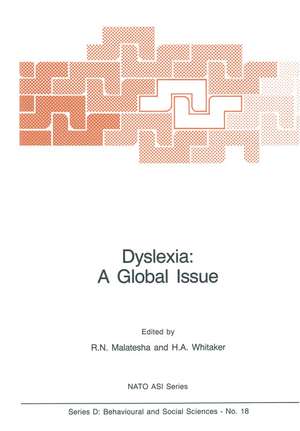
Dyslexia: A Global Issue: NATO Science Series D:, cartea 18
Editat de Rattihalli N. Malatesha, Harry Whitakeren Limba Engleză Paperback – 3 noi 2011
Din seria NATO Science Series D:
-
 Preț: 389.87 lei
 -
 Preț: 383.59 lei
 - 18%
 Preț: 982.89 lei
 -
 Preț: 375.07 lei
 - 18%
 Preț: 1176.72 lei
 -
 Preț: 403.19 lei
 - 18%
 Preț: 1265.21 lei
 - 18%
 Preț: 1172.30 lei
 - 5%
 Preț: 359.75 lei
 -
 Preț: 397.25 lei
 - 18%
 Preț: 1262.27 lei
 - 15%
 Preț: 465.49 lei
 -
 Preț: 397.25 lei
 - 18%
 Preț: 1264.90 lei
 - 5%
 Preț: 2191.63 lei
 - 5%
 Preț: 2034.23 lei
 - 15%
 Preț: 656.84 lei
 - 18%
 Preț: 1891.22 lei
 -
 Preț: 385.99 lei
 -
 Preț: 396.60 lei
 - 18%
 Preț: 1277.10 lei
 - 18%
 Preț: 1884.15 lei
 - 18%
 Preț: 1888.18 lei
 - 18%
 Preț: 1752.82 lei
 -
 Preț: 390.96 lei
 - 18%
 Preț: 982.26 lei
 - 18%
 Preț: 1893.74 lei
 - 18%
 Preț: 1757.66 lei
 - 18%
 Preț: 1265.94 lei
 - 18%
 Preț: 1263.10 lei
 -
 Preț: 387.03 lei
 - 18%
 Preț: 1889.82 lei
 - 18%
 Preț: 1754.36 lei
 -
 Preț: 381.19 lei
 - 18%
 Preț: 1713.27 lei
 - 18%
 Preț: 1590.55 lei
 - 18%
 Preț: 1261.20 lei
 - 18%
 Preț: 1169.73 lei
 - 5%
 Preț: 380.40 lei
 - 18%
 Preț: 1269.42 lei
 - 15%
 Preț: 623.39 lei
 - 18%
 Preț: 1888.18 lei
Preț: 394.67 lei
Preț vechi: 415.44 lei
-5%
Puncte Express: 592
Carte tipărită la comandă
Livrare economică 04-18 decembrie
Livrare prin curier în România Termenul estimat este afișat lângă disponibilitate.
Transport gratuit de la 400.00 lei Plată online sau ramburs, în funcție de opțiunile comenzii.
Retur gratuit în 14 zile Comandă securizată și suport în română.
Specificații
ISBN-13: 9789400969315
ISBN-10: 9400969317
Pagini: 604
Ilustrații: 599 p.
Dimensiuni: 170 x 244 x 33 mm
Greutate: 1.03 kg
Ediția:1984
Editura: Springer
Colecția NATO Science Series D:
Seria NATO Science Series D:
Locul publicării:Dordrecht, Netherlands
ISBN-10: 9400969317
Pagini: 604
Ilustrații: 599 p.
Dimensiuni: 170 x 244 x 33 mm
Greutate: 1.03 kg
Ediția:1984
Editura: Springer
Colecția NATO Science Series D:
Seria NATO Science Series D:
Locul publicării:Dordrecht, Netherlands
V-ar putea interesa
-
 -24%Preț: 379.91 lei502.25 lei
 -
 Primer on the Autonomic Nervous SystemPhillip A. Low-20%Preț: 563.44 lei700.94 lei
 -
 -22%Preț: 1045.85 lei1347.80 lei
 -
 The Neurology of AIDSHoward E. Gendelman-26%Preț: 3062.40 lei4145.96 lei
 -
 Muscle DiseaseGoebel-5%Preț: 2013.77 lei2119.76 lei
 -
 Swaiman's Pediatric Neurology: Principles and Practice, 2-Volume SetKenneth F. Swaiman-23%Preț: 1880.91 lei2430.99 lei
 -
 Reducing Your Risk of DementiaTom SmithPreț: 81.41 lei
 -
 -20%Preț: 173.07 lei217.07 lei
 -
 The Partner's Guide to Asperger SyndromeDr Anthony AttwoodPreț: 125.09 lei
 -
 Vestibular Migraine and Related SyndromesBruno Colombo-5%Preț: 691.26 lei727.65 lei
 -
 The Median NerveGiuliano Gentili-5%Preț: 1155.51 lei1216.33 lei
 -
 Muscular DystrophyRaymond A. Huml-5%Preț: 379.48 lei399.44 lei
 -
 Long-Term Outcomes of Epilepsy Surgery in Adults and ChildrenKristina Malmgren-5%Preț: 741.92 lei780.97 lei
 -
 Management of Post-Stroke ComplicationsAjay Bhalla-5%Preț: 754.74 lei794.47 lei
 -
 Syringomyelia: A Disorder of CSF CirculationGraham Flint-5%Preț: 1120.09 lei1179.04 lei
 -
 Störungen der GedächtnisfunktionThorsten Bartsch-5%Preț: 114.01 lei120.01 lei
 -
 Clinical Systems NeuroscienceKenji Kansaku-5%Preț: 748.27 lei787.66 lei
Public țintă
ResearchCuprins
One.- 1. The three phases of developmental dyslexia.- 2. Toward a rational taxonomy of the developmental dyslexias.- 3. Classification issues in subtype research: An application of some methods and concepts.- 4. Specific spelling problems.- 5. Neuropsychological perspectives on reading and developmental reading disability.- 6. In search of the core of dyslexia: Analysis of the reading process of dyslectic children.- 7. Developmental surface dyslexia in Italian.- 8. Developmental analogues to acquired phonological dyslexia.- 9. Letter naming as a spelling strategy.- 10. Temporal order perception and lateralization in dyslexic children.- 11. Eye movements in developmental dyslexia.- 12. Visual half-field studies of developmental reading disability.- Two.- 13. Alexia in relation to aphasia and agnosia.- 14. Toward a rational taxonony of acquired dyslexias.- 15. Word-recognition and word-production: data from pathology.- 16. Comments on pathological reading behavior due to lesions of the left hemisphere.- 17. Consistency and types of semantic errors in a deep dyslexic patient.- 18. Phonological dyslexia: A review.- 19. Acquired dyslexias and normal reading.- Three.- 20. Neuropsychological assessment of children and adults with developmental dyslexia.- 21. A diagnostic screening test for subtypes of dyslexia: The Boder test of reading-spelling patterns.- 22. Dyslexia: A diagnostic profile for a “special educational need”.- 23. An experimental study of multi-sensory teaching with normal and retarded readers.- 24. Instructing learning disabled children to make continued and general use of a strategy for memorizing information Margaret Jo Shepherd and Lynn.- 25. Dyslexia Diagnosis and treatment from the perspective of a reading specialist.- Four.- 26. Dyslexia inbilinguals.- 27. Hemispheric specialization and dual coding of alphabet.- 28. The importance of grapheme-to-phoneme conversion rules in beginning readers.- 29. Hyperlexia: Developmental reading without meaning.- 30. Interhemispheric integration of conflicting information by a split-brain man.- 31. The use of adult acquired neuropsychological syndromes as models of childhood developmental disorders.- 32. On the use of word and context based information sources evaluated by oral reading error analysis.- 33. Differences in levels of processing related to age.- 34. Information value of print size on reading performance.