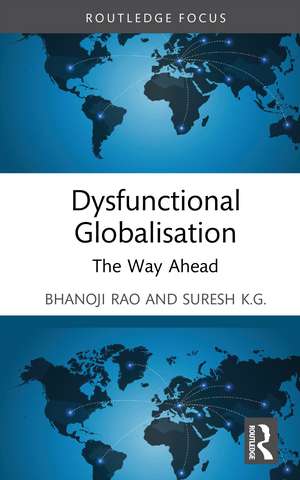
Dysfunctional Globalisation: The Way Ahead: Routledge Studies in the Modern World Economy
Autor Bhanoji Rao, Suresh K.G.en Limba Engleză Hardback – 14 oct 2026
The authors present a critical review of the latest literature of globalization, its evolution after the second world war, and the UN System’s emphasis on global unity, peace, and progress. They examine trade data of seven major countries, which together account for a little over half of the world’s population, to discuss the benefits of globalization. They then cover current challenges to globalization, including the gradual uncoupling of China and the USA. The book reflects on the role of intellectuals and multinational institutions in steering globalization and envisions a path towards greater peace.
Offering current research and insights into globalization and trade, this book will be of interest to students and experts interested in public policy and international economics.
Din seria Routledge Studies in the Modern World Economy
- 9%
 Preț: 1328.79 lei
 - 18%
 Preț: 1370.66 lei
 -
 Preț: 471.36 lei
 - 18%
 Preț: 753.60 lei
 - 18%
 Preț: 1256.21 lei
 - 15%
 Preț: 437.03 lei
 - 18%
 Preț: 1310.47 lei
 -
 Preț: 355.34 lei
 -
 Preț: 433.12 lei
 - 18%
 Preț: 1249.23 lei
 - 18%
 Preț: 1359.51 lei
 - 18%
 Preț: 777.33 lei
 - 18%
 Preț: 1357.75 lei
 - 18%
 Preț: 773.14 lei
 - 18%
 Preț: 714.60 lei
 -
 Preț: 453.10 lei
 - 18%
 Preț: 1306.77 lei
 - 18%
 Preț: 1306.61 lei
 - 18%
 Preț: 1307.32 lei
 - 18%
 Preț: 1264.59 lei
 - 18%
 Preț: 1258.30 lei
 - 18%
 Preț: 1257.26 lei
 - 18%
 Preț: 1250.28 lei
 -
 Preț: 472.22 lei
 - 18%
 Preț: 1298.38 lei
 - 15%
 Preț: 432.69 lei
 - 18%
 Preț: 1252.16 lei
 - 15%
 Preț: 431.25 lei
 - 18%
 Preț: 795.19 lei
 - 18%
 Preț: 682.59 lei
 - 18%
 Preț: 1257.26 lei
 - 18%
 Preț: 1256.11 lei
 - 18%
 Preț: 1266.67 lei
 - 18%
 Preț: 1058.11 lei
 - 18%
 Preț: 1251.34 lei
 - 18%
 Preț: 1265.62 lei
 - 18%
 Preț: 1251.34 lei
 - 18%
 Preț: 1263.54 lei
 - 18%
 Preț: 1312.32 lei
 - 18%
 Preț: 1254.12 lei
 - 18%
 Preț: 1418.98 lei
 - 18%
 Preț: 1317.09 lei
 -
 Preț: 459.75 lei
 - 15%
 Preț: 430.16 lei
 - 18%
 Preț: 1264.59 lei
 - 18%
 Preț: 1026.88 lei
Preț: 466.48 lei
Preț vechi: 592.75 lei
-21% Nou
Puncte Express: 700
Carte disponibilă
Livrare economică 28 octombrie-11 noiembrie
Livrare prin curier în România Termenul estimat este afișat lângă disponibilitate.
Transport gratuit pentru acest produs Plată online sau ramburs, în funcție de opțiunile comenzii.
Retur gratuit în 14 zile Comandă securizată și suport în română.
Specificații
ISBN-13: 9781041149781
ISBN-10: 1041149786
Pagini: 126
Dimensiuni: 138 x 216 mm
Greutate: 0.39 kg
Ediția:1
Editura: Taylor & Francis
Colecția Routledge
Seria Routledge Studies in the Modern World Economy
Locul publicării:Oxford, United Kingdom
ISBN-10: 1041149786
Pagini: 126
Dimensiuni: 138 x 216 mm
Greutate: 0.39 kg
Ediția:1
Editura: Taylor & Francis
Colecția Routledge
Seria Routledge Studies in the Modern World Economy
Locul publicării:Oxford, United Kingdom
Public țintă
Academic and PostgraduateRecenzii
“In this wide-ranging and deeply reflective book, Bhanoji Rao and Suresh K G confront the structural flaws of modern globalization. While globalization has expanded trade and capital flows, the authors expose the paradox of a hyper-connected world marked by persistent wars and systemic fragility. As the United Nations marks its 80th anniversary, the book offers a timely assessment of our multinational institutions, from Security Council gridlock to the limits of global financial governance. Unsentimental in diagnosis yet hopeful, the authors move beyond critique to propose a path toward a more integrated and peaceful world. Essential reading for economists, political scientists, policymakers, and indeed anyone grappling with the governance challenges of our time.”
-Sock-Yong Phang, Celia Moh Chair Professor of Economics, Vice Provost (Faculty Matters), Singapore Management University
“Seasoned researchers, Bhanoji and Suresh have not rehearsed familiar arguments about globalization in this book. Instead, they have traced how today’s system of global governance has evolved and why many of its promises have fallen short. Drawing on historical episodes, conflict cases, and trade patterns, they have shown where international institutions have stalled and why the post‑war vision of shared prosperity has proved so difficult to realize. Crucially, the book insists that globalization is not simply an economic process but a set of political and moral choices too. The authors are careful not to treat global dysfunction as an abstract problem. They point out how the functioning of international institutions, such as the UN, acts as constraints to make existing institutions more responsive and credible. Instead of just complaining about the state of world affairs, the authors have outlined reforms that could make existing institutions towards boosting accountability and trust. They also argue that scholars and public intellectuals need to work together in restoring a sense of responsibility and ethical purpose to global politics. In the current era of geopolitical rivalry and strained multilateral cooperation, their analysis offers a realistic roadmap for achieving sustained international cooperation to establish flawless world order.”
- Emeritus Professor Kaliappa Kalirajan, Arndt-Corden Department of Economics, Crawford School of Public Policy, The Australian National University, Canberra, Australia; Visiting Professor, Madras School of Economics, Chennai, India.; and VKRV Chair Professor, Institute for Social and Economic Change, Bengaluru, India.
“The history of globalization is ongoing, marked by both perennial and unprecedented challenges. A timely and thought-provoking work, this book offers a compelling vision of global unity, peace, and progress. By examining the vital role of intellectual leadership, the authors invite readers to imagine a more cooperative and equitable world through principles and practice. It is a valuable and insightful contribution to contemporary debates on global governance and humanity's shared future.”
-Dr. Eva-Maria Nag, Senior Executive Editor, Global Policy, Durham University
-Sock-Yong Phang, Celia Moh Chair Professor of Economics, Vice Provost (Faculty Matters), Singapore Management University
“Seasoned researchers, Bhanoji and Suresh have not rehearsed familiar arguments about globalization in this book. Instead, they have traced how today’s system of global governance has evolved and why many of its promises have fallen short. Drawing on historical episodes, conflict cases, and trade patterns, they have shown where international institutions have stalled and why the post‑war vision of shared prosperity has proved so difficult to realize. Crucially, the book insists that globalization is not simply an economic process but a set of political and moral choices too. The authors are careful not to treat global dysfunction as an abstract problem. They point out how the functioning of international institutions, such as the UN, acts as constraints to make existing institutions more responsive and credible. Instead of just complaining about the state of world affairs, the authors have outlined reforms that could make existing institutions towards boosting accountability and trust. They also argue that scholars and public intellectuals need to work together in restoring a sense of responsibility and ethical purpose to global politics. In the current era of geopolitical rivalry and strained multilateral cooperation, their analysis offers a realistic roadmap for achieving sustained international cooperation to establish flawless world order.”
- Emeritus Professor Kaliappa Kalirajan, Arndt-Corden Department of Economics, Crawford School of Public Policy, The Australian National University, Canberra, Australia; Visiting Professor, Madras School of Economics, Chennai, India.; and VKRV Chair Professor, Institute for Social and Economic Change, Bengaluru, India.
“The history of globalization is ongoing, marked by both perennial and unprecedented challenges. A timely and thought-provoking work, this book offers a compelling vision of global unity, peace, and progress. By examining the vital role of intellectual leadership, the authors invite readers to imagine a more cooperative and equitable world through principles and practice. It is a valuable and insightful contribution to contemporary debates on global governance and humanity's shared future.”
-Dr. Eva-Maria Nag, Senior Executive Editor, Global Policy, Durham University
Cuprins
1. Introduction 2. Globalization: Starting and Evolution 3. Present Challenges 4. Peace sans Unity? 5. Redefining Progress and Restructuring MNIs 6. Role of Intellectuals 7. The Way Forward. End Note
Notă biografică
Bhanoji Rao is presently a Governing Board Member of GITAM and IFHE, India. He was a faculty member at the University of Singapore (1967–1978), the National University of Singapore (1985–2001), and the LKY School of Public Policy (2009–2011). He served as a World Bank Economist during 1979–1985. He has authored and edited several books and monographs, as well as several journal articles.
Suresh K.G. is a faculty member in the area of Economics at the Indian Institute of Management (IIM), Bodh Gaya, India. With a Ph.D. in Economics, his research spans international trade, macroeconomic policy, and sustainability. His current work focuses on firm internationalization, environmental sustainability, and energy efficiency in exporting firms. He has co-authored two books: Public Policy (Pearson Education, 2024) and Inequality and Public Policy: Towards Visible Equality and Equal Opportunity (Routledge, UK, 2023).
Suresh K.G. is a faculty member in the area of Economics at the Indian Institute of Management (IIM), Bodh Gaya, India. With a Ph.D. in Economics, his research spans international trade, macroeconomic policy, and sustainability. His current work focuses on firm internationalization, environmental sustainability, and energy efficiency in exporting firms. He has co-authored two books: Public Policy (Pearson Education, 2024) and Inequality and Public Policy: Towards Visible Equality and Equal Opportunity (Routledge, UK, 2023).
Descriere
This book’s concern is with globalization, its evolution and its growing dysfunctionality across the political, economic, and social dimensions.