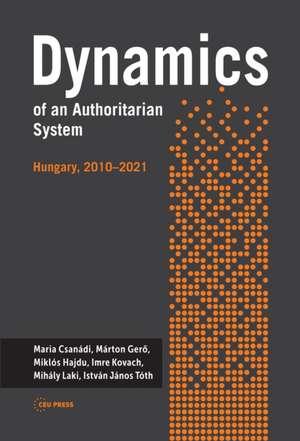
Dynamics of an Authoritarian System: Hungary, 2010-2021
Autor Mária Csanádi, Imre Kovách, Márton Gero, Miklós Hajduen Limba Engleză Hardback – 10 aug 2022
The authors reveal how a democratic setting can be used as a device for political capture. They show how a political entity managed to penetrate almost all sub-fields of the economy to arrive at institutionalized corruption, and how the centralized power structure reproduces itself. With the help of a powerful empirical apparatus—among others analyses of more than 220,000 public tenders, redistributions of state subsidies, and the interconnectedness of those privileged with the political elite — the authors detail the functioning of a crony system and the network aspects of political connections in the rapid enrichment of politically-linked businesses. Their studies demonstrate the role of political capture in this redistribution and how this capture leads to a new social stratification.
Preț: 676.15 lei
Preț vechi: 743.01 lei
-9%
Puncte Express: 1014
Carte disponibilă
Livrare economică 16-30 noiembrie
Livrare express 30 octombrie-05 noiembrie pentru 49.17 lei
Livrare prin curier în România Termenul estimat este afișat lângă disponibilitate.
Transport gratuit pentru acest produs Plată online sau ramburs, în funcție de opțiunile comenzii.
Retur gratuit în 14 zile Comandă securizată și suport în română.
Specificații
ISBN-13: 9789633865774
ISBN-10: 9633865778
Pagini: 376
Ilustrații: 21 Tables, black and white; 31 Figures
Dimensiuni: 152 x 229 x 25 mm
Greutate: 0.86 kg
Ediția:1
Editura: Amsterdam University Press
Colecția Central European University Press
Locul publicării:Oxford, United Kingdom
ISBN-10: 9633865778
Pagini: 376
Ilustrații: 21 Tables, black and white; 31 Figures
Dimensiuni: 152 x 229 x 25 mm
Greutate: 0.86 kg
Ediția:1
Editura: Amsterdam University Press
Colecția Central European University Press
Locul publicării:Oxford, United Kingdom
Public țintă
AcademicNotă biografică
Maria Csanádi is DSc in political science, scientific advisor, emerita at Institute of Economics of the Centre for Economic and Regional Studies in Hungary.
Imre Kovách is DSc in sociology, Scientific advisor, Institute of Sociology CSS, professor, University of Debrecen, head of Sociology PhD program.
Márton Gero is Assistant professor of sociology at the Eötvös Loránd University, Faculty of Social Sciences and a research fellow at the Centre for Social Sciences.
Miklós Hajdu is MSc in survey statistics, assistant lecturer at the Corvinus University of Budapest.
István János Tóth is a senior research fellow at the Institute of Economics of Centre for Economic and Regional Studies at the Hungarian Academy of Sciences and managing director of Corruption Research Center Budapest (CRCB).
Imre Kovách is DSc in sociology, Scientific advisor, Institute of Sociology CSS, professor, University of Debrecen, head of Sociology PhD program.
Márton Gero is Assistant professor of sociology at the Eötvös Loránd University, Faculty of Social Sciences and a research fellow at the Centre for Social Sciences.
Miklós Hajdu is MSc in survey statistics, assistant lecturer at the Corvinus University of Budapest.
István János Tóth is a senior research fellow at the Institute of Economics of Centre for Economic and Regional Studies at the Hungarian Academy of Sciences and managing director of Corruption Research Center Budapest (CRCB).
Cuprins
List of Figures, List of Tables, Preface, Introduction, PART I Metamorphosis of a Party into a System, PART II Reproduction Through Redistribution, Summary, List of Authors, Bibliography, Subject Index, Name Index
Descriere
Demonstrates how Viktor Orbán and his Fidesz party transformed Hungary from a democratic setting into a centralized authoritarian system in less than ten years, using their 2010 constitutional majority (two-thirds of parliamentary seats) to evolve and stabilize a system that reproduced similar majorities in 2014 and 2018