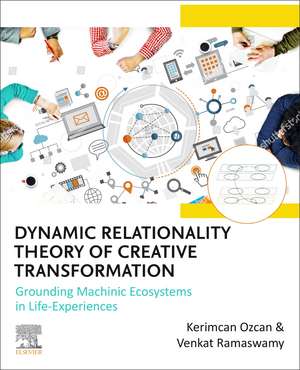
Dynamic Relationality Theory of Creative Transformation: Grounding Machinic Ecosystems in Life Experiences
Autor Kerimcan Ozcan, Venkat Ramaswamyen Limba Engleză Paperback – 15 noi 2024
Through an interdisciplinary approach combining philosophical insights and social theories with practical applications, this book navigates the complexities of digitalized life ecosystems, employing concepts and tools from assemblage theory, category theory, sheaf theory, differential topology, and gauge theory. For readers grappling with the complexities of AI and its societal implications, this book offers clarity and direction. It provides a robust theoretical framework to understand the changing landscape of human–technology interaction. Furthermore, it integrates philosophical insights and ethical considerations into the discussion of AI and technology, providing a well-rounded perspective that aids in ethical decision-making and responsible innovation. It also delves into practical applications and future implications of AI, aiding readers in applying these concepts in real-world scenarios.
By moving beyond a purely technological focus, this book equips readers with the insights needed to navigate the ethical, philosophical, and practical challenges posed by the integration of AI into daily life. A crucial resource for academics, professionals, and policymakers, this book serves as a guide to making informed decisions and fostering responsible innovation in the age of AI.
- Provides a novel and holistic approach—comprehensive framework of Dynamic Relationality Theory (DRT)—to understanding the interplay between AI and human experiences, helping readers grasp the complexities of this coevolution
- Uses an interdisciplinary approach which integrates philosophical, sociological, and technological perspectives, offering a multifaceted view that is crucial for a deep understanding of the subject
- Focuses on ethical and societal implications, guiding readers through the moral complexities of technology integration
Preț: 622.64 lei
Preț vechi: 848.13 lei
-27%
Puncte Express: 934
Carte tipărită la comandă
Livrare economică 08-22 iunie
Specificații
ISBN-13: 9780443301599
ISBN-10: 044330159X
Pagini: 260
Dimensiuni: 152 x 229 mm
Greutate: 0.78 kg
Editura: ELSEVIER SCIENCE
ISBN-10: 044330159X
Pagini: 260
Dimensiuni: 152 x 229 mm
Greutate: 0.78 kg
Editura: ELSEVIER SCIENCE
Cuprins
Part 1: Relational Dynamics
1. Theorizing Relational Dynamics of Creative Transformation
2. Grounding Machinic Ecosystems in Life-Experiences
Part 2: Dynamic Relationality Theory
3. Dynamic Relationalities in an Assemblage
4. Dynamic Relationalities on Strata
5. Dynamic Relationalities Across (Stacked) Strata
6. Dynamic Relationalities of Relational Dynamics
Part 3: Organizations and Creative Transformation
7. Creative Transformation Along a Molar /Molecular Stack
8. Diagrammatic Logic of Organizations in Ecosystems
9. Organizational Morphology and Development
10. Architectural Transformation in an Ecosystem
Part 4: Complex Transformative Emergence and Evolution
11. Emergent Transformation in a Machinic Life-Experience Ecosystem
12. Evolutionary Transformation in a Machinic Life-Experience Ecosystem
1. Theorizing Relational Dynamics of Creative Transformation
2. Grounding Machinic Ecosystems in Life-Experiences
Part 2: Dynamic Relationality Theory
3. Dynamic Relationalities in an Assemblage
4. Dynamic Relationalities on Strata
5. Dynamic Relationalities Across (Stacked) Strata
6. Dynamic Relationalities of Relational Dynamics
Part 3: Organizations and Creative Transformation
7. Creative Transformation Along a Molar /Molecular Stack
8. Diagrammatic Logic of Organizations in Ecosystems
9. Organizational Morphology and Development
10. Architectural Transformation in an Ecosystem
Part 4: Complex Transformative Emergence and Evolution
11. Emergent Transformation in a Machinic Life-Experience Ecosystem
12. Evolutionary Transformation in a Machinic Life-Experience Ecosystem
Recenzii
“…a much-needed theoretical framework which models how organizations can be transformed through co-intelligence. The depth and rigor of the book makes it an essential reading for scholars. However, the very interesting practical examples will also help managers to navigate the complexities of the co-intelligent business landscape.” Testimonial by Oriol Iglesias, Professor of Marketing, ESADE – Universitat Ramon Llull (Spain), 2025
“…a sophisticated and timely theorisation of evolutionary change within machinic life-experience ecosystems. … illuminate[s] the entangled dynamics of human-machinic relationality across diverse matrices. Particularly compelling is the book’s applicability to patient care, where complex, adaptive interactions among technology, clinicians, and lived experience increasingly shape therapeutic pathways. … this work offers a vital contribution to posthuman thought, systems theory, and creative transformation across technological, organisational, and existential domains.” Testimonial by Cristian Ortiz-Villalón, MD PhD PhD MBA, Karolinska Institute (Sweden), 2025
“Moving from an ontology grounded in fixed essences to one attuned to relations and processes is the defining feature of all contemporary social and political theory. Yet this move continues to bedevil scholars concerned to map new empirical coordinates for the social sciences. Offers a welcome breakthrough by presenting a systematic guide for empirical inquiry equal to the grand challenges of the age. … [It] sets out a new empiricism for the assemblage, presenting critical new tools for thinking about the transformations of work, life and culture.” Testimonial by Cameron Duff, Professor of Politics and Organisation, Centre for Organisations and Social Change, RMIT University (Australia), 2025
“…offers an emergent theory of Dynamic Relationality. It pulls both from the authors’ own impressive academic track record but also from a deep philosophical legacy. It is both timely and relevant in its treatment of interaction, experience and assemblage in the context of exploring the synergies between human and artificial intelligence. …[It] will undoubtedly stimulate new and innovative research in relational dynamics. Their ideas of Machinic General Intelligence (MGI) and Machinic Life Experience Ecosystem' (MLXE) are new and interesting ...” Testimonial by Richard Ian Gyrd-Jones, Professor of Marketing, Center for Tourism and Hospitality Management, Copenhagen Business School (Denmark), 2025
“…the concepts outlined here can serve as the foundation for any future thinking related to the intersection of value creation, AI and other key technologies (blockchain, distributed ledger technology, etc.). The ideas … are powerful, and this book is a must reading for anyone truly serious about the future of value measurement and value co-creation in technologically-enhanced environments and systems.” Testimonial by Philip Sugai, Professor of Marketing and Director of Value Research Center, Doshisha University (Japan), 2025
“… span[s] an impressive theoretical umbrella across digital ecosystems, (generative) AI, and organizational transformation. … [the authors] achieve a remarkable conceptual comprehensiveness and cohesiveness that covers technological, machinic, and strategic aspects just as much as human, (co-)creative, and experiential dimensions—not in isolation but with an explicit focus on their underlying intricate interactions and interdependencies. While grounded in … fundamental philosophies […], Ozcan and Ramaswamy never lose sight of the practical and pragmatic, applying their foundational theory to crucial sectors like food, health, and education, and deriving important implications for sustainability, well-being, and welfare.” Testimonial by Julian R.K. Wichmann, Assistant Professor of Marketing, Tilburg University (The Netherlands), 202
“…a sophisticated and timely theorisation of evolutionary change within machinic life-experience ecosystems. … illuminate[s] the entangled dynamics of human-machinic relationality across diverse matrices. Particularly compelling is the book’s applicability to patient care, where complex, adaptive interactions among technology, clinicians, and lived experience increasingly shape therapeutic pathways. … this work offers a vital contribution to posthuman thought, systems theory, and creative transformation across technological, organisational, and existential domains.” Testimonial by Cristian Ortiz-Villalón, MD PhD PhD MBA, Karolinska Institute (Sweden), 2025
“Moving from an ontology grounded in fixed essences to one attuned to relations and processes is the defining feature of all contemporary social and political theory. Yet this move continues to bedevil scholars concerned to map new empirical coordinates for the social sciences. Offers a welcome breakthrough by presenting a systematic guide for empirical inquiry equal to the grand challenges of the age. … [It] sets out a new empiricism for the assemblage, presenting critical new tools for thinking about the transformations of work, life and culture.” Testimonial by Cameron Duff, Professor of Politics and Organisation, Centre for Organisations and Social Change, RMIT University (Australia), 2025
“…offers an emergent theory of Dynamic Relationality. It pulls both from the authors’ own impressive academic track record but also from a deep philosophical legacy. It is both timely and relevant in its treatment of interaction, experience and assemblage in the context of exploring the synergies between human and artificial intelligence. …[It] will undoubtedly stimulate new and innovative research in relational dynamics. Their ideas of Machinic General Intelligence (MGI) and Machinic Life Experience Ecosystem' (MLXE) are new and interesting ...” Testimonial by Richard Ian Gyrd-Jones, Professor of Marketing, Center for Tourism and Hospitality Management, Copenhagen Business School (Denmark), 2025
“…the concepts outlined here can serve as the foundation for any future thinking related to the intersection of value creation, AI and other key technologies (blockchain, distributed ledger technology, etc.). The ideas … are powerful, and this book is a must reading for anyone truly serious about the future of value measurement and value co-creation in technologically-enhanced environments and systems.” Testimonial by Philip Sugai, Professor of Marketing and Director of Value Research Center, Doshisha University (Japan), 2025
“… span[s] an impressive theoretical umbrella across digital ecosystems, (generative) AI, and organizational transformation. … [the authors] achieve a remarkable conceptual comprehensiveness and cohesiveness that covers technological, machinic, and strategic aspects just as much as human, (co-)creative, and experiential dimensions—not in isolation but with an explicit focus on their underlying intricate interactions and interdependencies. While grounded in … fundamental philosophies […], Ozcan and Ramaswamy never lose sight of the practical and pragmatic, applying their foundational theory to crucial sectors like food, health, and education, and deriving important implications for sustainability, well-being, and welfare.” Testimonial by Julian R.K. Wichmann, Assistant Professor of Marketing, Tilburg University (The Netherlands), 202