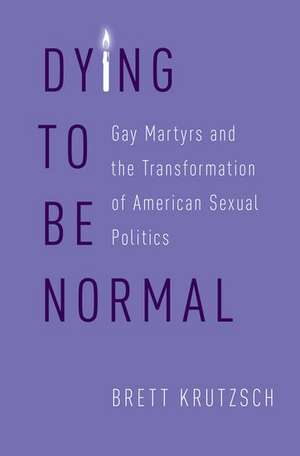
Dying to Be Normal: Gay Martyrs and the Transformation of American Sexual Politics
Autor Brett Krutzschen Limba Engleză Hardback – 4 apr 2019
Preț: 253.51 lei
Preț vechi: 316.93 lei
-20%
Puncte Express: 380
Carte tipărită la comandă
Livrare economică 03-08 decembrie
Livrare prin curier în România Termenul estimat este afișat lângă disponibilitate.
Transport gratuit de la 400.00 lei Plată online sau ramburs, în funcție de opțiunile comenzii.
Retur gratuit în 14 zile Comandă securizată și suport în română.
Specificații
ISBN-13: 9780190685218
ISBN-10: 0190685212
Pagini: 264
Dimensiuni: 239 x 165 x 28 mm
Greutate: 0.5 kg
Editura: Oxford University Press
Colecția OUP USA
Locul publicării:New York, United States
ISBN-10: 0190685212
Pagini: 264
Dimensiuni: 239 x 165 x 28 mm
Greutate: 0.5 kg
Editura: Oxford University Press
Colecția OUP USA
Locul publicării:New York, United States
Recenzii
A remarkably multifaceted study, of value to Queer Studies and the study of Christianity, American religion to comparative study of religion and politics, work on martyrdom generally, and-urgently-scholarship probing ethical questions about representation, this book should be widely taught.
Dying to Be Normal is a powerhouse text that I would highly recommend to scholars interested in queer theory, LGBT studies, or religion studies. The book is additionally helpful for scholars of media or activist history, as the author provides rich historic recollections of the media narratives and activist responses surrounding these figures.
A provocative blend of religion studies, LGBT studies, and media studies, Dying to Be Normal provides an expansive overview of the relationship between LGBT activists and religious discourses in America.... [A] powerhouse text.
A must-read for scholars and activists alike, Krutzsch's agile and far-reaching analysis demonstrates the tactics and the consequences of assimilationist gay politics: veneration of white, cisgender gay men through sanitized, semi-fictionalized, and Christianized versions of their lives that erase their own realities and those of their communities. Krutzsch reminds us that there have always been other options, and challenges us to reject assimilationist tactics that are ultimately rooted in exclusion.
Dying to Be Normal offers a fascinating and heartbreaking history of the memorialization and martyrdom of gay figures in the United States. Krutzsch reveals how religious and secular narratives work in this history - often in unexpected ways - to make some gays appear normal, a process that all too often transubstantiates complicated queer lives into suitable Christian narratives, while leaving others, especially queer people of color, outside the circuit of memory. This moving, unflinching analysis raises the bar for how we talk about religion and sexuality in American politics.
Brett Krutzsch's Dying to Be Normal is a brilliant study of martyrdom and memorialization as central to gay activism in the United States. Although religiosity and sexuality are often thought to be opposing forces, the book shows that religion and sex are powerfully entwined. Christian nationalism and Protestant secularism may form the current parameters of political possibility, but Krutzsch provides an expansive, alternative analysis that opens toward a diverse sexual democracy.
Dying to Be Normal is a powerhouse text that I would highly recommend to scholars interested in queer theory, LGBT studies, or religion studies. The book is additionally helpful for scholars of media or activist history, as the author provides rich historic recollections of the media narratives and activist responses surrounding these figures.
A provocative blend of religion studies, LGBT studies, and media studies, Dying to Be Normal provides an expansive overview of the relationship between LGBT activists and religious discourses in America.... [A] powerhouse text.
A must-read for scholars and activists alike, Krutzsch's agile and far-reaching analysis demonstrates the tactics and the consequences of assimilationist gay politics: veneration of white, cisgender gay men through sanitized, semi-fictionalized, and Christianized versions of their lives that erase their own realities and those of their communities. Krutzsch reminds us that there have always been other options, and challenges us to reject assimilationist tactics that are ultimately rooted in exclusion.
Dying to Be Normal offers a fascinating and heartbreaking history of the memorialization and martyrdom of gay figures in the United States. Krutzsch reveals how religious and secular narratives work in this history - often in unexpected ways - to make some gays appear normal, a process that all too often transubstantiates complicated queer lives into suitable Christian narratives, while leaving others, especially queer people of color, outside the circuit of memory. This moving, unflinching analysis raises the bar for how we talk about religion and sexuality in American politics.
Brett Krutzsch's Dying to Be Normal is a brilliant study of martyrdom and memorialization as central to gay activism in the United States. Although religiosity and sexuality are often thought to be opposing forces, the book shows that religion and sex are powerfully entwined. Christian nationalism and Protestant secularism may form the current parameters of political possibility, but Krutzsch provides an expansive, alternative analysis that opens toward a diverse sexual democracy.
Notă biografică
Brett Krutzsch is Coordinator of the Center for Religion and Media and Instructor in the Department of Religious Studies at New York University. His scholarship examines intersections of religion, sexuality, gender, race, and politics in the United States.