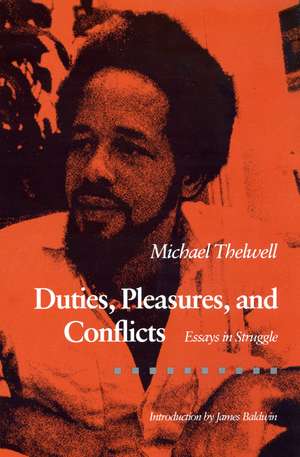
Duties, Pleasures, and Conflicts: Essays in Struggle
Autor Michael M. Thelwell Introducere de James Baldwinen Limba Engleză Paperback – 16 mar 1987
This powerful collection of essays and short stories provides a unique perspective on the black civil rights movement over the past twenty-five years. A long-time activist, Michael Thelwell was a member of the Student Non-Violent Coordinating Committee [SNCC] and the Mississippi Freedom Democratic Party in the early 1960s, a founder of the W.E.B. Du Bois Department of Afro-American Studies at the University of Massachusetts in 1970, author of the widely praised novel The Harder They Come published in 1980, and an organizer for Jesse Jackson's presidential campaign in 1984. Thelwell is a writer of rare grace, integrity, and strong political convictions.
The collection begins with three stories. Set in the Mississippi Delta in the 1960s, the stories explore how individuals manage to preserve their dignity in a world of racism and violence. The next six essays, also written in the 1960s, are historical and journalistic. They discuss the March on Washington for Jobs and Freedom, the situation in the South as seen by SNCC workers, the political challenges in Mississippi, the articulation of the Black Power movement, the causes of the black student revolt at Cornell, and the need for Black Studies as the intellectual offensive in the struggle for black liberation.
The section that follows is composed of literary pieces: two appreciative essays on James Baldwin, two critical reviews of William Styron and his treatment of Nat Turner, an excoriating assessment of V. S. Naipaul, a profile of Amos Tutuola, and a thoughtful analysis of the social responsibility of the black writer.
The final essay examines the history of Jesse Jackson's presidential campaign and comments on the political climate of the 1980s.
The collection begins with three stories. Set in the Mississippi Delta in the 1960s, the stories explore how individuals manage to preserve their dignity in a world of racism and violence. The next six essays, also written in the 1960s, are historical and journalistic. They discuss the March on Washington for Jobs and Freedom, the situation in the South as seen by SNCC workers, the political challenges in Mississippi, the articulation of the Black Power movement, the causes of the black student revolt at Cornell, and the need for Black Studies as the intellectual offensive in the struggle for black liberation.
The section that follows is composed of literary pieces: two appreciative essays on James Baldwin, two critical reviews of William Styron and his treatment of Nat Turner, an excoriating assessment of V. S. Naipaul, a profile of Amos Tutuola, and a thoughtful analysis of the social responsibility of the black writer.
The final essay examines the history of Jesse Jackson's presidential campaign and comments on the political climate of the 1980s.
Preț: 227.51 lei
Puncte Express: 341
Preț estimativ în valută:
40.22€ • 47.44$ • 35.06£
40.22€ • 47.44$ • 35.06£
Carte indisponibilă temporar
Doresc să fiu notificat când acest titlu va fi disponibil:
Se trimite...
Specificații
ISBN-13: 9780870235238
ISBN-10: 0870235230
Pagini: 288
Dimensiuni: 150 x 228 x 20 mm
Greutate: 0.48 kg
Ediția:First Edition
Editura: University of Massachusetts Press
Colecția University of Massachusetts Press
ISBN-10: 0870235230
Pagini: 288
Dimensiuni: 150 x 228 x 20 mm
Greutate: 0.48 kg
Ediția:First Edition
Editura: University of Massachusetts Press
Colecția University of Massachusetts Press
Notă biografică
Michael Thelwell is professor of Afro-American Studies at the University of Massachusetts, Amherst.
Cuprins
Preface
Introduction by James Baldwin
Part I. Southern Movement Fiction
1. The Organizer
2. Bright an' Mownin' Star (1)
3. Bright an' Mownin' Star (2)
Part II. On Politics
4. The August 28th March on Washington: The Castrated Giant
5. Fish Are Jumping an' the Cotton Is High: Notes from the Mississippi Delta
6. The Politics of Necessity and Survival in Mississippi
7. Toward Black Liberation
8. Negroes with Guns
9. Black Studies: A Political Perspective
Part III. On Literature
10. James Baldwin: “Native Alien”
11. Baldwin's New York Novel
12. Mr. William Styron and the Reverend Turner
13. The Turner Thesis
14. Contra Naipaul
15. “The Gods Had Perished”: Tutuola's Palm-Win Drinkard
16. Modernist Fallacies and the Responsibility of the Black Writer
Part IV. A Contemporary Perspective
17. “God Aint Finished with Us Yet”: Jesse Jackson and the Politics of the 1980s
Introduction by James Baldwin
Part I. Southern Movement Fiction
1. The Organizer
2. Bright an' Mownin' Star (1)
3. Bright an' Mownin' Star (2)
Part II. On Politics
4. The August 28th March on Washington: The Castrated Giant
5. Fish Are Jumping an' the Cotton Is High: Notes from the Mississippi Delta
6. The Politics of Necessity and Survival in Mississippi
7. Toward Black Liberation
8. Negroes with Guns
9. Black Studies: A Political Perspective
Part III. On Literature
10. James Baldwin: “Native Alien”
11. Baldwin's New York Novel
12. Mr. William Styron and the Reverend Turner
13. The Turner Thesis
14. Contra Naipaul
15. “The Gods Had Perished”: Tutuola's Palm-Win Drinkard
16. Modernist Fallacies and the Responsibility of the Black Writer
Part IV. A Contemporary Perspective
17. “God Aint Finished with Us Yet”: Jesse Jackson and the Politics of the 1980s
Recenzii
"I think it an important and very timely book, because we need to be reminded, and our youth to be taught. The book is well written, funny, and honest. In terms of the political struggle, it is invariably clear, consistently intelligent and accurate. The literary and cultural pieces show exactly why the political struggle must be accompanied by an intellectual one."—Julian Bond
"It is a book of the utmost importance which, I am certain, will find an enthusiastic readership not only in America but in African and European intellectual circles as well."—Chinua Achebe