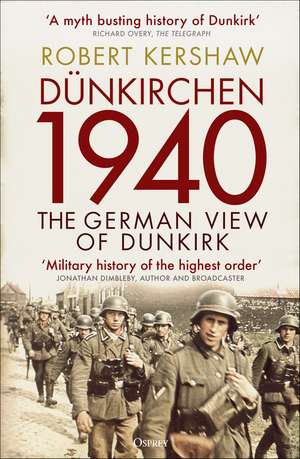
Dunkirchen 1940
Autor Robert Kershawen Limba Engleză Paperback – 14 mar 2024
Aplicabilitatea practică a volumului Dunkirchen 1940 rezidă în capacitatea sa de a demonta un mit istoric prin prisma analizei operaționale riguroase. Observăm că, deși evacuarea trupelor aliate este un subiect recurent în cultura populară, perspectiva germană asupra acestui „miracol” a rămas, până recent, insuficient explorată în literatura de specialitate. Autorul Robert Kershaw utilizează experiența sa militară directă și fluența în limba germană pentru a investiga de ce diviziile de panzere s-au oprit la doar șapte kilometri de portul Dunkerque, transformând o victorie iminentă într-o eroare strategică majoră.
Subliniem structura logică a lucrării, care urmărește cronologia evenimentelor din mai-iunie 1940, punând accent pe faimosul „Halt Order” din 24 mai. Prin capitole dedicate infanteriei (Landser), forțelor blindate și logisticii navale, Robert Kershaw oferă o explicație tehnică a eșecului de comandă german. Cartea reprezintă o alternativă modernă la Dunkirk de Hans-Adolf Jacobsen pentru cursurile de istorie militară, cu avantajul accesului la surse primare germane recent identificate și a unei analize tactice mai profunde. Credem că această lucrare completează natural portofoliul autorului, menținând rigoarea documentară din 24 Hours at the Somme și abordarea echilibrată din Fighting the Invasion: The German Army at D-Day. Stilul este precis, axat pe fapte și rapoarte de luptă, oferind o perspectivă lucidă asupra modului în care s-a pierdut un avantaj strategic decisiv.
Preț: 56.35 lei
Preț vechi: 75.86 lei
-26%
Carte disponibilă
Livrare economică 12-26 iunie
Livrare express 28 mai-03 iunie pentru 43.15 lei
Specificații
ISBN-10: 147285439X
Pagini: 352
Ilustrații: 16-page plate section in black and white
Dimensiuni: 128 x 196 x 28 mm
Greutate: 0.31 kg
Editura: Bloomsbury Publishing
Locul publicării:London, United Kingdom
De ce să citești această carte
Recomandăm această carte studenților la istorie și pasionaților de strategie militară care doresc să înțeleagă Al Doilea Război Mondial dincolo de narativele triumfaliste. Cititorul câștigă o înțelegere clară a erorilor de comandă germane, sprijinită de hărți și ilustrații de arhivă. Este o resursă esențială pentru a vedea cum deciziile luate în teren, sub presiunea „vremii Führerului”, au schimbat cursul istoriei europene.
Descriere
The British evacuation from the beaches of the small French port town of Dunkirk is one of the iconic moments of military history. The battle has captured the popular imagination through LIFE magazine photo spreads, the fiction of Ian McEwan and, of course, Christopher Nolan's hugely successful Hollywood blockbuster. But what is the German view of this stunning Allied escape? Drawing on German interviews, diaries and unit post-action reports, Robert Kershaw creates a page-turning history of a battle that we thought we knew.
Dünkirchen 1940 is the first major history on what went wrong for the Germans at Dunkirk. As supreme military commander, Hitler had seemingly achieved a miracle after the swift capitulation of Holland and Belgium, but with just seven kilometres before the panzers captured Dunkirk - the only port through which the trapped British Expeditionary force might escape - they came to a shuddering stop. Only a detailed interpretation of the German perspective - historically lacking to date - can provide answers as to why.
Dünkirchen 1940 delves into the under-evaluated major German miscalculation both strategically and tactically that arguably cost Hitler the war.
Cuprins
List of Illustrations
List of Maps
Chapter 1: Führer Weather
Chapter 2: Landser
Chapter 3: The Sea
Chapter 4: 24 May, The Day of the Halt Order
Chapter 5: Panzers Against Ports
Chapter 6: Running the Gauntlet
Chapter 7: Sea, Air and Land
Chapter 8: The Great Escape, 1 June
Chapter 9: Elusive Victory
Postscript: Dünkirchen
Notes
Bibliography
Index
Recenzii
A myth-busting history of Dunkirk
This is military history of the highest order. Superbly written and drawn from richly original sources, Dünkirchen 1940 throws new light on what the British tend to regard as an heroic humiliation but for the Germans was a victorious sideshow. An abundance of vivid personal memories, woven deftly in a clear narrative, make for a truly gripping read.
Robert Kershaw's accurate and gritty account provides a fresh coherency to the German action in Belgium and France in the spring of 1940. His methodical approach dispels many of the myths surrounding Dunkirk.
Impeccably researched, a unique and enthralling approach - Dunkirk solely from the victors' perspective.
Robert Kershaw has produced another superb book that demands a reassessment of the fighting at Dunkirk. In this highly readable and insightful account, Kershaw provides a much needed corrective to some of the assumptions made about the German forces using a new and underutilised sources. The result is blend of absorbing narrative history and clinical analysis, that deserves take its place among the great works about this totemic battle.
An impressive account - Kershaw uses a mass of eye-witness testimony to fashion a compelling narrative. In doing so, he offers an important reassessment of this pivotal moment in World War Two.
Robert Kershaw makes all the complexities of 1940 easy to comprehend. This is a first-class book by a master of his trade. He comfortably combines British, French and German voices in an epic story which traverses the tactical to the grand strategic. In each area, a new and refreshing telling of one of the most decisive years in British history, he demonstrates that he is master of all.
Kershaw tells an excellent story from a hitherto neglected viewpoint.