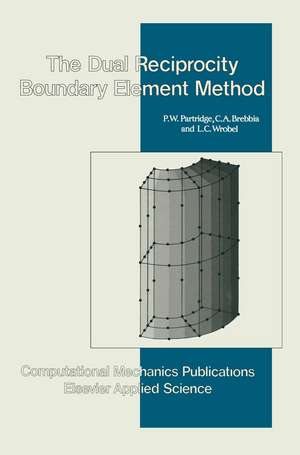
Dual Reciprocity Boundary Element Method: International Series on Computational Engineering
Editat de P. W. Partridge, C. A. Brebbia, Wrobelen Limba Engleză Hardback – 31 dec 1991
Preț: 611.49 lei
Preț vechi: 719.39 lei
-15%
Puncte Express: 917
Carte tipărită la comandă
Livrare economică 27 noiembrie-11 decembrie
Livrare prin curier în România Termenul estimat este afișat lângă disponibilitate.
Transport gratuit pentru acest produs Plată online sau ramburs, în funcție de opțiunile comenzii.
Retur gratuit în 14 zile Comandă securizată și suport în română.
Specificații
ISBN-13: 9781851667000
ISBN-10: 1851667008
Pagini: 304
Ilustrații: XVI, 284 p.
Dimensiuni: 160 x 241 x 22 mm
Greutate: 0.57 kg
Ediția:1991
Editura: Springer
Colecția International Series on Computational Engineering
Seria International Series on Computational Engineering
Locul publicării:Dordrecht, Netherlands
ISBN-10: 1851667008
Pagini: 304
Ilustrații: XVI, 284 p.
Dimensiuni: 160 x 241 x 22 mm
Greutate: 0.57 kg
Ediția:1991
Editura: Springer
Colecția International Series on Computational Engineering
Seria International Series on Computational Engineering
Locul publicării:Dordrecht, Netherlands
V-ar putea interesa
-
 Illustrated Sourcebook of Mechanical ComponentsRobert Parmley-38%Preț: 940.92 lei1511.21 lei
 -
 -38%Preț: 444.75 lei716.51 lei
 -
 Corrosion EngineeringPierre Roberge-40%Preț: 836.74 lei1401.72 lei
 -
 Master LocksmithingBill Phillips-37%Preț: 345.11 lei547.84 lei
 -
 Water-Resistant Design and ConstructionWilliam Walker-37%Preț: 405.59 lei648.46 lei
 -
 String Theory DemystifiedDavid McMahon-38%Preț: 161.01 lei258.81 lei
 -
 Harris' Shock and Vibration HandbookAllan Piersol-33%Preț: 1117.99 lei1676.48 lei
 -
 Design for Six SigmaKai Yang-40%Preț: 687.74 lei1141.27 lei
 -
 Complex Variables DemystifiedDavid McMahon-38%Preț: 163.19 lei262.13 lei
 -
 Locksmith and Security Professionals' Exam Study GuideBill PhillipsPreț: 322.98 lei
 -
 Foundation Engineering Handbook 2/ERobert Day-40%Preț: 925.81 lei1536.71 lei
 -
 Statistical Process Control DemystifiedPaul Keller-38%Preț: 161.96 lei259.19 lei
 -
 Mechanical Engineering ScienceJ. Hannah-15%Preț: 540.80 lei636.24 lei
 -
 CNC Control Setup for Milling and TurningPeter Smid-20%Preț: 651.03 lei813.79 lei
Public țintă
ResearchCuprins
1 Introduction.- 2 The Boundary Element Method for Equations ?2u = 0 and ?2u = b.- 2.1 Introduction.- 2.2 The Case of the Laplace Equation.- 2.3 Formulation for the Poisson Equation.- 2.4 Computer Program 1.- 2.5 References.- 3 The Dual Reciprocity Method for Equations of the Type ?2u = b(x, y).- 3.1 Equation Development.- 3.2 Different f Expansions.- 3.3 Computer Implementation.- 3.4 Computer Program 2.- 3.5 Results for Different Functions b = b(x,y).- 3.6 Problems with Different Domain Integrals on Different Regions.- 3.7 References.- 4 The Dual Reciprocity Method for Equations of the Type ?2u = b(x, y, u).- 4.1 Introduction.- 4.2 The Convective Case.- 4.3 The Helmholtz Equation.- 4.4 Non-Linear Cases.- 4.5 Computer Program 3.- 4.6 Three-Dimensional Analysis.- 4.7 References.- 5 The Dual Reciprocity Method for Equations of the Type ?2u = b(x, y, u, t).- 5.1 Introduction.- 5.2 The Diffusion Equation.- 5.3 Computer Program 4.- 5.4 Special f Expansions.- 5.5 The Wave Equation.- 5.6 The Transient Convection-Diffusion Equation.- 5.7 Non-Linear Problems.- 5.8 References.- 6 Other Fundamental Solutions.- 6.1 Introduction.- 6.2 Two-Dimensional Elasticity.- 6.3 Plate Bending.- 6.4 Three-Dimensional Elasticity.- 6.5 Transient Convection-Diffusion.- 6.6 References.- 7 Conclusions.- Appendix 1.- Appendix 2.- The Authors.