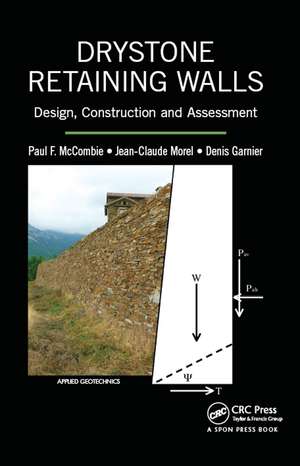
Drystone Retaining Walls: Design, Construction and Assessment: Applied Geotechnics
Autor Paul F. McCombie, Jean-Claude Morel, Denis Garnieren Limba Engleză Hardback – 25 sep 2015
Drystone retaining walls make very efficient use of local materials, and sit comfortably in their environment. They make an important contribution to heritage and to the character of the landscape, and are loved by many people who value the skill and ingenuity that has gone into their construction, as well as simply how they look.
And yet, in engineering terms, they are complex. They can deform significantly as their loading changes and their constituent stones weather. This gives them ductility—they deal with changes by adapting to them. In some ways, they behave like conventional concrete retaining walls, but in many ways they are better. They cannot be designed or assessed correctly unless these differences are understood.
Implementing concepts that require no prior knowledge of civil engineering, the authors:
- Explain the behavior of earth retaining structures
- Provide a theoretical framework for modeling the mechanical stability of a drystone retaining wall
- Outline reliable rules for constructing a drystone retaining wall
- Include charts to support the preliminary sizing of drystone retaining walls
- Examine the relevance of drystone in terms of sustainability
- Describe more advanced methods of analysis




Preț: 1099.79 lei
Preț vechi: 1458.81 lei
-25%
Puncte Express: 1650
Carte indisponibilă temporar
Doresc să fiu notificat când acest titlu va fi disponibil:
Se trimite...
Specificații
ISBN-13: 9781482250886
ISBN-10: 1482250888
Pagini: 186
Ilustrații: 126 black & white illustrations, 7 black & white tables
Dimensiuni: 156 x 234 x 15 mm
Greutate: 0.46 kg
Ediția:1
Editura: CRC Press
Colecția CRC Press
Seria Applied Geotechnics
ISBN-10: 1482250888
Pagini: 186
Ilustrații: 126 black & white illustrations, 7 black & white tables
Dimensiuni: 156 x 234 x 15 mm
Greutate: 0.46 kg
Ediția:1
Editura: CRC Press
Colecția CRC Press
Seria Applied Geotechnics
Cuprins
Introduction. An introduction to the behaviour of simple earth retaining structures. Behaviour of drystone retaining structures. Analysis and design. Construction. Assessment. Design charts - to enable initial sizing. References.
Recenzii
"This book will offer practical advice to those responsible for transport networks which will include drystone retaining walls. It will greatly assist the understanding and future management and maintenance strategies for such structures."
—Richard Fish, Civil Engineering Consultant
—Richard Fish, Civil Engineering Consultant
Notă biografică
Paul F. McCombie graduated with a BA in engineering from Cambridge University in 1981. He then worked for a consulting engineer and studied for an M.Sc in soil mechanics at Imperial College, London. After three years with Netlon Limited, in 1990 he moved to the University of Bath, where he served as director of studies for civil engineering and head of civil engineering. He has been deputy head of department since 2009. In 2010, he was awarded the Institution of Civil Engineers John Mitchell Medal for his research on dry stone retaining walls within the BRE Centre for Innovative Construction Materials (BRE CICM).
Jean-Claude Morel was director of research (equivalent to professor) at École Nationale des Travaux Publics de l’État (ENTPE) in France. He is now professor of low impact buildings at Coventry University. He gained his Ph.D in 1996 from the University Joseph Fourier of Grenoble. In 1998, following an invitation from the architect Patrick Cohen, he initiated a series of research projects on drystone walls, at first with Boris Villemus, and later with Denis Garnier, Anne-Sophie Colas, and then Eric Vincens. He has carried out major research work on low-impact building materials, including a series of testing campaigns on full-scale dry stone retaining structures, on which he has published extensively.
Denis Garnier gained his Ph.D in soil mechanics in the prestigious École Nationale des Ponts et Chaussées (Paris, France), where he is now senior lecturer and teaches the course on continuum mechanics. He is also professor at ENTPE (member of the University of Lyons, France), where he teaches the course of yield design analysis theories. He started his research in the team of Jean Salençon with Patrick de Buhan. He has carried out major research work on rock engineering and the stability modelling of drystone structures, mainly based on homogenization theories. He collaborates with Jean-Claude Morel of ENTPE in 3D modelling and full-scale experiments of dry stone masonries.
Jean-Claude Morel was director of research (equivalent to professor) at École Nationale des Travaux Publics de l’État (ENTPE) in France. He is now professor of low impact buildings at Coventry University. He gained his Ph.D in 1996 from the University Joseph Fourier of Grenoble. In 1998, following an invitation from the architect Patrick Cohen, he initiated a series of research projects on drystone walls, at first with Boris Villemus, and later with Denis Garnier, Anne-Sophie Colas, and then Eric Vincens. He has carried out major research work on low-impact building materials, including a series of testing campaigns on full-scale dry stone retaining structures, on which he has published extensively.
Denis Garnier gained his Ph.D in soil mechanics in the prestigious École Nationale des Ponts et Chaussées (Paris, France), where he is now senior lecturer and teaches the course on continuum mechanics. He is also professor at ENTPE (member of the University of Lyons, France), where he teaches the course of yield design analysis theories. He started his research in the team of Jean Salençon with Patrick de Buhan. He has carried out major research work on rock engineering and the stability modelling of drystone structures, mainly based on homogenization theories. He collaborates with Jean-Claude Morel of ENTPE in 3D modelling and full-scale experiments of dry stone masonries.
Descriere
This book draws on theoretical work, modelling and full-scale practical testing to give sound guidance in the design and assessment of drystone retaining walls. It shows how to design new or replacement drystone retaining walls that are efficient, sustainable, attractive, and in keeping with the character of the area where they are built, and demonstrates how to make reliable assessments of existing walls.