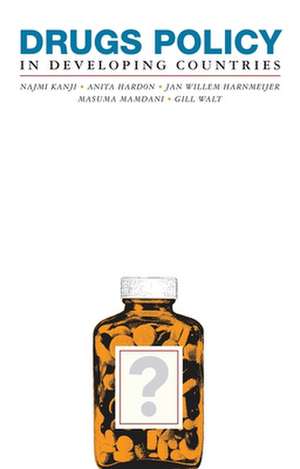
Drugs Policy in Developing Countries
Autor Najmi Kanji, Anita Hardon, Gill Walten Limba Engleză Paperback – sep 1992
It should prove useful to policy makers and academics, teachers and students, managers and professionals, as well as international agencies in the health field.
Preț: 155.60 lei
Preț vechi: 187.82 lei
-17%
Puncte Express: 233
Carte tipărită la comandă
Livrare economică 30 noiembrie-14 decembrie
Livrare prin curier în România Termenul estimat este afișat lângă disponibilitate.
Transport gratuit de la 400.00 lei Plată online sau ramburs, în funcție de opțiunile comenzii.
Retur gratuit în 14 zile Comandă securizată și suport în română.
Specificații
ISBN-13: 9781856490603
ISBN-10: 1856490602
Pagini: 152
Dimensiuni: 136 x 212 x 12 mm
Greutate: 0.2 kg
Editura: Bloomsbury Publishing
Colecția Zed Books
Locul publicării:London, United Kingdom
ISBN-10: 1856490602
Pagini: 152
Dimensiuni: 136 x 212 x 12 mm
Greutate: 0.2 kg
Editura: Bloomsbury Publishing
Colecția Zed Books
Locul publicării:London, United Kingdom
Cuprins
Tables and Figures
Contributors
Foreword and Acknowledgements
Acronyms and Abbreviations
1. Early Initiatives in Essential Drugs Policy - Masuma Mamdani
2. Formulating an Essential Drugs Policy: WHO's Role - Gill Walt and Jan Willem Harnmeijer
3. Consumers versus Producers: Power Play Behind the Scenes - Anita Hardon
4. Action at Country Level: The International and National Influences - Najmi Kanji
5. What Has Been Achieved and Where are We Now? - Najmi Kanji and Anita Hardon
6. New Horizons in the 1990s - Anita Hardon and Najmi Kanji
Appendix
Index
Contributors
Foreword and Acknowledgements
Acronyms and Abbreviations
1. Early Initiatives in Essential Drugs Policy - Masuma Mamdani
2. Formulating an Essential Drugs Policy: WHO's Role - Gill Walt and Jan Willem Harnmeijer
3. Consumers versus Producers: Power Play Behind the Scenes - Anita Hardon
4. Action at Country Level: The International and National Influences - Najmi Kanji
5. What Has Been Achieved and Where are We Now? - Najmi Kanji and Anita Hardon
6. New Horizons in the 1990s - Anita Hardon and Najmi Kanji
Appendix
Index
Recenzii
This book comes as a welcome reminder of the many efforts to develop policies for a more rational use of medecines. It provides a clear outline of some of the possible strategies to achieve change.
Anyone who wants to understand the limitations and constraints of developing and executing a global policy to improve health in developing countries will find this book essential reading.
The WHO has succeeded in making "essential drugs" a respected concept. This book documents this crucial step in the improvement of the supply of medicines for people in the South.
Anyone who wants to understand the limitations and constraints of developing and executing a global policy to improve health in developing countries will find this book essential reading.
The WHO has succeeded in making "essential drugs" a respected concept. This book documents this crucial step in the improvement of the supply of medicines for people in the South.