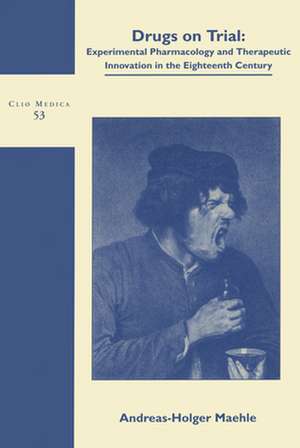
Drugs on Trial
Autor Andreas-Holger Maehleen Limba Engleză Paperback – 1999
Preț: 319.09 lei
Preț vechi: 335.89 lei
-5%
Puncte Express: 479
Carte indisponibilă temporar
Doresc să fiu notificat când acest titlu va fi disponibil:
Se trimite...
Specificații
ISBN-13: 9789042007833
ISBN-10: 9042007834
Pagini: 378
Dimensiuni: 150 x 225 mm
Greutate: 0.5 kg
Editura: Brill
ISBN-10: 9042007834
Pagini: 378
Dimensiuni: 150 x 225 mm
Greutate: 0.5 kg
Editura: Brill
Cuprins
Acknowledgements
1. General Introduction: Features of Eighteenth-Century Pharmacology
2. Dissolving the Stone: The Search for Lithontriptics
3. Opium: Explorations of an Ambiguous Drug
4. Peruvian Bark: From Specific Febrifuge to Universal Remedy
5. General Conclusions: Experimental Pharmacology and Therapeutic Innovation
Bibliography
Index
1. General Introduction: Features of Eighteenth-Century Pharmacology
2. Dissolving the Stone: The Search for Lithontriptics
3. Opium: Explorations of an Ambiguous Drug
4. Peruvian Bark: From Specific Febrifuge to Universal Remedy
5. General Conclusions: Experimental Pharmacology and Therapeutic Innovation
Bibliography
Index
Notă biografică
Andreas-Holger Maehle is Reader in History of Medicine at the University of Durham, England. He was trained as a doctor in Bonn and as a medical historian in Göttingen and London. He has published books on the toxicology of Johann Jakob Wepfer (1620-95) and on the origins of the vivisection debate in the seventeenth and eighteenth centuries. His current research deals with the history of medical professional ethics in Germany and Britain.