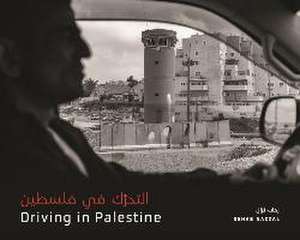
Driving in Palestine التحرّك في فلسطين
Autor Rehab Nazzal رحاب نزالen Limba Engleză Paperback – 6 apr 2023
Driving in Palestine is a research-creation project by acclaimed artist Rehab Nazzal, who explores the visible indices of the politics of mobility that she encountered firsthand while traversing the occupied West Bank between 2010 and 2020. This photography book consists of 160 black and white photographs, hand-drawn maps and critical essays in Arabic and English by Palestinian and Canadian scholars and artists.
The photographs were all captured from moving vehicles on the roads of the West Bank. They focus on Israel’s architecture of movement restrictions and surveillance structures that proliferate in the West Bank, including the Apartheid Wall, segregation walls surrounding illegal colonies, gates, fences, watchtowers, roadblocks and military checkpoints among other obstacles to freedom of movement.
Preț: 176.36 lei
Preț vechi: 227.35 lei
-22%
Puncte Express: 265
Carte disponibilă
Livrare economică 27 octombrie-10 noiembrie
Livrare express 10-16 octombrie pentru 92.42 lei
Livrare prin curier în România Termenul estimat este afișat lângă disponibilitate.
Transport gratuit de la 400.00 lei Plată online sau ramburs, în funcție de opțiunile comenzii.
Retur gratuit în 14 zile Comandă securizată și suport în română.
Specificații
ISBN-13: 9781773635934
ISBN-10: 177363593X
Pagini: 208
Dimensiuni: 254 x 203 x 6 mm
Greutate: 0.64 kg
Editura: Fernwood Publishing
Colecția Fernwood Publishing
Locul publicării:Canada
ISBN-10: 177363593X
Pagini: 208
Dimensiuni: 254 x 203 x 6 mm
Greutate: 0.64 kg
Editura: Fernwood Publishing
Colecția Fernwood Publishing
Locul publicării:Canada
Recenzii
“Rehab Nazzal’s Driving in Palestine takes us on a powerful journey of the Palestinian landscape, the land scarred with Israeli colonies, checkpoints, walls, surveillance outposts, and all sorts of military structures. Most brilliantly, Nazzal’s images, taken from a moving car, appear to us in a still black-and-white form that makes us forget the motion from which the images were taken. But there are small reminders throughout the book that these images are taken in motion, are of motion. Thus, the stillness of an image that is in fact rooted in motion allows us to sense and feel, albeit transiently, the Palestinian experience of movement, not as free, smooth, and open but rather brutally and by Israeli design as restrictive, stifling, still, and suffocating. Combining images with texts from a variety of perspectives and positionalities, this is a book that presents a penetrating method of capturing and communicating this inhumane experience of movement that Palestinians endure. It also critically accentuates Palestinian resistance and insistence on seeing, living, and experiencing Palestinian lands as whole and free.”
“Nazzal’s photography book, Driving in Palestine, presents a vivid and powerful account of the infrastructures that segregate, surveil, and suppress Palestinian movement — checkpoints, watchtowers, illegal colonies, and the expansive Apartheid Wall. The images and accompanying testimonies capture how Israel’s occupation continues to fracture and militarize the ever-shrinking landscape of Palestine. And while the camera’s lens is a window to the architecture of colonization and mobility control, it also offers an aperture into the courage — and even defiance — that marks a Palestinian’s daily travel.”
“Rehab Nazzal’s Driving in Palestine traces her itineraries across a landscape fractured by the mundane and militarized structures of settler colonialism. The photographs she takes along the way document the texture and imposition of Israel’s colonial impediments while clearly asserting the power of the watched who are always watching back. Alongside the photos, Nazzal weaves in narrative reflections on her images from several writers/intellectuals/activists. The result is a visual symphony that evinces what Mohammed El-Kurd in his contribution calls, ‘the dignity of negating the cement.’”
“In Driving in Palestine, Rehab Nazal takes readers on a sojourn across the prison-like landscape of the Palestinian West Bank, captured in a collection of haunting black-and-white photographs. Images of guard towers, razor-wire fencing, and concrete walls dominate the monochromatic hues in these photos, providing a stark visual testament to a journey across a carceral geography. What is particularly compelling is how the book conveys this visual sense of territorial confinement. All the photos were taken by the author in vehicles moving along roads in various districts of this barrier-laden and surveillance-stricken land. It’s a wonderfully successful and original idea for conveying the ground-level atmospherics of the confined and fractured West Bank landscape. There are many works that enlist photo imagery to represent the carceral character imposed on the Palestinian West Bank by the State of Israel, but I am not aware of any book that has used the car as a vantage to recreate the sensory experience of confinement in the way Driving in Palestine does. It is a truly ground-breaking tour of a land that has endured suffering far too long.”
“Nazzal’s photography book, Driving in Palestine, presents a vivid and powerful account of the infrastructures that segregate, surveil, and suppress Palestinian movement — checkpoints, watchtowers, illegal colonies, and the expansive Apartheid Wall. The images and accompanying testimonies capture how Israel’s occupation continues to fracture and militarize the ever-shrinking landscape of Palestine. And while the camera’s lens is a window to the architecture of colonization and mobility control, it also offers an aperture into the courage — and even defiance — that marks a Palestinian’s daily travel.”
“Rehab Nazzal’s Driving in Palestine traces her itineraries across a landscape fractured by the mundane and militarized structures of settler colonialism. The photographs she takes along the way document the texture and imposition of Israel’s colonial impediments while clearly asserting the power of the watched who are always watching back. Alongside the photos, Nazzal weaves in narrative reflections on her images from several writers/intellectuals/activists. The result is a visual symphony that evinces what Mohammed El-Kurd in his contribution calls, ‘the dignity of negating the cement.’”
“In Driving in Palestine, Rehab Nazal takes readers on a sojourn across the prison-like landscape of the Palestinian West Bank, captured in a collection of haunting black-and-white photographs. Images of guard towers, razor-wire fencing, and concrete walls dominate the monochromatic hues in these photos, providing a stark visual testament to a journey across a carceral geography. What is particularly compelling is how the book conveys this visual sense of territorial confinement. All the photos were taken by the author in vehicles moving along roads in various districts of this barrier-laden and surveillance-stricken land. It’s a wonderfully successful and original idea for conveying the ground-level atmospherics of the confined and fractured West Bank landscape. There are many works that enlist photo imagery to represent the carceral character imposed on the Palestinian West Bank by the State of Israel, but I am not aware of any book that has used the car as a vantage to recreate the sensory experience of confinement in the way Driving in Palestine does. It is a truly ground-breaking tour of a land that has endured suffering far too long.”