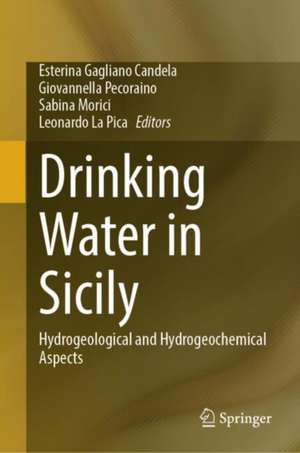
Drinking Water in Sicily
Editat de Esterina Gagliano Candela, Giovannella Pecoraino, Sabina Morici, Leonardo La Picaen Limba Engleză Hardback – 20 iul 2024
Observăm în Drinking Water in Sicily, editată de Esterina Gagliano Candela și colaboratorii săi, o monografie tehnică riguroasă dedicată resurselor de apă potabilă dintr-o regiune critică a Mediteranei. Volumul reprezintă o sinteză hidrogeochimică exhaustivă, documentând starea actuală a celor 1014 izvoare care alimentează rețeaua de apeducte a Siciliei. Lucrarea depășește cadrul legislativ convențional, propunând o abordare științifică multidisciplinară care îmbină geologia, geofizica și geochimia pentru a identifica zonele cu vulnerabilitate ridicată la poluarea antropică.
Subliniem importanța metodologică a acestei ediții 2024, care prelucrează datele istorice din Piano Regolatore degli Acquedotti și studiile INGV prin intermediul sistemelor informatice geografice (GIS). Această abordare permite o reconstrucție precisă a evoluției resurselor subterane într-un context marcat de scăderea precipitațiilor. Structura cărții este organizată sistematic, începând cu o introducere metodologică, urmată de unsprezece capitole dedicate fiecărui bazin hidrogeologic major, de la complexul vulcanic al Muntelui Etna până la Munții Peloritani și Trapani. Această segmentare oferă o imagine granulară asupra calității apei și a dinamicii hidrogeologice locale.
În comparație cu Water Security in the Mediterranean Region de Andrea Scozzari, care analizează securitatea resurselor la nivel regional și transfrontalier, volumul de față aplică aceleași principii de protecție a mediului la o scară locală detaliată, oferind date empirice specifice teritoriului sicilian. De asemenea, lucrarea extinde cadrul teoretic propus de Advances in Hydrogeochemistry Research prin studii de caz aplicate, transformând parametrii chimici abstracți în instrumente practice pentru planificarea și monitorizarea resurselor de apă potabilă în zonele cu stres hidric.
Preț: 899.16 lei
Preț vechi: 1096.54 lei
-18%
Carte disponibilă
Livrare economică 02-16 noiembrie
Specificații
ISBN-10: 3031604725
Pagini: 244
Ilustrații: X, 290 p. 10 illus.
Dimensiuni: 160 x 241 x 18 mm
Greutate: 0.58 kg
Ediția:2024
Editura: Springer
Locul publicării:Cham, Switzerland
V-ar putea interesa
-
 Fundamentals of HydrologyTim DaviePreț: 425.62 lei
 -
 Practical and Theoretical GeoarchaeologyPaul Goldberg-23%Preț: 642.56 lei834.49 lei
 -
 HydrogeologyKevin M Hiscock-23%Preț: 607.91 lei789.50 lei
 -
 Aquifers: Formation, Transport & PollutionRachel H Laughton-26%Preț: 1834.76 lei2495.99 lei
 -
 Groundwater: Hydrogeochemistry, Environmental Impacts & Management PracticesSegun Michael Adelana-27%Preț: 1328.96 lei1811.91 lei
 -
 Water Security in LibyaSalem El-Maiar-31%Preț: 443.36 lei643.77 lei
 -
 From Hydrology to Hydroarchaeology in the Ancient MediterraneanGiovanni Lecturer (UniPa) PolizziPreț: 299.00 lei
 -
 AquaChiara BarziniPreț: 121.00 lei
 -
 Rough Guide Map SicilyRough GuidesPreț: 36.66 lei
 -
 WaterDanielle LobbanPreț: 75.74 lei
 -
 Preț: 52.69 lei
 -
 EuroKarst 2022, MálagaBartolomé Andreo-24%Preț: 1350.19 lei1776.57 lei
 -
 Recent Research on Hydrogeology, Geoecology and Atmospheric SciencesHaroun Chenchouni-18%Preț: 1596.16 lei1946.54 lei
 -
 -24%Preț: 1694.45 lei2229.53 lei
 -
 -18%Preț: 1608.90 lei1962.08 lei
 -
 Surface, Sub-Surface Hydrology and ManagementSubodh Chandra Pal-18%Preț: 1102.59 lei1344.62 lei
 -
 Abbay River BasinAssefa MelessePreț: 484.00 lei
 -
 HydrogeologyBernward Hölting-15%Preț: 574.19 lei675.52 lei
 -
 Advances in Water Resource Planning and SustainabilityPraveen Kumar Rai-18%Preț: 868.28 lei1058.87 lei
De ce să citești această carte
Această monografie este esențială pentru hidrologi, geologi și planificatori de mediu care activează în regiunea mediteraneană. Cititorul obține acces la o bază de date vastă despre 1014 izvoare siciliene, procesată prin tehnologii GIS. Este o resursă indispensabilă pentru înțelegerea vulnerabilității acviferelor și pentru fundamentarea unor strategii de monitorizare bazate pe dovezi geochimice, nu doar pe reglementări administrative.
Despre autor
Esterina Gagliano Candela, împreună cu echipa editorială formată din Giovannella Pecoraino, Sabina Morici și Leonardo La Pica, reprezintă o colaborare de experți în domeniul geosciințelor cu o vastă experiență în contextul italian. Specializați în hidrogeochimie și monitorizarea resurselor naturale, aceștia au lucrat în strânsă legătură cu instituții de renume precum Istituto Nazionale di Geofisica e Vulcanologia (INGV), secțiunea Palermo. Activitatea lor se concentrează pe analiza calității apelor subterane și pe dezvoltarea unor metodologii de protecție a resurselor hidrice în fața provocărilor climatice și antropice contemporane.
Descriere scurtă
The reference is the Piano Regolatore degli Acquedotti (PRGA) of Sicily, Italy (updated in November 2010), which lists all the springs, subdivided by province (a total of 1014), currently used to supply water to Sicilian aqueducts. With regard to the geochemical part, the studies carried out by the INGV, Sezione di Palermo, for the Water Protection Plan for Sicily (2004-2005) were used as basic data. The study of the chemical characteristics of groundwater is of fundamental importance from a hydrogeological point of view as it allows the origin of the water and its evolution to be reconstructed. Springs as a groundwater resource are of considerable importance in relation to the availability of water resources due to the general decrease in precipitation. In the first part of the book all the existing data (flow rates, geochemical parameters, water quality, etc.) are collected and subsequently transferred to GIS software, after appropriate evaluations on the validity of the acquired data. Considering that the subject is quite delicate and involves various aspects (compliance with regulations, vulnerability of groundwater, anthropogenic pollution, etc.), carrying out a purely scientific study allows groundwater to be placed in a broader context than that of legislation aimed exclusively at compliance with the regulations in force.
Cuprins
Notă biografică
Giovannella Pecoraino has a decade’s expertise in geochemistry applied to volcanic/hydrothermal systems. Her research experiences include geochemical surveillance of active Italian volcanoes (Ischia, Pantelleria, Vulcano, Etna), geochemistry of fluids, and gas-water-rock interactions in different volcanic and geothermal areas in the world on the basis of chemical (major, minor, and trace elements) and stable isotopic (δD and δ 18O of water, δ 13C of CO2 and TDC, 3He/4He) compositions and gas outputs in fumarolic areas and in lakes (Specchio di Venere, Albano and Nemi Lakes Italy El Chichon, Costa Rica and Barombi Mbo, Cameroon). She has also been involved as responsible or associate in several DPC founding projects with the emphasis on model, on the basis of fluid geochemistry, the structure of the hydro-geothermal system of the Ischia and Pantelleria Islands, and define a conceptual model for the recognition of chemical and/or isotopic precursors of underground eruptions in Vulcano and Phlegraean Fields on the basis of knowledge acquired in Poas and Turrialba (Costa Rica) “groundwater active” volcanoes (FREAPROB-Precursors for phreatic eruptions) in collaboration with Centro de Investigaciones en Ciencias Geologicas, Universidad de Costa Rica. She has been involved as an associate in several projects in Canary Islands (Spain) focused on the geochemical characterization of the fluids (gas and aquifers) of Tenerife and El Hierro, the evaluation of the CO2 budgets emitted by the soils in the Las Cañadas caldera (Teide). She has also been involved in project in Greek Islands focused on the geochemical characterization of the released gases and CO2 output estimation at the geothermal system of Kos and the Gyali Island. Today, she is involved in the COLLANE project, and she is studying the degassing model for Lago Albano with its implications for the natural CO2budget of volcanic lakes and, on its turn, climate change.
Sabina Morici was born in Palermo on 17/11/1971 professional profile researcher-III level, at INGV-Section of Palermo and participated in the Water And Land Legacy (WALL) project, Tunisia; and programme to support regional cooperation—APQ Mediterranean Line 2.3. The Integrated Project addresses the issue of water resource protection and management in the areas of Kairouan and Cap Bon (Tunisia) and in the area of Licata (Sicily Pilot Project). INGV Palermo Section. Studies and research aimed at the reclassification of groundwater bodies for the updating and management of the Water Protection Plan and the implementation of the Single Monitoring and Information System to support the management of the Hydrographic District of Sicily. Framework Directive 2000/60 EC. - D. Lgs 152/2006 - D. Lgs 30/2009, within the agreement for studies and researches between INGV Sez. of Palermo and the Regional Department of Water and Waste - Water Observatory Service, Sicily Region. Collaboration agreement with the Department of Water and Waste (DAR) for the execution of studies and investigations for the definition of Conceptual Models of groundwater bodies and related geophysical investigations (M. Peloritani, M. Nebrodi e M. Iblei-Ragusani).
Leonardo La Pica was graduated in Geological Sciences in 2002 at the University of Palermo: since 2005 he has benefited from 3 years of scholarships and 10 years of research allowance at the Palermo section of the National Institute of Geophysics and Volcanology, and since 2018 he has a fixed-term contract with the professional profile of the technologist. He has always been involved in fluid geochemistry in the context of geochemical surveillance in volcanic and seismic areas of Sicily (Etna, Vulcano and Stromboli) and Campania (Vesuvius and Ischia) and for environmental reasons through the hydrogeochemical study of groundwater. His activity is mainly concerned with the study of the chemical and isotopic composition of groundwater and dissolved gases and of meteoric waters, to describe water-rock interactions and to hypothesize geochemical models related to hydrogeological circulation.