Dresden: Harper Perennial
Autor Frederick Tayloren Limba Engleză Paperback – 12 apr 2023
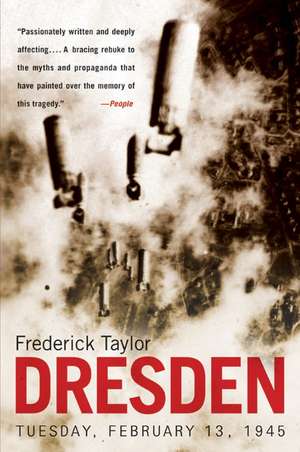
The dramatic and controversial account that completely re-examines the Allied attack on Dresden
For decades it has been assumed that the Allied bombing of Dresden was militarily unjustifiable, an act of rage and retribution for Germany’s ceaseless bombing of London and other parts of England.
In Dresden, Frederick Taylor’s groundbreaking research offers a completely new examination of the facts, and reveals that Dresden was a highly-militarized city actively involved in the production of military armaments and communications concealed beneath the cultural elegance for which the city was famous. Incorporating first-hand accounts, contemporaneous press material and memoirs, and never-before-seen government records, Taylor documents unequivocally the very real military threat Dresden posed, and thus altering forever our view of that attack.
Din seria Harper Perennial
-
 Preț: 98.81 lei
 -
 Preț: 108.54 lei
 -
 Preț: 98.73 lei
 - 5%
 Preț: 105.38 lei
 -
 Preț: 100.22 lei
 -
 Preț: 107.31 lei
 -
 Preț: 112.94 lei
 -
 Preț: 85.05 lei
 -
 Preț: 95.26 lei
 -
 Preț: 72.29 lei
 -
 Preț: 83.59 lei
 -
 Preț: 89.90 lei
 -
 Preț: 97.41 lei
 -
 Preț: 93.47 lei
 -
 Preț: 110.64 lei
 -
 Preț: 97.41 lei
 -
 Preț: 110.84 lei
 -
 Preț: 87.63 lei
 -
 Preț: 68.84 lei
 -
 Preț: 96.39 lei
 -
 Preț: 67.98 lei
Preț: 112.14 lei
Puncte Express: 168
Preț estimativ în valută:
19.85€ • 23.12$ • 17.25£
19.85€ • 23.12$ • 17.25£
Carte indisponibilă temporar
Doresc să fiu notificat când acest titlu va fi disponibil:
Se trimite...
Preluare comenzi: 021 569.72.76
Specificații
ISBN-13: 9780060006778
ISBN-10: 0060006773
Pagini: 518
Dimensiuni: 133 x 203 x 31 mm
Greutate: 0.45 kg
Ediția:Perennial.
Editura: Harpercollins
Colecția HarperPerennial
Seria Harper Perennial
ISBN-10: 0060006773
Pagini: 518
Dimensiuni: 133 x 203 x 31 mm
Greutate: 0.45 kg
Ediția:Perennial.
Editura: Harpercollins
Colecția HarperPerennial
Seria Harper Perennial
V-ar putea interesa
-
 Hitler and StalinAlan BullockPreț: 186.21 lei
 -
 Preț: 114.92 lei
 -
 Hitler: A Study in TyrannyAlan Bullock-19%Preț: 107.07 lei132.47 lei
 -
 The Origins of the Second World WarProfessor A J P TaylorPreț: 75.89 lei
 -
 Iron KingdomChristopher Clark-19%Preț: 106.87 lei132.35 lei
 -
 The SleepwalkersChristopher Clark-20%Preț: 106.20 lei131.95 lei
 -
 The 900 DaysHarrison E. SalisburyPreț: 138.44 lei
 -
 The LobotomistJack El-HaiPreț: 111.73 lei
 -
 A War Of NervesBen Shephard-19%Preț: 113.70 lei140.07 lei
 -
 Leningrad: State of SiegeMichael Jones-27%Preț: 55.57 lei76.15 lei
 -
 Leningrad 1943: Inside a City Under SiegeNicolas WerthPreț: 110.98 lei
 -
 The Berlin Wall: 13 August 1961 - 9 November 1989 (reissued)Frederick Taylor-27%Preț: 85.69 lei117.57 lei
 -
 Exorcising Hitler: The Occupation and Denazification of GermanyFrederick Taylor-41%Preț: 85.06 lei143.13 lei
 -
 A Savage War of Peace: Algeria 1954-1962Alistair HornePreț: 142.45 lei
 -
 The Nazi and the PsychiatristJack El-Hai-42%Preț: 91.87 lei158.18 leiRecomandat
 -
 -21%Preț: 72.64 lei92.15 lei
 -
 The Man with the Poison GunSerhii PlokhyPreț: 83.48 lei
 -
 Preț: 75.48 lei
 -
 Preț: 82.98 lei
 -
 Preț: 89.60 lei
 -
 Napoléon III. Enfance, JeunesseGeorges DuvalPreț: 170.11 lei
 -
 La Réorganisation de l'Algérie, Lettre À S. A. I. Le Prince NapoléonClément DuvernoisPreț: 76.41 lei
 -
 Preț: 192.25 lei
 -
 L'Empire En ProvinceJ. -H DuvivierPreț: 76.21 lei
 -
 Preț: 76.59 lei
 -
 Preț: 191.73 lei
 -
 Preț: 69.81 lei
 -
 Preț: 371.32 lei
 -
 MOTHMEISTER DARK AND DYSTOPIAN POSTMothmeisterPreț: 406.19 lei
Textul de pe ultima copertă
For decades it has been assumed that the Allied bombing of Dresden -- a cultured city famous for its china, chocolate, and fine watches -- was militarily unjustifiable, an act of retribution for Germany's ceaseless bombing of London and other parts of England.
Now, Frederick Taylor's groundbreaking research offers a completely new examination of the facts and reveals that Dresden was a highly militarized city actively involved in the production of military armaments and communications. Incorporating first-hand accounts, contemporaneous press material and memoirs, and never-before-seen government records, Taylor proves unequivocally the very real military threat Dresden posed -- and how a legacy of propaganda shrouded the truth for sixty years.
Now, Frederick Taylor's groundbreaking research offers a completely new examination of the facts and reveals that Dresden was a highly militarized city actively involved in the production of military armaments and communications. Incorporating first-hand accounts, contemporaneous press material and memoirs, and never-before-seen government records, Taylor proves unequivocally the very real military threat Dresden posed -- and how a legacy of propaganda shrouded the truth for sixty years.
Recenzii
“Deeply affecting ... a bracing rebuke to the myths and propaganda that have painted over the memory of this tragedy.” — People
“The enigmatic past and the patient muse of history are brilliantly served ... by this blockbuster of a book.” — Chicago Sun-Times
“Taylor carefully debunks .... the ‘pervasive postwar myth’ ... What emerges is a picture markedly different from conventional accounts.” — New York Times Book Review
“Fascinating....a fine, revealing work of revisionist history. He has also given us a deeply haunting human drama.” — Houston Chronicle
“Compelling ... [Taylor] puts the assault in its proper context to reveal the inherent moral tangle of total war.” — Atlantic Monthly
“A riveting narrative account.” — Salon.com
“Compelling ... Mr. Taylor makes a persuasive case that Dresden was not an innocent bystander in the tragedy that was WWII.” — Washington Times
“A strong and provocative work of World War II scholarship.” — Library Journal
“Accomplished.” — Publishers Weekly (starred review)
“A major contribution to the story of Dresden.” — Christian Science Monitor
“Genius...an absolutely magnificent work both of scholarship and of narration.” — The Literary Review (London)
“[An] authoritative and moving account …. Impeccably documented.” — The Independent (London)
“In narrative power and persuasion, [Taylor] has paralleled in DRESDEN what Antony Beevor achieved in STALINGRAD.” — Nicholas Fearn, The Independent on Sunday (London)
“Well-researched, objective and compassionate...Frederick Taylor convincingly sets the record straight.” — Anthony Looch, Daily Post (Liverpool)
“Groundbreaking … [shines] new light on that fateful day and the resulting myths.” — Calgary Sun
“I thought I knew what happened at Dresden on that fiery day in 1945 -- and then I read this book.” — James Bradley
“Anyone who thinks that during World War Two Dresden manufactured just chinaware must read this penetrating book.” — Stanley P. Hirschson, author of General Patton: A Soldier's Life
“A provocative re-examination of the bombing of Dresden ... elgantly written and deeply moving.” — Peter Duffy, author of The Bielski Brothers
“The enigmatic past and the patient muse of history are brilliantly served ... by this blockbuster of a book.” — Chicago Sun-Times
“Taylor carefully debunks .... the ‘pervasive postwar myth’ ... What emerges is a picture markedly different from conventional accounts.” — New York Times Book Review
“Fascinating....a fine, revealing work of revisionist history. He has also given us a deeply haunting human drama.” — Houston Chronicle
“Compelling ... [Taylor] puts the assault in its proper context to reveal the inherent moral tangle of total war.” — Atlantic Monthly
“A riveting narrative account.” — Salon.com
“Compelling ... Mr. Taylor makes a persuasive case that Dresden was not an innocent bystander in the tragedy that was WWII.” — Washington Times
“A strong and provocative work of World War II scholarship.” — Library Journal
“Accomplished.” — Publishers Weekly (starred review)
“A major contribution to the story of Dresden.” — Christian Science Monitor
“Genius...an absolutely magnificent work both of scholarship and of narration.” — The Literary Review (London)
“[An] authoritative and moving account …. Impeccably documented.” — The Independent (London)
“In narrative power and persuasion, [Taylor] has paralleled in DRESDEN what Antony Beevor achieved in STALINGRAD.” — Nicholas Fearn, The Independent on Sunday (London)
“Well-researched, objective and compassionate...Frederick Taylor convincingly sets the record straight.” — Anthony Looch, Daily Post (Liverpool)
“Groundbreaking … [shines] new light on that fateful day and the resulting myths.” — Calgary Sun
“I thought I knew what happened at Dresden on that fiery day in 1945 -- and then I read this book.” — James Bradley
“Anyone who thinks that during World War Two Dresden manufactured just chinaware must read this penetrating book.” — Stanley P. Hirschson, author of General Patton: A Soldier's Life
“A provocative re-examination of the bombing of Dresden ... elgantly written and deeply moving.” — Peter Duffy, author of The Bielski Brothers
Notă biografică
Frederick Taylor studied history and modern languages at Oxford University and Sussex University. A Volkswagen Studentship award enabled him to research and travel widely in both parts of divided Germany at the height of the Cold War. Taylor is the author of Dresden and has edited and translated a number of works from German, including The Goebbels Diaries, 1939-1941. He is married with three children and lives in Cornwall, England.
Descriere
Descriere de la o altă ediție sau format:
The definitive story of the shocking and controversial Allied bombing of Dresden
'In narrative power and persuasion, he has paralleled in Dresden what Antony Beevor achieved in Stalingrad' Independent on Sunday
'Well-researched and unpretentious ... fascinating ... Taylor skilfully interweaves various personal accounts of the impact of the raids' Guardian
At 9.51 p.m. on Tuesday 13 February 1945, Dresden's air-raid sirens sounded as they had done many times during the Second World War. But this time was different. By the next morning, more than 4,500 tons of high explosives and incendiary devices had been dropped on the unprotected city.
At least 25,000 inhabitants died in the terrifying firestorm and thirteen square miles of the city's historic centre, including incalculable quantities of treasure and works of art, lay in ruins. In this portrait of the city, its people, and its still-controversial destruction, Frederick Taylor has drawn on archives and sources only accessible since the fall of the East German regime, and talked to Allied aircrew and survivors, from members of the German armed services and refugees fleeing the Russian advance to ordinary citizens of Dresden.
The definitive story of the shocking and controversial Allied bombing of Dresden
'In narrative power and persuasion, he has paralleled in Dresden what Antony Beevor achieved in Stalingrad' Independent on Sunday
'Well-researched and unpretentious ... fascinating ... Taylor skilfully interweaves various personal accounts of the impact of the raids' Guardian
At 9.51 p.m. on Tuesday 13 February 1945, Dresden's air-raid sirens sounded as they had done many times during the Second World War. But this time was different. By the next morning, more than 4,500 tons of high explosives and incendiary devices had been dropped on the unprotected city.
At least 25,000 inhabitants died in the terrifying firestorm and thirteen square miles of the city's historic centre, including incalculable quantities of treasure and works of art, lay in ruins. In this portrait of the city, its people, and its still-controversial destruction, Frederick Taylor has drawn on archives and sources only accessible since the fall of the East German regime, and talked to Allied aircrew and survivors, from members of the German armed services and refugees fleeing the Russian advance to ordinary citizens of Dresden.