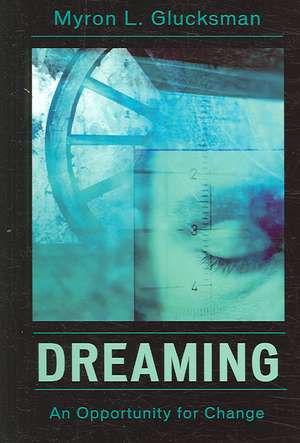
Dreaming: An Opportunity for Change
Autor Myron L. Glucksman, M.D.en Limba Engleză Paperback – 8 dec 2006
Dreaming is written in clear, understandable language with a minimum of psychological jargon. Technical terms are explained and illustrated. Although it includes theoretical material, the emphasis is on clinically relevant issues. The information it provides can be integrated into various therapeutic modalities (psychodynamic, cognitive-behavioral) as well as diverse styles of clinical work.
Preț: 324.93 lei
Preț vechi: 460.05 lei
-29%
Puncte Express: 487
Carte tipărită la comandă
Livrare economică 30 noiembrie-14 decembrie
Livrare prin curier în România Termenul estimat este afișat lângă disponibilitate.
Transport gratuit de la 400.00 lei Plată online sau ramburs, în funcție de opțiunile comenzii.
Retur gratuit în 14 zile Comandă securizată și suport în română.
Specificații
ISBN-13: 9780765704481
ISBN-10: 076570448X
Pagini: 167
Dimensiuni: 154 x 233 x 14 mm
Greutate: 0.27 kg
Editura: Bloomsbury Publishing
Colecția Jason Aronson Inc
Locul publicării:New York, United States
ISBN-10: 076570448X
Pagini: 167
Dimensiuni: 154 x 233 x 14 mm
Greutate: 0.27 kg
Editura: Bloomsbury Publishing
Colecția Jason Aronson Inc
Locul publicării:New York, United States
V-ar putea interesa
-
 Psychoanalysis and ReligionErich Fromm-5%Preț: 202.36 lei213.02 lei
 -
 Mastering Counselling TheoryRay Colledge-5%Preț: 243.05 lei255.83 lei
 -
 -5%Preț: 396.39 lei417.25 lei
 -
 -27%Preț: 235.93 lei325.19 lei
 -
 Preț: 389.21 lei
 -
 -5%Preț: 375.47 lei395.23 lei
 -
 Attachment Processes in Couple and Family TherapySusan M. Johnson-5%Preț: 429.09 lei451.68 lei
 -
 Preț: 115.06 lei
 -
 -5%Preț: 385.54 lei405.83 lei
 -
 -29%Preț: 207.43 lei292.84 lei
 -
 Art-Based ResearchShaun McNiffPreț: 246.94 lei
 -
 Hidden Self-Harm: Narratives from PsychotherapyMaggie Turp-29%Preț: 195.04 lei273.94 lei
 -
 Challenging Behaviour: Principles and PracticesDave HewettPreț: 391.02 lei
 -
 Kleinian TheoryCathy BronsteinPreț: 450.93 lei
Cuprins
Chapter 1 Introduction
Chapter 2 Free Association and Interpretation
Chapter 3 Emotions and Mood
Chapter 4 Relationships with Others
Chapter 5 Self Identity
Chapter 6 Problem-Solving, Decision-Making
Chapter 7 Anxiety and Repetitive Dreams
Chapter 8 Wish-Fulfillment Dreams
Chapter 9 Life Crisis, Stress and Dreams
Chapter 10 Changes in Dream Imagery
Chapter 11 The Interpretive Process
Chapter 12 The Dreams as a Facilitator of Change
Chapter 2 Free Association and Interpretation
Chapter 3 Emotions and Mood
Chapter 4 Relationships with Others
Chapter 5 Self Identity
Chapter 6 Problem-Solving, Decision-Making
Chapter 7 Anxiety and Repetitive Dreams
Chapter 8 Wish-Fulfillment Dreams
Chapter 9 Life Crisis, Stress and Dreams
Chapter 10 Changes in Dream Imagery
Chapter 11 The Interpretive Process
Chapter 12 The Dreams as a Facilitator of Change
Recenzii
This is a much needed book which fills an ever widening gap, namely that caused by the fading of teaching about dreams and dreaming to clinicians. Dr. Glucksman provides an extremely rich and scholarly, a veritable gold mine, integration of modern psychoanalytic thinking and sleep research which provide a solid foundation for understanding and working with dreams in the clinical setting. The book contains a large number of vivid clinical examples. The combination of such a scholarly review of the literature with such clinically wise work with dreams should lead every reader to a much deeper appreciation of how to understand and to work with dreams.
In Dreaming: An Opportunity for Change, Myron Glucksman provides an excellent introduction to the use of dreams in psychotherapy. Without getting into the sometimes controversial aspects of dream theory, he describes a simple but effective methodfor extracting the meaning of a dream as it pertains to the dreamer's life and problems in living. Glucksman provides many rich examples of dreams that illuminate issues that were ignored or neglected by his patients because they seemed too difficultto confront or too threatening to their self esteem. One big advantage of Glucksman' interpretive method is that it can be used by therapists who have no knowledge of the functions of dreaming itself in the psychology of the patient. By showing beginning therapists that they can work therapeutically with dreams, Glucksman should be motivating them to incorporate this wider knowledge into their therapeutic toolkits.
Glucksman's book is probably the most comprehensive and useful one on how to understand and interpret dreams that I have ever read. His excellent summaries at the end of each chapter about the salient points made, as well as his suggested reading lists, are musts for both beginning and experienced clinicians. This book is likely to become an instant classic.
Dr. Glucksman, a widely experienced psychoanalyst and clinical dream researcher, provides an exceptional clinical contribution for dreamers and therapists on how to utilize dreams to facilitate psychological and behavioral change. He provides an approach to establish the meaning of the dream through the use of a dialogue based application of free associations that connect the dream's theme to the current and past life situations of the dreamer. His compelling and extensive use of understandable examples of his client's dreams permits the reader to grasp more thoroughly the concept Glucksman is exploring whether that is how dreams deal with emotions and moods, interpersonal relations, problem solving or life crises. He concludes each chapter with an outline of suggestions for how to approach the exploration of a topic that the dream theme suggests. The book is written in an easy to read style and is a major contribution to the constructive use of the dream in psychotherapy and in self-understanding.
Even those who have read extensively on the topic of dreaming will find this lively, reader-friendly discussion unique and valuable. Summing Up: Highly recommended. All readers; all levels.
Glucksman explains his method in clear, easy-to-understand language. His writing style is engaging, and copious examples illustrate how his method of interactive dream interpretation can facilitate change. Especially helpful are the step-by-step instructions for the therapist at the end of most chapters. Dream interpretation is a method that has worked well in the clinic for Glucksman. Whether or not dream interpretation really is the royal road to the unconscious, Glucksman shows that, at the very least, it is one path that the therapist and client can explore together on the way to mental health.
In Dreaming: An Opportunity for Change, Myron Glucksman provides an excellent introduction to the use of dreams in psychotherapy. Without getting into the sometimes controversial aspects of dream theory, he describes a simple but effective methodfor extracting the meaning of a dream as it pertains to the dreamer's life and problems in living. Glucksman provides many rich examples of dreams that illuminate issues that were ignored or neglected by his patients because they seemed too difficultto confront or too threatening to their self esteem. One big advantage of Glucksman' interpretive method is that it can be used by therapists who have no knowledge of the functions of dreaming itself in the psychology of the patient. By showing beginning therapists that they can work therapeutically with dreams, Glucksman should be motivating them to incorporate this wider knowledge into their therapeutic toolkits.
Glucksman's book is probably the most comprehensive and useful one on how to understand and interpret dreams that I have ever read. His excellent summaries at the end of each chapter about the salient points made, as well as his suggested reading lists, are musts for both beginning and experienced clinicians. This book is likely to become an instant classic.
Dr. Glucksman, a widely experienced psychoanalyst and clinical dream researcher, provides an exceptional clinical contribution for dreamers and therapists on how to utilize dreams to facilitate psychological and behavioral change. He provides an approach to establish the meaning of the dream through the use of a dialogue based application of free associations that connect the dream's theme to the current and past life situations of the dreamer. His compelling and extensive use of understandable examples of his client's dreams permits the reader to grasp more thoroughly the concept Glucksman is exploring whether that is how dreams deal with emotions and moods, interpersonal relations, problem solving or life crises. He concludes each chapter with an outline of suggestions for how to approach the exploration of a topic that the dream theme suggests. The book is written in an easy to read style and is a major contribution to the constructive use of the dream in psychotherapy and in self-understanding.
Even those who have read extensively on the topic of dreaming will find this lively, reader-friendly discussion unique and valuable. Summing Up: Highly recommended. All readers; all levels.
Glucksman explains his method in clear, easy-to-understand language. His writing style is engaging, and copious examples illustrate how his method of interactive dream interpretation can facilitate change. Especially helpful are the step-by-step instructions for the therapist at the end of most chapters. Dream interpretation is a method that has worked well in the clinic for Glucksman. Whether or not dream interpretation really is the royal road to the unconscious, Glucksman shows that, at the very least, it is one path that the therapist and client can explore together on the way to mental health.