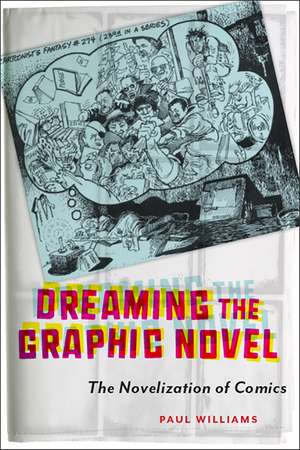
Dreaming the Graphic Novel: The Novelization of Comics
Autor Paul Williamsen Limba Engleză Paperback – 17 ian 2020 – vârsta ani
Honorable Mention, 2019-2020 Research Society for American Periodicals Book Prize
The term “graphic novel” was first coined in 1964, but it wouldn’t be broadly used until the 1980s, when graphic novels such as Watchmen and Maus achieved commercial success and critical acclaim. What happened in the intervening years, after the graphic novel was conceptualized yet before it was widely recognized?
Dreaming the Graphic Novel examines how notions of the graphic novel began to coalesce in the 1970s, a time of great change for American comics, with declining sales of mainstream periodicals, the arrival of specialty comics stores, and (at least initially) a thriving underground comix scene. Surveying the eclectic array of long comics narratives that emerged from this fertile period, Paul Williams investigates many texts that have fallen out of graphic novel history. As he demonstrates, the question of what makes a text a ‘graphic novel’ was the subject of fierce debate among fans, creators, and publishers, inspiring arguments about the literariness of comics that are still taking place among scholars today.
Unearthing a treasure trove of fanzines, adverts, and unpublished letters, Dreaming the Graphic Novel gives readers an exciting inside look at a pivotal moment in the art form’s development.
Preț: 233.31 lei
Puncte Express: 350
Preț estimativ în valută:
41.24€ • 48.84$ • 35.93£
41.24€ • 48.84$ • 35.93£
Carte indisponibilă temporar
Doresc să fiu notificat când acest titlu va fi disponibil:
Se trimite...
Specificații
ISBN-13: 9781978805064
ISBN-10: 1978805063
Pagini: 278
Ilustrații: 10 color photographs, 6 figures, 5 tables
Dimensiuni: 152 x 229 x 18 mm
Greutate: 0 kg
Ediția:None
Editura: Rutgers University Press
Colecția Rutgers University Press
ISBN-10: 1978805063
Pagini: 278
Ilustrații: 10 color photographs, 6 figures, 5 tables
Dimensiuni: 152 x 229 x 18 mm
Greutate: 0 kg
Ediția:None
Editura: Rutgers University Press
Colecția Rutgers University Press
Notă biografică
PAUL WILLIAMS is a Senior Lecturer in Twentieth-Century Literature at the University of Exeter in the U.K. The author of the books Race, Ethnicity and Nuclear War: Representations of Nuclear Weapons and Post-Apocalyptic Worlds (2011) and Paul Gilroy (2012), he has also published numerous articles and book chapters on the history of comics.
Recenzii
"A thoughtful and engaging exploration of the complex disagreements and debates over the term, form and temporality of the 'graphic novel.'"
"Accessible and detailed, Williams’s study expands on previous scholarship on the evolution of comics into graphic narratives. Highly recommended."
"There is much to recommend in Williams’ examples of, and conversation around, long-form comics of the period provided throughout the book....An excellent corrective to the scatter-shot references one usually encounters [that] succeeds in correcting some long-standing misconceptions about the development of the graphic novel."
Review of Dreaming the Graphic Novel in Medienwissenschaft 01/2021
"Dreaming the Graphic Novel is a methodological wonder for scholars interested in American popular culture, digital humanities, text mining, and the history of comics and graphic novels. His mixed methodological approach allows him to successfully participate in 'the ongoing recovery of comics studies’ prehistory' as well as establish 'a new way of doing graphic novel history.' Williams’ book should be a required reading...for courses offering an introduction to graphic novels in the U.S. Comics fans, comics scholars, and those interested in the history of graphic novel might also find this a stimulating read."
"Dreaming the Graphic Novel undertakes the very important task of deepening our understanding of the origins of book format comics and giving a historical context to the anxieties around comics and graphic novels in the 2000s."
Descriere
This book examines the early history of the graphic novel in the 1970s, after the term was coined but before this art form achieved popular success and critical acclaim. Unearthing a treasure trove of fanzines, adverts, and unpublished letters, it gives readers an exciting inside look at a pivotal moment in the development of the graphic novel.