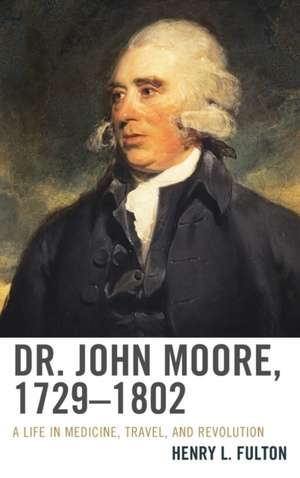
Dr. John Moore, 1729–1802: A Life in Medicine, Travel, and Revolution
Autor Henry L. Fultonen Limba Engleză Hardback – 24 dec 2014
In this biography Fulton covers not only Moore's publications but also discusses his circle of friends among nobility, politicians, artists, and others. Also discussed is Moore's involvement in the French Revolution, his correspondence with Robert Burns, and his strained family relationships. Additionally presented here is new information regarding Moore's finances drawn from archival records in Glasgow and Edinburgh and his bank ledgers in London.
Preț: 1098.83 lei
Preț vechi: 1209.31 lei
-9%
Puncte Express: 1648
Carte tipărită la comandă
Livrare economică 05-19 decembrie
Livrare prin curier în România Termenul estimat este afișat lângă disponibilitate.
Transport gratuit pentru acest produs Plată online sau ramburs, în funcție de opțiunile comenzii.
Retur gratuit în 14 zile Comandă securizată și suport în română.
Specificații
ISBN-13: 9781611494938
ISBN-10: 1611494931
Pagini: 810
Ilustrații: 14 BW Photos, 4 Tables
Dimensiuni: 163 x 237 x 55 mm
Greutate: 1.38 kg
Editura: Bloomsbury Publishing
Colecția University of Delaware Press
Locul publicării:New York, United States
ISBN-10: 1611494931
Pagini: 810
Ilustrații: 14 BW Photos, 4 Tables
Dimensiuni: 163 x 237 x 55 mm
Greutate: 1.38 kg
Editura: Bloomsbury Publishing
Colecția University of Delaware Press
Locul publicării:New York, United States
V-ar putea interesa
-
 Turmoil and Transition in Boston: A Political Memoir from the Busing EraLawrence S. DiCara-27%Preț: 229.07 lei312.71 lei
 -
 Frontier MadamJune ReadPreț: 105.28 lei
 -
 DisraeliSarah BradfordPreț: 209.48 lei
 -
 Fruits of EdenAmanda HarrisPreț: 152.91 lei
 -
 Fundraiser A: My Fight for Freedom and JusticeRobert BlagojevichPreț: 132.76 lei
 -
 Dustoff 7-3Erik SabistonPreț: 83.42 lei
 -
 Preț: 89.13 lei
 -
 A Political Life in Ming China: A Grand Secretary and His TimesJohn W. Dardess-34%Preț: 630.91 lei957.00 lei
 -
 -34%Preț: 603.24 lei912.02 lei
 -
 Germany Player M.P. in MunichThomas Leslie DonnellPreț: 76.79 lei
 -
 From Green Hills to Blue SeasJames A. SagerholmPreț: 115.45 lei
 -
 No Silent WitnessCynthia Grant TuckerPreț: 108.20 lei
 -
 The Promise of the WestMary Barmeyer O'BrienPreț: 100.32 lei
 -
 Best Outdoor Adventures ChattanoogaJohnny MolloyPreț: 157.20 lei
 -
 -33%Preț: 704.35 lei1054.11 lei
 -
 The Annotated Two Years Before the MastRichard Henry DanaPreț: 199.28 lei
 -
 Bernhard Karlgren: Portrait of A ScholarN. G. D. Malmqvist-37%Preț: 660.87 lei1054.54 lei
 -
 -28%Preț: 289.45 lei404.15 lei
 -
 Remembering Ernie KuckMarilyn G EricksenPreț: 127.61 lei
 -
 Preț: 127.12 lei
 -
 Robert C. ByrdRobert C ByrdPreț: 205.96 lei
 -
 Lebenserinnerungen Und Denkschriften: Mit Ungedruckten Briefen, Gedichten Und Einer Autobiographie GeibelsHeinrich Friedrich Karl vom und zum SteinPreț: 386.64 lei
 -
 Preț: 222.02 lei
 -
 General Ne WinRobert Taylor-8%Preț: 497.38 lei540.63 lei
 -
 Preț: 259.13 lei
 -
 Preț: 395.10 lei
Cuprins
Preface
Acknowledgments
Abbreviations
Note on Quotations and Citations
List of Illustrations
Chapter 1: The Reverend Charles Moore
Chapter 2: The Saltmarket
Chapter 3: Medical Training, Glasgow
Chapter 4: Flanders, London, and Paris
Chapter 5: Establishment
Chapter 6: Practice
Chapter 7: Family and Friendships
Chapter 8: The Hamilton Cause
Chapter 9: Geneva
Chapter 10: Germany and Austria
Chapter 11: Italy
Chapter 12: Clarges Street
Chapter 13: Clifford Street
Chapter 14: Patronage
Chapter 15: Zeluco
Chapter 16: Parliamentary Watch
Chapter 17: Paris, 1792
Chapter 18: Reflections on the Revolution
Chapter 19: The War Years
Chapter 20: Richmond
Chapter 21: Death
Bibliography
Acknowledgments
Abbreviations
Note on Quotations and Citations
List of Illustrations
Chapter 1: The Reverend Charles Moore
Chapter 2: The Saltmarket
Chapter 3: Medical Training, Glasgow
Chapter 4: Flanders, London, and Paris
Chapter 5: Establishment
Chapter 6: Practice
Chapter 7: Family and Friendships
Chapter 8: The Hamilton Cause
Chapter 9: Geneva
Chapter 10: Germany and Austria
Chapter 11: Italy
Chapter 12: Clarges Street
Chapter 13: Clifford Street
Chapter 14: Patronage
Chapter 15: Zeluco
Chapter 16: Parliamentary Watch
Chapter 17: Paris, 1792
Chapter 18: Reflections on the Revolution
Chapter 19: The War Years
Chapter 20: Richmond
Chapter 21: Death
Bibliography
Recenzii
Nominally, a biography attempts to provide an account of a particular chosen life. However, in adroit hands it can also illumine the surroundings of its subject, detailing a life lived within the wider contexts of a vibrant and vital world. Such an example may be found in Henry L Fulton's book: as well as describing John Moore from cradle to grave, it provides an in-depth and fascinating portrait of the multifarious spheres - professional, personal, cultural, political - Moore inhabited. . . .This book, substantial and substantive, will stand as the definitive version on its subject for many decades. . . .[I]n the biography of John Moore, the richness and variety of a life lived through a wide variety of intellectual and cultural pursuits is demonstrated. Henry L Fulton should be commended in producing not only a work of considerable scholarly learning, but also for providing a readable account of this heterogeneous and fascinating figure.
Henry L. Fulton has spent decades engaged in this task, and it shows, not only in the heft of the book, but in the depth and breadth of the coverage. . . .Medicine is a case in point.Dr. John Moore is a rich, comprehensive biography that is not only sure to be the definitive life of its subject but also a work of great interest to scholars in many different fields, including medicine.
Fulton's biography assembles the pieces of Moore's life with admirable clarity and depth, offering extensive analyses of its various phases; throughout the biography, one finds many intriguing portrayals of Moore and his milieus based on primary research and the author's extensive knowledge of his subject.... Fulton's detailed and shrewd biography provides much insight not only into Moore's eventful life but also offers commentary on the tumultuous periods during which he was active in literature and political affairs.... Fulton has indeed succeeded in bringing the life and work of Dr. John Moore back to light; this biography is a major work in the fields of biography and social history, and it will serve as the definitive life of Moore and his intellectual and political milieus for years to come. Fulton is to be highly commended for the care and attention that went into this invaluable work of scholarship, and readers will be rewarded for his efforts to recover the cultural legacy of a major neglected writer and thinker of the Scottish Enlightenment.
Henry L. Fulton has spent decades engaged in this task, and it shows, not only in the heft of the book, but in the depth and breadth of the coverage. . . .Medicine is a case in point.Dr. John Moore is a rich, comprehensive biography that is not only sure to be the definitive life of its subject but also a work of great interest to scholars in many different fields, including medicine.
Fulton's biography assembles the pieces of Moore's life with admirable clarity and depth, offering extensive analyses of its various phases; throughout the biography, one finds many intriguing portrayals of Moore and his milieus based on primary research and the author's extensive knowledge of his subject.... Fulton's detailed and shrewd biography provides much insight not only into Moore's eventful life but also offers commentary on the tumultuous periods during which he was active in literature and political affairs.... Fulton has indeed succeeded in bringing the life and work of Dr. John Moore back to light; this biography is a major work in the fields of biography and social history, and it will serve as the definitive life of Moore and his intellectual and political milieus for years to come. Fulton is to be highly commended for the care and attention that went into this invaluable work of scholarship, and readers will be rewarded for his efforts to recover the cultural legacy of a major neglected writer and thinker of the Scottish Enlightenment.