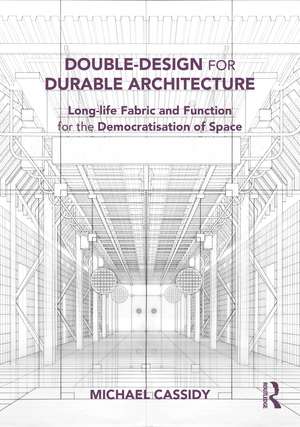
Double-Design for Durable Architecture: Long-life Fabric and Function for the Democratisation of Space
Autor Michael Cassidyen Limba Engleză Hardback – 29 dec 2025
Through the assessment of compatibilities of the physical requirements for buildings serving different uses over time, this book suggests an approach that establishes a long-life infrastructure within which shorter-life and recyclable material may be used in the fit-out to serve each successive use. Over time, the implementation of Double-Design would provide buildings that are more suited to the changing needs of the future.
Guided by sixty years of professional experience as an architect, planner and teacher, Dr. Cassidy considers the underlying assumptions that provide the present context for design and construction. Building upon the work of many scholars and practitioners, he suggests that Double-Design could contribute to the reinvigoration of architecture by keeping it grounded in serving human needs.
This is essential reading for practising architects, those entering the profession and anyone interested in the built environment's future. This book is considered an important contribution to the debate about the future of architecture in the new era of information.
Preț: 904.99 lei
Preț vechi: 1196.67 lei
-24% Nou
Puncte Express: 1357
Preț estimativ în valută:
160.27€ • 187.18$ • 139.23£
160.27€ • 187.18$ • 139.23£
Carte indisponibilă temporar
Doresc să fiu notificat când acest titlu va fi disponibil:
Se trimite...
Preluare comenzi: 021 569.72.76
Specificații
ISBN-13: 9781032896298
ISBN-10: 1032896299
Pagini: 354
Ilustrații: 262
Dimensiuni: 174 x 246 mm
Greutate: 0.81 kg
Ediția:1
Editura: Taylor & Francis
Colecția Routledge
Locul publicării:Oxford, United Kingdom
ISBN-10: 1032896299
Pagini: 354
Ilustrații: 262
Dimensiuni: 174 x 246 mm
Greutate: 0.81 kg
Ediția:1
Editura: Taylor & Francis
Colecția Routledge
Locul publicării:Oxford, United Kingdom
Public țintă
Postgraduate, Professional Practice & Development, and Undergraduate AdvancedCuprins
1. BASIS FOR DOUBLE-DESIGN 2. ARCHITECTURE AND PEOPLE 3. DESIGN IMPERATIVES TO ACHIEVE USE LONGEVITY 4. DESIGN IMPERATIVES TO ACHIEVE MATERIAL LONGEVITY 5. CASE STUDY AND PRECEDENTS 6. THE WAY FORWARD 7. IMPLEMENTATION AND IMPACT 8. CONCLUSIONS AND FUTURE RESEARCH
Recenzii
“Double-Design is a visionary concept that has the potential to redefine architecture for a sustainable future; it addresses key challenges of resource efficiency, waste reduction, and uncertainty. Double-Design offers a pathway to reconcile tradition with innovation. It is a call to architects to embrace their role not just as creators of buildings, but as stewards of a built environment that serves both present and future generations”
Axel Ilhuicamina, Architect, Mexico
“Music to the ear in a world that is stridently discordant. A few thousand years ago humans took shelter in caves to protect themselves from changes in the environment. As the species succeeded, accommodation was expanded by excavating additional spaces; simple and effective with little environmental impact. Numbers have caused us now to operate in the built environment but we would be well advised to retain the same principles where shelter is more or less permanent and can be adapted to fulfil changing roles and requirements. Double-Design […] will make sufficient differences to the environment to make the future desirable again.”
Richard A D’Arcy, Architect and CAD Pioneer
“I see Double-Design as one of several strategies that could lead to more responsive and inclusive environments. At a concept absorption level – with Universal Design pointing towards ergonomics, inclusivity and personalisation, and Sustainable Design addressing the energy (operational and embodied) consumption – I have a sense that Double-Design is a wider overarching framework – about ‘place-making over time’ giving the environment – and its fabric – time to breathe over a couple of generations.”
Rod Bond, Architect and IT Researcher, Ireland, UK
“In learning to become an architect, it is to some extent far more important to acquire an attitude and a manner than a specific to-do list. [This] book is a great place for clarification and understanding many frustrations, confusions and complexities faced by students and architects at different career stages. Longitudinally, buildings last and should last for a long time. So do and should our architectural career and our education.”
Quinsan Ciao, Professor of Architecture, China
Axel Ilhuicamina, Architect, Mexico
“Music to the ear in a world that is stridently discordant. A few thousand years ago humans took shelter in caves to protect themselves from changes in the environment. As the species succeeded, accommodation was expanded by excavating additional spaces; simple and effective with little environmental impact. Numbers have caused us now to operate in the built environment but we would be well advised to retain the same principles where shelter is more or less permanent and can be adapted to fulfil changing roles and requirements. Double-Design […] will make sufficient differences to the environment to make the future desirable again.”
Richard A D’Arcy, Architect and CAD Pioneer
“I see Double-Design as one of several strategies that could lead to more responsive and inclusive environments. At a concept absorption level – with Universal Design pointing towards ergonomics, inclusivity and personalisation, and Sustainable Design addressing the energy (operational and embodied) consumption – I have a sense that Double-Design is a wider overarching framework – about ‘place-making over time’ giving the environment – and its fabric – time to breathe over a couple of generations.”
Rod Bond, Architect and IT Researcher, Ireland, UK
“In learning to become an architect, it is to some extent far more important to acquire an attitude and a manner than a specific to-do list. [This] book is a great place for clarification and understanding many frustrations, confusions and complexities faced by students and architects at different career stages. Longitudinally, buildings last and should last for a long time. So do and should our architectural career and our education.”
Quinsan Ciao, Professor of Architecture, China
Notă biografică
Michael Cassidy graduated in 1962 with First Class Honours in Architecture from University College, London, and received his Master's degree in 1970 in City and Regional Planning from the University of California, Berkeley, where he was a Harkness Fellow. The University of Plymouth recently awarded him his Doctorate in Architecture. Following experience in hospital research, teaching and design, he was appointed leader of the Environmental Studies Group in the Greater London Council. From 1975, he worked as an architect and planner in private practice and has been responsible for the design and execution of more than one million square meters of buildings in twenty-six countries. He has held academic positions at University College, London, the Regent's Street Polytechnic (now University of Middlesex), Washington University, St Louis, the Centre for Planning and Development Research, UC, Berkeley, Kuwait University Department of Architecture and Gulf University for Science and Technology. He is a Registered Architect in the UK. He has published widely in the technical press and has held exhibitions of his paintings in Kuwait and Mexico.
Descriere
In this book, Michael Cassidy argues that the built environment should be designed to last physically for a very long time, saving on valuable material resources. This is essential reading for practising architects, those entering the profession, and anyone interested in the built environment's future.