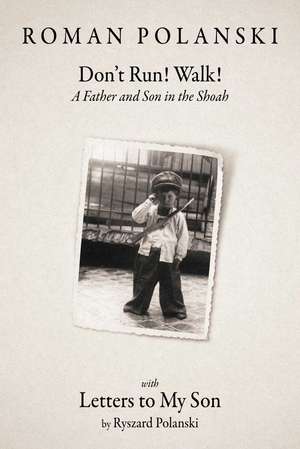
Don't Run! Walk!: A Father and Son in the Shoah
Autor Roman Polanskien Limba Engleză Hardback – 18 iun 2026
Preț: 163.13 lei
Puncte Express: 245
Carte disponibilă
Livrare economică 27 octombrie-10 noiembrie
Livrare prin curier în România Termenul estimat este afișat lângă disponibilitate.
Transport gratuit de la 400.00 lei Plată online sau ramburs, în funcție de opțiunile comenzii.
Retur gratuit în 14 zile Comandă securizată și suport în română.
Specificații
ISBN-13: 9781964219318
ISBN-10: 1964219310
Pagini: 192
Dimensiuni: 152 x 229 x 23 mm
Greutate: 0.41 kg
Editura: RatPac Press
Colecția RatPac Press
ISBN-10: 1964219310
Pagini: 192
Dimensiuni: 152 x 229 x 23 mm
Greutate: 0.41 kg
Editura: RatPac Press
Colecția RatPac Press
V-ar putea interesa
-
 Father and SonJonathan Raban-34%Preț: 51.52 lei78.22 lei
 -
 But You Did Not Come BackMarceline Loridan-IvensPreț: 76.18 lei
 -
 The PianistWladyslaw Szpilman-27%Preț: 67.53 lei92.81 lei
 -
 Kiss the Red StairsMarsha LedermanPreț: 97.88 lei
 -
 PedigreePatrick Modiano-29%Preț: 54.23 lei76.23 lei
 -
 -19%Preț: 46.26 lei56.88 lei
 -
 -16%Preț: 66.09 lei79.10 lei
 -
 -27%Preț: 66.73 lei91.65 lei
 -
 A Little Girl in AuschwitzLidia Maksymowicz-41%Preț: 45.68 lei77.07 lei
 -
 My Dear Boy: A World War II Story of Escape, Exile, and RevelationJoanie Holzer SchirmPreț: 152.40 lei
 -
 -19%Preț: 222.73 lei275.10 lei
 -
 Who Will Tell My Story?AnonymousPreț: 94.71 lei
 -
 Brief Stop on the Road from AuschwitzGöran RosenbergPreț: 71.64 lei
 -
 My Name is StramerMikolaj LozinskiPreț: 106.67 lei
 -
 Run Towards The DangerSarah Polley-19%Preț: 68.86 lei85.00 lei
 -
 Along the Roads to HellMichael AdmiraalPreț: 80.22 lei
 -
 Reckoning: A MemoirMagda Szubanski-16%Preț: 81.15 lei96.75 lei
 -
 After the Holocaust the Bells Still RingJoseph PolakPreț: 138.59 lei
Notă biografică
Roman Polanski is one of the most acclaimed filmmakers in the history of cinema. He was born in Paris in 1933. Winner of the Academy Award for directing and numerous prizes at Cannes, Venice, and Berlin, Polanski has directed over thirty films, including Rosemary’s Baby, Chinatown, Tess, The Pianist, The Ghost Writer, and An Officer and a Spy. In 1984, he published his autobiography, Roman by Polanski.
Recenzii
This is not a memoir shaped by hindsight or consolation. It is the remembered world of a child thrust into catastrophe—too young to understand what was happening yet forced to endure it. The author was six years old when the war began and twelve when it ended. What marked him was not hunger or fear, but abandonment, loneliness, and the relentless hope of finding his parents.
This book is drawn from many hours of recorded testimony, originally given for major Holocaust archival projects. The narrative preserves the texture of spoken memory—its digressions, hesitations, and breaks—refusing the false clarity that distance and editing can impose. It is a singular, subjective account, yet inseparable from the unprecedented historical crime of the attempted extermination of European Jews.
This book is drawn from many hours of recorded testimony, originally given for major Holocaust archival projects. The narrative preserves the texture of spoken memory—its digressions, hesitations, and breaks—refusing the false clarity that distance and editing can impose. It is a singular, subjective account, yet inseparable from the unprecedented historical crime of the attempted extermination of European Jews.