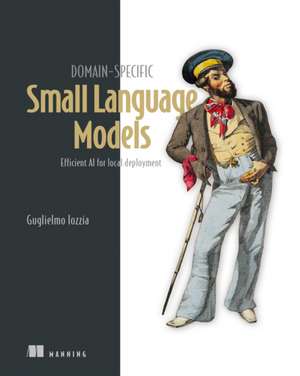
Domain-Specific Small Language Models
Autor Guglielmo Iozziaen Limba Engleză Hardback – 29 iun 2026
When you need a language model to respond accurately and quickly about a specific field of knowledge, the sprawling capacity of a LLM may hurt more than it helps. This book teaches you to build generative AI models optimized for specific fields.
Perfect for cost- or hardware-constrained environments, Small Language Models (SLMs) train on domain specific data for high-quality results in specific tasks. In this book you’ll develop SLMs that can generate everything from Python code to protein structures and antibody sequences—all on commodity hardware.
In Domain-Specific Small Language Models you’ll discover:
• Model sizing best practices
• Open source libraries, frameworks, utilities and runtimes
• Fine-tuning techniques for custom datasets
• Hugging Face’s libraries for SLMs
• Running SLMs on commodity hardware
• Model optimization or quantization
Foreword by Matthew R. Versaggi.
About the technology
Small-footprint language models trained on custom data sets and hosted locally can perform as well as large generalist models in speed and accuracy, often at a fraction of the cost. Domain-Specific Small Language Models shows you how to build privacy-preserving and regulation-compliant SLMs for agentic systems, specialist applications, and deployment on the edge.
About the book
This is a practical book that shows you how to adapt pretrained open source models to your domain using transfer learning and parameter-efficient fine-tuning. You’ll learn to minimize cost through optimization and quantization, develop secure APIs to serve your models, and deploy SLMs on commodity hardware—including small devices. The hands-on examples include integrating SLMs into RAG systems and agentic workflows.
What's inside
• ONNX and other quantization methods
• Integrate SLMs into end-to-end applications
• Deploy SLMs on laptops, smartphones, and other devices
About the reader
For AI engineers familiar with Python.
About the author
Guglielmo Iozzia is a Director of AI and Applied Mathematics at Merck & Co. and a Distinguished Member of the American Society for Artificial Intelligence. He specializes in AI biomedical applications.
The technical editor on this book was Riccardo Mattivi.
Table of Contents
Part 1
1 Small language models
Part 2
2 Tuning for a specific domain
3 End-to-end transformer fine-tuning
4 Running inference
5 Exploring ONNX
6 Quantizing for your production environment
Part 3
7 Generating Python code
8 Generating protein structures
Part 4
9 Advanced quantization techniques
10 Profiling insights
11 Deployment and serving
12 Running on your laptop
13 Creating end-to-end LLM applications
14 Advanced components for LLM applications
15 Test-time compute and small language models
Preț: 336.89 lei
Preț vechi: 421.11 lei
-20%
Puncte Express: 505
Carte disponibilă
Livrare economică 27 octombrie-10 noiembrie
Livrare prin curier în România Termenul estimat este afișat lângă disponibilitate.
Transport gratuit de la 400.00 lei Plată online sau ramburs, în funcție de opțiunile comenzii.
Retur gratuit în 14 zile Comandă securizată și suport în română.
Specificații
ISBN-13: 9781633436701
ISBN-10: 1633436705
Pagini: 376
Dimensiuni: 185 x 232 x 24 mm
Greutate: 0.52 kg
Editura: Manning Publications
ISBN-10: 1633436705
Pagini: 376
Dimensiuni: 185 x 232 x 24 mm
Greutate: 0.52 kg
Editura: Manning Publications
Descriere
Perfect for cost- or hardware-constrained environments, Small Language Models (SLMs) train on domain specific data for high-quality results in specific tasks. In Domain-Specific Small Language Models you’ll develop SLMs that can generate everything from Python code to protein structures and antibody sequences—all on commodity hardware.