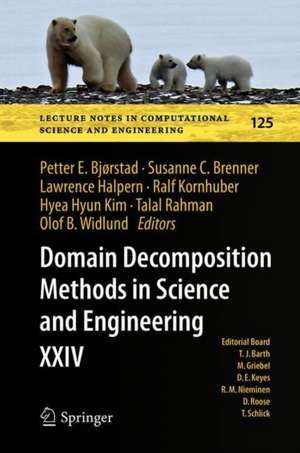
Domain Decomposition Methods in Science and Engineering XXIV
Editat de Petter E. Bjørstad, Susanne C. Brenner, Lawrence Halpern, Hyea Hyun Kim, Ralf Kornhuber, Talal Rahman, Olof B. Widlunden Limba Engleză Hardback – 6 ian 2019
These are the proceedings of the 24th International Conference on Domain Decomposition Methods in Science and Engineering, which was held in Svalbard, Norway in February 2017.
Domain decomposition methods are iterative methods for solving the often very large systems of equations that arise when engineering problems are discretized, frequently using finite elements or other modern techniques. These methods are specifically designed to make effective use of massively parallel, high-performance computing systems.
The book presents both theoretical and computational advances in this domain, reflecting the state of art in 2017.
Domain decomposition methods are iterative methods for solving the often very large systems of equations that arise when engineering problems are discretized, frequently using finite elements or other modern techniques. These methods are specifically designed to make effective use of massively parallel, high-performance computing systems.
The book presents both theoretical and computational advances in this domain, reflecting the state of art in 2017.
Preț: 928.84 lei
Preț vechi: 1132.72 lei
-18%
Puncte Express: 1393
Preț estimativ în valută:
164.23€ • 194.87$ • 142.79£
164.23€ • 194.87$ • 142.79£
Carte tipărită la comandă
Livrare economică 01-15 aprilie
Specificații
ISBN-13: 9783319938721
ISBN-10: 331993872X
Pagini: 592
Ilustrații: XXII, 570 p. 129 illus., 110 illus. in color.
Dimensiuni: 160 x 241 x 38 mm
Greutate: 1.05 kg
Ediția:1st ed. 2018
Editura: Springer
Locul publicării:Cham, Switzerland
ISBN-10: 331993872X
Pagini: 592
Ilustrații: XXII, 570 p. 129 illus., 110 illus. in color.
Dimensiuni: 160 x 241 x 38 mm
Greutate: 1.05 kg
Ediția:1st ed. 2018
Editura: Springer
Locul publicării:Cham, Switzerland
Cuprins
Part I Plenary Talks (PT).- Part II Talks in Minisymposia (MT).- Part III Contributed Talks and Posters (CT).
Textul de pe ultima copertă
These are the proceedings of the 24th International Conference on Domain Decomposition Methods in Science and Engineering, which was held in Svalbard, Norway in February 2017.
Domain decomposition methods are iterative methods for solving the often very large systems of equations that arise when engineering problems are discretized, frequently using finite elements or other modern techniques. These methods are specifically designed to make effective use of massively parallel, high-performance computing systems.
The book presents both theoretical and computational advances in this domain, reflecting the state of art in 2017.
Domain decomposition methods are iterative methods for solving the often very large systems of equations that arise when engineering problems are discretized, frequently using finite elements or other modern techniques. These methods are specifically designed to make effective use of massively parallel, high-performance computing systems.
The book presents both theoretical and computational advances in this domain, reflecting the state of art in 2017.