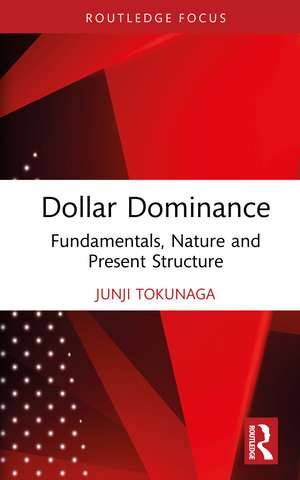
Dollar Dominance: Fundamentals, Nature, and Present Structure: Routledge Focus on Economics and Finance
Autor Junji Tokunagaen Limba Engleză Hardback – 30 apr 2026
It begins by drawing upon Minsky and Kindleberger’s financial fragility hypothesis, explaining how analysis of dynamics in balance sheet expansion helps to reveal the fundamentals of the dollar standard system. It then examines the dollar standard system in the 2000s and during the Global Financial Crisis (GFC) of 2007-09, showing how endogenous finance of the dollar drove said banks to overstretch their balance sheets. An analysis of the dollar standard system post-crisis suggests that US Treasury securities as universal collateral assets have acted as a bedrock for the present dollar standard system.
Dollar Dominance will interest scholars and graduate students of international finance, monetary systems, money, and banking. It is also a useful resource for central bankers, financial regulators, and other finance industry professionals.
Din seria Routledge Focus on Economics and Finance
-
 Preț: 217.24 lei
 - 8%
 Preț: 545.00 lei
 -
 Preț: 213.22 lei
 -
 Preț: 222.82 lei
 -
 Preț: 237.80 lei
 -
 Preț: 231.62 lei
 - 15%
 Preț: 431.97 lei
 - 15%
 Preț: 447.63 lei
 -
 Preț: 187.00 lei
 -
 Preț: 212.21 lei
 -
 Preț: 245.40 lei
 - 15%
 Preț: 428.70 lei
 -
 Preț: 233.46 lei
 -
 Preț: 225.37 lei
 -
 Preț: 187.00 lei
 -
 Preț: 471.07 lei
 -
 Preț: 233.72 lei
 -
 Preț: 230.76 lei
 -
 Preț: 203.26 lei
 -
 Preț: 186.99 lei
 - 15%
 Preț: 420.28 lei
 - 15%
 Preț: 430.16 lei
 -
 Preț: 233.79 lei
 -
 Preț: 220.45 lei
 -
 Preț: 221.51 lei
 -
 Preț: 219.85 lei
 - 8%
 Preț: 441.65 lei
 -
 Preț: 439.83 lei
 -
 Preț: 495.56 lei
 -
 Preț: 220.70 lei
 -
 Preț: 218.15 lei
Preț: 443.70 lei
Preț vechi: 482.28 lei
-8%
Puncte Express: 666
Carte disponibilă
Livrare economică 13-27 noiembrie
Livrare express 29 octombrie-04 noiembrie pentru 27.32 lei
Livrare prin curier în România Termenul estimat este afișat lângă disponibilitate.
Transport gratuit pentru acest produs Plată online sau ramburs, în funcție de opțiunile comenzii.
Retur gratuit în 14 zile Comandă securizată și suport în română.
Specificații
ISBN-13: 9781041227878
ISBN-10: 1041227876
Pagini: 136
Ilustrații: 30
Dimensiuni: 138 x 216 mm
Greutate: 0.31 kg
Ediția:1
Editura: Taylor & Francis
Colecția Routledge
Seria Routledge Focus on Economics and Finance
Locul publicării:Oxford, United Kingdom
ISBN-10: 1041227876
Pagini: 136
Ilustrații: 30
Dimensiuni: 138 x 216 mm
Greutate: 0.31 kg
Ediția:1
Editura: Taylor & Francis
Colecția Routledge
Seria Routledge Focus on Economics and Finance
Locul publicării:Oxford, United Kingdom
Public țintă
AcademicCuprins
Foreword by Gerald Epstein
Preface
List of Abbreviations
Acknowledgements
Part I: Our approach
Chapter 1. Introduction
1. Literature review on the US dollar standard system
2. The money view in offshore context
3. Global capital flows since the 2000s
Chapter 2. Minsky and Kindleberger’s framework on endogenous finance of money
1. Asset and liability management strategy
2. Procyclical mechanism of gross balance sheets during euphoria
3. Characteristics of Minsky and Kindleberger’s framework
Part II: The fundamentals of the US dollar standard system
Chapter 3. The comparative advantage of the US shadow banking system in the 2000s
1. The structural shortage of global safe assets in the 2000s
2. Shadow banking system
3. The fuller development of the US shadow banking system in the 2000s
4. The underdevelopment of the shadow banking system in the Eurozone in the 2000s
5. The evolution of US Fed policy
6. The US dollar’s dominance in the shadow banking system in the 2000s
Part III: The nature of the US dollar standard system
Chapter 4. The endogenous finance of the global dollar in the shadow banking system in the 2000s
1. Dealer banks in the shadow banking system
2. Global repurchase agreements
3. The endogenously elastic finance of the global dollar in the shadow banking system
Chapter 5: Global financial fragility during the US housing bubble and the Global Financial Crisis (GFC) of 2007-09
1. The changes in financial conditions during the US housing bubble
2. The endogenously highly elastic finance of the global dollar in the shadow banking system
3. The Global Financial Crisis of 2007-09
Part IV: The present structure of the US dollar standard system
Chapter 6. The unparalleled status of US Treasury securities as collateral assets in the 2010s
1. The evolution in the US Fed role as lender of last resort during the GFC
2. The intensification in the structural shortage of global safe assets in the 2010s
3. The less developed dynamics in the US shadow banking system in the 2010s
4. The underdevelopment of the shadow banking system in the Eurozone in the 2010s
5. The US Treasury securities as universal collateral assets in the 2010s
Chapter 7. The US dollar standard system at a watershed
1. The structural imbalances for US Treasury market intermediation since the GFC
2. The COVID-19 financial meltdown in US Treasury markets in March 2020
3. The dysfunctionality in US Treasury securities as universal collateral assets
Chapter 8. Conclusion
Preface
List of Abbreviations
Acknowledgements
Part I: Our approach
Chapter 1. Introduction
1. Literature review on the US dollar standard system
2. The money view in offshore context
3. Global capital flows since the 2000s
Chapter 2. Minsky and Kindleberger’s framework on endogenous finance of money
1. Asset and liability management strategy
2. Procyclical mechanism of gross balance sheets during euphoria
3. Characteristics of Minsky and Kindleberger’s framework
Part II: The fundamentals of the US dollar standard system
Chapter 3. The comparative advantage of the US shadow banking system in the 2000s
1. The structural shortage of global safe assets in the 2000s
2. Shadow banking system
3. The fuller development of the US shadow banking system in the 2000s
4. The underdevelopment of the shadow banking system in the Eurozone in the 2000s
5. The evolution of US Fed policy
6. The US dollar’s dominance in the shadow banking system in the 2000s
Part III: The nature of the US dollar standard system
Chapter 4. The endogenous finance of the global dollar in the shadow banking system in the 2000s
1. Dealer banks in the shadow banking system
2. Global repurchase agreements
3. The endogenously elastic finance of the global dollar in the shadow banking system
Chapter 5: Global financial fragility during the US housing bubble and the Global Financial Crisis (GFC) of 2007-09
1. The changes in financial conditions during the US housing bubble
2. The endogenously highly elastic finance of the global dollar in the shadow banking system
3. The Global Financial Crisis of 2007-09
Part IV: The present structure of the US dollar standard system
Chapter 6. The unparalleled status of US Treasury securities as collateral assets in the 2010s
1. The evolution in the US Fed role as lender of last resort during the GFC
2. The intensification in the structural shortage of global safe assets in the 2010s
3. The less developed dynamics in the US shadow banking system in the 2010s
4. The underdevelopment of the shadow banking system in the Eurozone in the 2010s
5. The US Treasury securities as universal collateral assets in the 2010s
Chapter 7. The US dollar standard system at a watershed
1. The structural imbalances for US Treasury market intermediation since the GFC
2. The COVID-19 financial meltdown in US Treasury markets in March 2020
3. The dysfunctionality in US Treasury securities as universal collateral assets
Chapter 8. Conclusion
Recenzii
“In the spirit of Minsky and Kindleberger, Tokunaga offers an original account of dollar dominance, highlighting its dynamic and crisis-prone nature. He locates its core in endogenous, collateral-driven shadow banking and balance-sheet dynamics, with United States Treasury securities serving as universal collateral. This distinctive agenda goes beyond available accounts. A must-read!”
Hasan Cӧmert, Associate Professor of Economics at Trinity College, CT, USA
“How has the dollar survived at the top of the international currency pyramid through decades of global financial turmoil? Is it destined to remain at the top indefinitely? Junji Tokunaga’s Dollar Dominance: Fundamentals, Nature, and Present Structure addresses these important questions with careful, painstaking, and extremely clear analyses of the recent history and underlying structures of the international financial markets and their relationship with the US dollar. The book is remarkable in that it tackles enormously complex issues–such as the underlying 'plumbing' of various financial markets–with great clarity and ease of exposition. I hope all my students read this excellent book. I know I will assign it to them.”
Gerald Epstein, Professor of Economics and Co-Director of Political Economy Research Institute (PERI), University of Massachusetts Amherst, USA
“This book unravels an enigma as follows: What supports the US dollar hegemony in the last few decades of financialization in which all kinds of wealth present itself as ‘an immense amount of fictitious capital’?”
Takuyoshi Takada, Emeritus Professor at Chuo University, Tokyo, Japan
Hasan Cӧmert, Associate Professor of Economics at Trinity College, CT, USA
“How has the dollar survived at the top of the international currency pyramid through decades of global financial turmoil? Is it destined to remain at the top indefinitely? Junji Tokunaga’s Dollar Dominance: Fundamentals, Nature, and Present Structure addresses these important questions with careful, painstaking, and extremely clear analyses of the recent history and underlying structures of the international financial markets and their relationship with the US dollar. The book is remarkable in that it tackles enormously complex issues–such as the underlying 'plumbing' of various financial markets–with great clarity and ease of exposition. I hope all my students read this excellent book. I know I will assign it to them.”
Gerald Epstein, Professor of Economics and Co-Director of Political Economy Research Institute (PERI), University of Massachusetts Amherst, USA
“This book unravels an enigma as follows: What supports the US dollar hegemony in the last few decades of financialization in which all kinds of wealth present itself as ‘an immense amount of fictitious capital’?”
Takuyoshi Takada, Emeritus Professor at Chuo University, Tokyo, Japan
Notă biografică
Junji Tokunaga is a Professor at the Department of Economics, Dokkyo University, Saitama, Japan. His research focuses on the international monetary system.
Descriere
This book critically analyzes the US dollar’s dominance as an international currency through an analysis of US dollar gross balance sheets in the shadow banking system at global, systematically important banks.