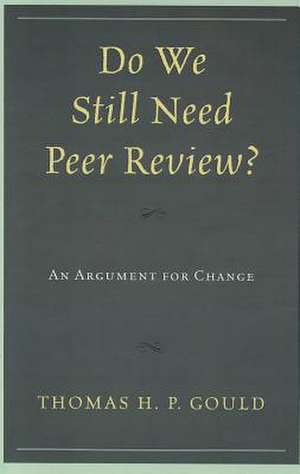
Do We Still Need Peer Review?: An Argument for Change
Autor Thomas H. P. Goulden Limba Engleză Paperback – 20 noi 2012
As new technology provides authors with a direct, unsupervised route to publication, the peer review situation is nearing a tipping point, beyond which the nature of academic research will be profoundly altered. This book proposes that rather than tossing out peer review altogether, the process can be saved and made stronger, offering suggestions on how to do just that.
Preț: 507.07 lei
Preț vechi: 730.76 lei
-31%
Puncte Express: 761
Carte tipărită la comandă
Livrare economică 16-30 noiembrie
Livrare prin curier în România Termenul estimat este afișat lângă disponibilitate.
Transport gratuit pentru acest produs Plată online sau ramburs, în funcție de opțiunile comenzii.
Retur gratuit în 14 zile Comandă securizată și suport în română.
Specificații
ISBN-13: 9780810885745
ISBN-10: 0810885743
Pagini: 175
Ilustrații: 3 BW Illustrations
Dimensiuni: 148 x 229 x 13 mm
Greutate: 0.27 kg
Editura: Bloomsbury Publishing
Colecția Scarecrow Press
Locul publicării:New York, United States
ISBN-10: 0810885743
Pagini: 175
Ilustrații: 3 BW Illustrations
Dimensiuni: 148 x 229 x 13 mm
Greutate: 0.27 kg
Editura: Bloomsbury Publishing
Colecția Scarecrow Press
Locul publicării:New York, United States
Cuprins
Preface
Acknowledgements
Chapter 1: What Is Peer Review and Why Do We Need It?
Chapter 2: Early Peer Review
Chapter 3: Peer Review 1600-1950
Chapter 4: Anonymous, Double-Blind Peer Review
Chapter 5: The Rise of the Internet, the Supremacy of the Individual
Chapter 6: Recent Suggested Solutions
Chapter 7: Option One - Eliminate Peer Review (partially and totally)
Chapter 8: Can We Review Ourselves?
Chapter 9: Private Industry and Academic Associations Solve It All (But Are Tenure Committees Left Holding the Bag?)
Chapter 10: The Future of Peer Review: What Have We Lost and What Can We Gain?
In Closing
Acknowledgements
Chapter 1: What Is Peer Review and Why Do We Need It?
Chapter 2: Early Peer Review
Chapter 3: Peer Review 1600-1950
Chapter 4: Anonymous, Double-Blind Peer Review
Chapter 5: The Rise of the Internet, the Supremacy of the Individual
Chapter 6: Recent Suggested Solutions
Chapter 7: Option One - Eliminate Peer Review (partially and totally)
Chapter 8: Can We Review Ourselves?
Chapter 9: Private Industry and Academic Associations Solve It All (But Are Tenure Committees Left Holding the Bag?)
Chapter 10: The Future of Peer Review: What Have We Lost and What Can We Gain?
In Closing
Recenzii
Do We Still Need Peer Review? is a compact book with more historical information than one would expect. The historical discussion not only adds perspective to the problem at hand, but is one of the most interesting aspects of the work. True to his word, Gould, rather than advocating for the abolishment of peer review, offers steps that can be taken to improve this important part of academia.
Peer review is one of the academic traditions that divide academia. While some believe it to be indispensable for separating bad research from good, others slam it as elitist, biased and, overall, ineffective. Starting from the 1970s, peer review has found itself under scrutiny that has resulted in a substantial body of research. Do We Still Need Peer Review? written by a mass communication scholar, Thomas Gould, contributes to this tradition by offering a truly Foucauldian analysis of peer review's origins and foundations. . . .[T]he monograph is well written, well argued and employs a wide range of (peer-reviewed) sources. Sure it will find supporters as well as sceptics among academic librarians, but, most importantly, it will start a much-needed conversation about the future of academic publishing, the role of academic librarians in research process and the place of peer review in the age of the Internet.
Peer review is one of the academic traditions that divide academia. While some believe it to be indispensable for separating bad research from good, others slam it as elitist, biased and, overall, ineffective. Starting from the 1970s, peer review has found itself under scrutiny that has resulted in a substantial body of research. Do We Still Need Peer Review? written by a mass communication scholar, Thomas Gould, contributes to this tradition by offering a truly Foucauldian analysis of peer review's origins and foundations. . . .[T]he monograph is well written, well argued and employs a wide range of (peer-reviewed) sources. Sure it will find supporters as well as sceptics among academic librarians, but, most importantly, it will start a much-needed conversation about the future of academic publishing, the role of academic librarians in research process and the place of peer review in the age of the Internet.