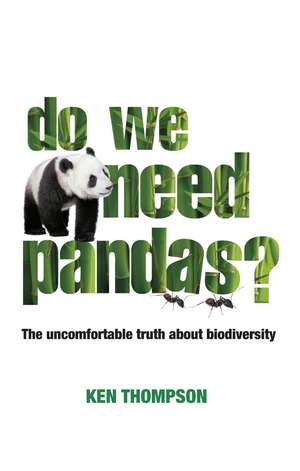
Do We Need Pandas?: The Uncomfortable Truth About Biodiversity
Autor Ken Thompsonen Limba Engleză Paperback – 14 sep 2010
All over the world, biodiversity is gravely threatened - by overfishing, habitat destruction, pollution and climate change. Yet life on Earth has previously experienced five episodes of mass extinction, and nature has repeatedly proved itself to be a resilient, regenerative force.
In this fascinating book, ecologist Dr. Ken Thompson surveys the Earth's biodiversity, its origins and some of the threats it currently faces. Thought-provoking and deeply engaging, Do We Need Pandas? offers a non-technical overview of our ecosystems and expands on the causes and consequences of biodiversity loss.
Importantly, it also examines what we should be doing to secure the survival not only of the species with which we share the planet, but of ourselves - and whether we need to be more concerned about ecosystems as a whole than about iconic species such as the orangutan and giant Panda.
Preț: 63.35 lei
Preț vechi: 111.90 lei
-43%
Puncte Express: 95
Preț estimativ în valută:
11.19€ • 12.97$ • 9.76£
11.19€ • 12.97$ • 9.76£
Carte disponibilă
Livrare economică 24 aprilie-08 mai
Livrare express 09-15 aprilie pentru 68.33 lei
Specificații
ISBN-13: 9781900322867
ISBN-10: 1900322862
Pagini: 160
Ilustrații: 7 black and white illustrations.
Dimensiuni: 134 x 214 x 16 mm
Greutate: 0.22 kg
Editura: Bloomsbury Publishing
Colecția Green Books
Locul publicării:London, United Kingdom
ISBN-10: 1900322862
Pagini: 160
Ilustrații: 7 black and white illustrations.
Dimensiuni: 134 x 214 x 16 mm
Greutate: 0.22 kg
Editura: Bloomsbury Publishing
Colecția Green Books
Locul publicării:London, United Kingdom
V-ar putea interesa
-
 The Diversity of LifeEdward O. Wilson-20%Preț: 72.01 lei89.59 lei
 -
 Biodiversity Conservation: A Very Short IntroductionDavid W. Macdonald-20%Preț: 54.71 lei68.52 lei
 -
 Preț: 200.32 lei
 -
 Extinctions: From Dinosaurs to YouCharles FrankelPreț: 140.33 lei
 -
 VanishedSadiah QureshiPreț: 221.22 lei
 -
 -15%Preț: 125.41 lei146.70 lei
 -
 The Future Of LifeProfessor Edward O. Wilson-29%Preț: 62.98 lei88.16 lei
 -
 BiodiversityJohn SpicerPreț: 69.41 lei
 -
 -27%Preț: 54.61 lei74.78 lei
 -
 -27%Preț: 99.94 lei136.42 lei
 -
 Our StoryColin Butfield-22%Preț: 124.69 lei160.13 lei
 -
 Before They VanishPaul R. EhrlichPreț: 166.81 lei
 -
 CornerstonesBenedict Macdonald-27%Preț: 54.45 lei74.67 lei
 -
 Lost WondersTom LathanPreț: 76.42 lei
 -
 The Hidden UniverseAlexandre Antonelli-20%Preț: 92.80 lei116.38 lei
 -
 The Anthropocene ReviewedJohn Green-31%Preț: 70.51 lei101.94 lei
 -
 Preț: 115.42 lei
 -
 -15%Preț: 80.86 lei94.97 lei
 -
 Human NatureKate MarvelPreț: 130.60 lei
 -
 Life on a Little-Known PlanetElizabeth KolbertPreț: 180.25 lei
Cuprins
Foreword by Tony Kendle
Introduction
What is biodiversity?
Biodiversity: where and why?
Inside species
What is biodiversity worth?
Threats to biodiversity
Are species necessary?
Reasons to be cheerful?
Glossary
References
Introduction
What is biodiversity?
Biodiversity: where and why?
Inside species
What is biodiversity worth?
Threats to biodiversity
Are species necessary?
Reasons to be cheerful?
Glossary
References
Recenzii
I would recommend this book as a very good read to anyone involved in nature conservation.
To those of us who do not have ready access to scientific periodicals, this short book is a revelation.
Do We Need Pandas? is an accessible and engaging read. The author's ideas are well organised, with specific examples cited to demonstrate what is being discussed.
I'm not a scientific expert [...] but I could see the well-reasoned logic of Thompson's argument. And, if all those delegates in Nagoya could read this and note that just $5 billion (US) could solve the most urgent conservation problem, they might be won over, too.
Closing with reasons to be cheerful, it offers a fresh and fascinating look at a subject of increasing importance.
By putting the focus only on what nature can do for us, Thompson leaves open to possibilities that ecosystems that do not deliver sufficient services might be thrown out with all the biodiversity that they contain.
This readable book persuasively explains the calamity of the modern biodiversity crisis and presents a thoughtful analysis of how best to conserve the world's species.
To those of us who do not have ready access to scientific periodicals, this short book is a revelation.
Do We Need Pandas? is an accessible and engaging read. The author's ideas are well organised, with specific examples cited to demonstrate what is being discussed.
I'm not a scientific expert [...] but I could see the well-reasoned logic of Thompson's argument. And, if all those delegates in Nagoya could read this and note that just $5 billion (US) could solve the most urgent conservation problem, they might be won over, too.
Closing with reasons to be cheerful, it offers a fresh and fascinating look at a subject of increasing importance.
By putting the focus only on what nature can do for us, Thompson leaves open to possibilities that ecosystems that do not deliver sufficient services might be thrown out with all the biodiversity that they contain.
This readable book persuasively explains the calamity of the modern biodiversity crisis and presents a thoughtful analysis of how best to conserve the world's species.