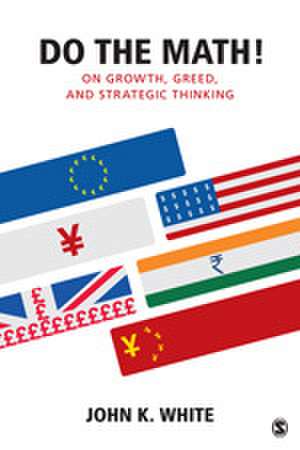
Do the Math!: On Growth, Greed, and Strategic Thinking
Autor John K. Whiteen Limba Engleză Electronic book text – 20 iun 2013
Preț: 175.73 lei
Puncte Express: 264
Indisponibil temporar
Doresc să fiu notificat când acest titlu va fi disponibil:
Se trimite...
Specificații
ISBN-13: 9781452281063
ISBN-10: 1452281068
Pagini: 392
Dimensiuni: 152 x 229 mm
Ediția:1
Editura: SAGE Publications
Colecția Sage Publications, Inc
Locul publicării:Thousand Oaks, United States
ISBN-10: 1452281068
Pagini: 392
Dimensiuni: 152 x 229 mm
Ediția:1
Editura: SAGE Publications
Colecția Sage Publications, Inc
Locul publicării:Thousand Oaks, United States
V-ar putea interesa
-
 Preț: 446.20 lei
 -
 -18%Preț: 1115.17 lei1359.96 lei
 -
 Relational Research and Organisation StudiesCharlotte Øland Madsen-18%Preț: 1110.91 lei1354.77 lei
 -
 Egocentric Network AnalysisBrea L. Perry-11%Preț: 498.85 lei560.51 lei
 -
 -11%Preț: 421.36 lei473.44 lei
 -
 Egocentric Network AnalysisBrea L. PerryPreț: 332.35 lei
 -
 Crafting Phenomenological ResearchMark D. Vagle-18%Preț: 960.65 lei1171.53 lei
 -
 Crafting Phenomenological ResearchMark D. VaglePreț: 317.65 lei
 -
 Preț: 303.75 lei
 -
 Comparability in Social ResearchMargaret Stacey-18%Preț: 784.38 lei956.56 lei
 -
 -18%Preț: 1110.11 lei1353.79 lei
 -
 Preț: 458.47 lei
 -
 -18%Preț: 843.39 lei1028.53 lei
 -
 Knowledge Construction in AcademiaElena Sheldon-23%Preț: 425.88 lei553.09 lei
 -
 Comparison – A Methodological Introduction for the Social SciencesLeonardo MorlinoPreț: 143.58 lei
Recenzii
“This
book
is
easy
to
understand
and
very
readable.
I
very
much
enjoyed
the
author’s
ability
to
use
fables
to
explain
mathematical
concepts,
he
does
manage
to
capture
the
reader’s
attention
right
from
the
beginning.”
“I personally love the unabashed connection to morality, what you should do versus what you can do, which rarely shows up in books today.”
“The key strength is in the description of the problems that greed has created, and the impact that has on our physical and social environment. Equipping students with the knowledge to look at statistical reports on the economy, for example, and to be skeptical and know that there is more to the story in the numbers is very valuable, and could help make better consumers.”
“The key strengths of the text are the numerous examples and stories related to connecting political, economic, cultural, scientific, and mathematical concepts. Some stories are classic tales, some are current events, and others are hypothetical situations that all make the reader think and provide excellent visual matter.”
“The author does a good job demystifying some pretty sophisticated mathematical concepts through the use of engaging and entertaining examples.”
“Students…benefit from an understanding of the role of statistical analysis, probability and calculus in governmental systems, historical trending and political prediction. The text encourages readers to consider the larger implications of fundamental mathematical concepts.”
“I personally love the unabashed connection to morality, what you should do versus what you can do, which rarely shows up in books today.”
“The key strength is in the description of the problems that greed has created, and the impact that has on our physical and social environment. Equipping students with the knowledge to look at statistical reports on the economy, for example, and to be skeptical and know that there is more to the story in the numbers is very valuable, and could help make better consumers.”
“The key strengths of the text are the numerous examples and stories related to connecting political, economic, cultural, scientific, and mathematical concepts. Some stories are classic tales, some are current events, and others are hypothetical situations that all make the reader think and provide excellent visual matter.”
“The author does a good job demystifying some pretty sophisticated mathematical concepts through the use of engaging and entertaining examples.”
“Students…benefit from an understanding of the role of statistical analysis, probability and calculus in governmental systems, historical trending and political prediction. The text encourages readers to consider the larger implications of fundamental mathematical concepts.”
Cuprins
Chapter
1.
The
doubling
game:
From
Thomas
Malthus
to
Bernie
Madoff
Chapter 2. She told two friends and they told two friends and they told two friends and...
Chapter 3. The mathematics of change: A new world model
Chapter 4. Fairness and uncertainty: Who watches the watchers?
Chapter 5. Statistics made simple: The science of weighting
Chapter 6. A case for correlation: Sampling and inference from Shakespeare to death row to sports competitiveness
Chapter 7. Counting and computers: From Boole to Google and back
Chapter 8. Who to believe? Numbers and the art of deception
Chapter 9. Two kinds of people: Those who divide and those who don't
Chapter 10. How to get along: Be nice, clear your ice
Chapter 11. Cooperation: The art and science of agreement
Chapter 12. The roots of economic disaster: Making money from money
Chapter 2. She told two friends and they told two friends and they told two friends and...
Chapter 3. The mathematics of change: A new world model
Chapter 4. Fairness and uncertainty: Who watches the watchers?
Chapter 5. Statistics made simple: The science of weighting
Chapter 6. A case for correlation: Sampling and inference from Shakespeare to death row to sports competitiveness
Chapter 7. Counting and computers: From Boole to Google and back
Chapter 8. Who to believe? Numbers and the art of deception
Chapter 9. Two kinds of people: Those who divide and those who don't
Chapter 10. How to get along: Be nice, clear your ice
Chapter 11. Cooperation: The art and science of agreement
Chapter 12. The roots of economic disaster: Making money from money
Descriere
A
fresh
look
at
the
numbers
of
daily
living,
particularly
in
light
of
current
economic
troubles,
where
modern
economic
practices,
mathematical
concepts,
and
everyday
moral
dilemmas
are
discussed.
Notă biografică
John K. White (Ph.D.) has a B.Sc. from the University of Waterloo, Canada, and a Ph.D. from University College, Dublin in Applied Physics. Currently, he is a lecturer and Research Fellow at University College, Dublin. However, over the past 25 years, he has also worked as Project Manager and Technical Writer for Sun Microsystems, as a Computational Analysis/Technical Writer for Berminghammer Foundation, Consultant for Interactive Image Technologies for ScotiaBank, and Programmer/Computational analyst for the Ontario Government. He has a wide range of interests and is also active in promoting science and physics in secondary schools. He has published widely in a range of areas in academic journals, has contributed chapters to edited volumes, and has authored a number of technical publications.