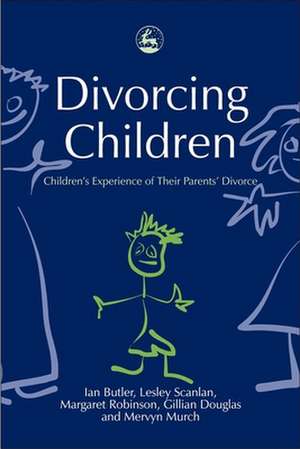
Divorcing Children: Children's Experience of their Parents' Divorce
Autor Dr Lesley Scan, Miss Gillian Douglas, Margaret G Robinson, Professor Ian Butler, Prof Mervyn Murchen Limba Engleză Paperback – 15 aug 2003
The authors show what children want and need to know as the process of divorce unfolds and how professionals can respond appropriately to help them to understand and adjust to their changing circumstances. Divorcing Children addresses the weaknesses of current legislation in family justice and suggests ways of improving the skills and knowledge of all professionals who work with children during this difficult period in children's lives.
Preț: 201.14 lei
Preț vechi: 270.14 lei
-26%
Puncte Express: 302
Carte disponibilă
Livrare economică 11-25 noiembrie
Livrare prin curier în România Termenul estimat este afișat lângă disponibilitate.
Transport gratuit de la 400.00 lei Plată online sau ramburs, în funcție de opțiunile comenzii.
Retur gratuit în 14 zile Comandă securizată și suport în română.
Specificații
ISBN-13: 9781843101031
ISBN-10: 1843101033
Pagini: 240
Dimensiuni: 154 x 232 x 16 mm
Greutate: 0.4 kg
Editura: JESSICA KINGSLEY PUBLISHERS
Colecția Jessica Kingsley Publishers
Locul publicării:London, United Kingdom
ISBN-10: 1843101033
Pagini: 240
Dimensiuni: 154 x 232 x 16 mm
Greutate: 0.4 kg
Editura: JESSICA KINGSLEY PUBLISHERS
Colecția Jessica Kingsley Publishers
Locul publicării:London, United Kingdom
V-ar putea interesa
-
 Social Work: A Very Short IntroductionSally Holland-20%Preț: 56.85 lei70.93 lei
 -
 -28%Preț: 221.80 lei307.27 lei
 -
 Law and ParenthoodChris BartonPreț: 373.60 lei
 -
 Counseling PsychologyRuth Chu-Lien ChaoPreț: 309.88 lei
 -
 Multicultural Social Work PracticeDerald Wing Sue-23%Preț: 599.80 lei778.96 lei
 -
 The Relationship InventoryGodfrey T Barrett-LennardPreț: 404.73 lei
 -
 Applying Theory to Generalist Social Work PracticeCarol L Langer-8%Preț: 422.92 lei459.70 lei
 -
 The Compleat Social WorkerDavid Howe-10%Preț: 170.65 lei189.23 lei
 -
 Counseling Across CulturesPaul B. Pedersen-27%Preț: 965.99 lei1323.28 lei
 -
 Social Work with Children and Families: Getting into Practice Third EditionProfessor Ian Butler-25%Preț: 204.20 lei272.59 lei
 -
 -26%Preț: 214.87 lei288.48 lei
 -
 -29%Preț: 206.28 lei289.91 lei
 -
 -26%Preț: 197.64 lei267.38 lei
 -
 Burger Bar DadIan ButlerPreț: 106.48 lei
 -
 -26%Preț: 199.74 lei268.73 lei
 -
 Practice Teaching - Changing Social WorkHilary Lawson-24%Preț: 244.73 lei323.18 lei
 -
 -25%Preț: 242.50 lei321.79 lei
 -
 Grandparenting in divorced familiesNeil FergusonPreț: 247.84 lei
 -
 Living With Grief: Children, Adolescents and LossKenneth J. DokaPreț: 235.93 lei
 -
 Forensic Interviews Regarding Child Sexual AbuseWilliam T. O'Donohue-18%Preț: 1271.93 lei1551.14 lei
Recenzii
This is an excellent book that should be read not only by all professionals dealing with children but also by parents and wider family. The quotations from the young people powerfully describe the situation in which they, through no fault of their own, find themselves.
There is a wealth of first-hand accounts by children. The research shows clearly the extent of crisis felt by the children, their need to understand what was happening and what would follow, and their need for emotional comfort. However, the study also highlighted these children's skills and resilience. The work is very relevant for a wide range of social care staff.
This straightforward book is an effort to better understand the process of divorce through children's eyes. It provides an expanded overview and discussion of a British study that carefully reviewed the experiences of 104 children, aged 7 to 15, with their parent's separation and divorce... For the most part, this book accomplishes what it has promised to do. Important findings include the common experience of a sense of crisis in these changes for many children, some inconsistency in meeting their needs for reliable information and a variable sense of being adequately supported. Interesting themes were; difficulty communicating with fathers, value of support from friends, and a sense of involvement without understanding the legal process. Direct quotes liven children's emotions, struggles and successes... This study provides a useful way to keep the child's experience at the forefront for parents, clinicians, and others who seek to support these children. This should be of interest to those who work within the legal context or who seek to shape the legal system and public policy in this area.
The objective of the book is admirable as its aim to expose and address "the ambiguity that inhabits much of our thinking about children in contemporary Britain". It is very important that the views expressed by children in the study are brought to the attention of practitioners and policy-makers alike to whom I recommend the book. Improvements in practice are dependent on the availability of research such as this.
There is a wealth of first-hand accounts by children. The research shows clearly the extent of crisis felt by the children, their need to understand what was happening and what would follow, and their need for emotional comfort. However, the study also highlighted these children's skills and resilience. The work is very relevant for a wide range of social care staff.
This straightforward book is an effort to better understand the process of divorce through children's eyes. It provides an expanded overview and discussion of a British study that carefully reviewed the experiences of 104 children, aged 7 to 15, with their parent's separation and divorce... For the most part, this book accomplishes what it has promised to do. Important findings include the common experience of a sense of crisis in these changes for many children, some inconsistency in meeting their needs for reliable information and a variable sense of being adequately supported. Interesting themes were; difficulty communicating with fathers, value of support from friends, and a sense of involvement without understanding the legal process. Direct quotes liven children's emotions, struggles and successes... This study provides a useful way to keep the child's experience at the forefront for parents, clinicians, and others who seek to support these children. This should be of interest to those who work within the legal context or who seek to shape the legal system and public policy in this area.
The objective of the book is admirable as its aim to expose and address "the ambiguity that inhabits much of our thinking about children in contemporary Britain". It is very important that the views expressed by children in the study are brought to the attention of practitioners and policy-makers alike to whom I recommend the book. Improvements in practice are dependent on the availability of research such as this.
Cuprins
Introduction: Divorcing Children. 1. Children and Divorce: Developments in Policy and Practice. 2. Finding Out. 3. Telling Others. 4. Parent-Child Relationships. 5. Contact. 6. Change and Adaptation. 7. Legal Aspects. 8. Conclusions. Appendix: How to Listen to Children. References. Index.