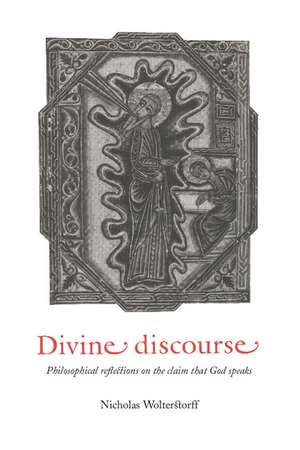
Divine Discourse
Autor Nicholas Wolterstorffen Limba Engleză Paperback – 19 dec 1995
Observăm că, în literatura academică de specialitate, tema discursului divin a fost adesea marginalizată sau tratată insuficient, filozofii tinzând să confunde fenomenul vorbirii cu cel al revelației. Divine Discourse vine să completeze această lacună fundamentală, oferind o reflecție susținută asupra afirmațiilor centrale din tradițiile iudaice, creștine și islamice conform cărora Dumnezeu comunică activ. Nicholas Wolterstorff propune o abordare riguroasă, ancorată în teoria modernă a actelor de limbaj (speech-action theory), pe care o extinde pentru a demonstra validitatea și inteligibilitatea conceptului de „Dumnezeu care vorbește”. Suntem de părere că elementul cel mai distinctiv al acestui volum este dezvoltarea unei teorii inovatoare a „dublei-hermeneutici”. Prin aceasta, autorul intră într-o polemică directă cu pozițiile lui Paul Ricoeur și Jacques Derrida, contestând ideea că interpretarea unui text pentru a descoperi intenția autorului ar fi o demers eronat. Cititorii familiarizați cu Is There an Author in This Text? de Peter A. Sutcliffe vor aprecia modul în care Nicholas Wolterstorff duce dezbaterea hermeneutică mai departe, oferind un cadru filozofic solid care justifică dreptul epistemologic al credincioșilor de a susține că au recepționat un mesaj divin. Subliniem că acest volum reprezintă o piesă de bază în bibliografia autorului, făcând trecerea de la epistemologia reformată explorată în Faith and Rationality către o filozofie a limbajului aplicată teologiei. Dacă în lucrări precum Lament for a Son sau Walking Through Twilight – A Wife′s Illness – A Philosopher′s Lament autorul explorează dimensiunea existențială și emoțională a credinței în fața suferinței, Divine Discourse păstrează rigoarea analitică specifică edițiilor Cambridge University Press, fiind o lectură densă, argumentată cu precizie, esențială pentru înțelegerea modului în care limbajul uman și cel divin se intersectează.
Preț: 238.67 lei
Carte tipărită la comandă
Livrare economică 01-15 decembrie
Specificații
ISBN-10: 0521475570
Pagini: 340
Dimensiuni: 152 x 229 x 20 mm
Greutate: 0.55 kg
Editura: Cambridge University Press
Locul publicării:Cambridge, United Kingdom
V-ar putea interesa
-
 The Creative Suffering of GodPaul S. Fiddes-19%Preț: 381.53 lei473.13 lei
 -
 -33%Preț: 722.68 lei1075.55 lei
 -
 Natural TheologyWilliam Paley-18%Preț: 65.40 lei79.75 lei
 -
 Is There a God?Richard Swinburne-16%Preț: 94.77 lei113.30 lei
 -
 Knowing the Unknowable GodDavid B. Burrell C. S. C.Preț: 193.01 lei
 -
 Conversations With GodNeale Donald Walsch-27%Preț: 57.48 lei78.57 lei
 -
 Conversations with God - Book 2: An uncommon dialogueNeale Donald Walsch-26%Preț: 58.06 lei78.92 lei
 -
 Conversations with God - Book 3: An uncommon dialogueNeale Donald Walsch-25%Preț: 60.07 lei80.12 lei
 -
 Darwin, God and the Meaning of LifeSteve Stewart-WilliamsPreț: 235.14 lei
 -
 -25%Preț: 238.63 lei320.12 lei
 -
 And Man Created GodRobert BanksPreț: 70.71 lei
 -
 Preț: 106.99 lei
 -
 The Reality of God and the Problem of EvilFr Brian Davies-17%Preț: 321.67 lei388.94 lei
De ce să citești această carte
Această lucrare este recomandată cercetătorilor și studenților la filozofie sau teologie care doresc să înțeleagă fundamentele raționale ale comunicării divine. Cititorul va câștiga o perspectivă clară asupra modului în care teoria actelor de limbaj poate fi aplicată textelor sacre, oferind un argument solid împotriva scepticismului hermeneutic modern. Este o resursă esențială pentru oricine analizează autoritatea textului biblic prin prisma filozofiei analitice.
Despre autor
Nicholas Wolterstorff este profesor emerit de teologie filozofică la Yale University (Noah Porter Professor Emeritus) și cercetător senior la Institute for Advanced Studies in Culture din cadrul University of Virginia. Este recunoscut la nivel mondial ca unul dintre cei mai influenți filozofi creștini contemporani. Opera sa vastă cuprinde titluri de referință precum John Locke and the Ethics of Belief, Justice: Rights and Wrongs și Practices of Belief. Cariera sa îmbină rigoarea filozofiei analitice cu o sensibilitate profundă față de liturghie, dreptate socială și experiența umană a suferinței, teme reflectate atât în cursurile sale universitare, cât și în memoriile sale.
Descriere scurtă
Cuprins
Recenzii
'Derived from his Wilde Lectures delivered at Oxford in 1993, Wolterstorff's Divine discourse makes an important contribution to contemporary research at the intersection of philosophy, theology, and biblical studies. Wolterstorff approaches biblical texts by focusing on the notion of divine speech, rather than by examining the idea of revelation, as is commonly done. The result is an original and creative account of God's communication with human beings, which provides a new way of thinking about biblical interpretation and about the interpretation of texts in general. This book is mandatory reading for anyone interested in these topics.' Eleonore Stump, St Louis University
'… a very interesting and important book and one for which the philosophical community should be grateful.' Richard Swinburne, Philosophy
' … an impressive work, carefully argued and well informed, not only philosophically but also theologically and more widely.' Journal of Religious Studies