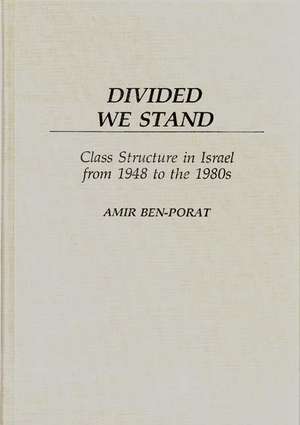
Divided We Stand
Autor Amir Ben-Poraten Limba Engleză Hardback – 3 noi 1989
"Divided We Stand" monitors the development of class structure in Israel from 1948 to the mid-1980s by using information on the economy and on individuals' positions in the economy (gathered by the Israeli Central Bureau of Statistics). Numerous tables complement the written content by examining certain variables--such as immigration, gender, ethnic origin, mobility, types of industry and religion--over three decades. This book also analyzes the structural transformation of the society and explores the process of allocation and reallocation of Israeli citizens. "Divided We Stand" can be a practical, informative source for academics and students of sociology, political development, and Middle East affairs. As Israel continues to define itself, the book can serve as a useful guide and study to one of the more unexplored aspects of Israeli society.
Preț: 385.26 lei
Preț vechi: 630.97 lei
-39%
Puncte Express: 578
Carte tipărită la comandă
Livrare economică 19 decembrie 26 - 02 ianuarie 27
Livrare prin curier în România Termenul estimat este afișat lângă disponibilitate.
Transport gratuit de la 400.00 lei Plată online sau ramburs, în funcție de opțiunile comenzii.
Retur gratuit în 14 zile Comandă securizată și suport în română.
Specificații
ISBN-13: 9780313264023
ISBN-10: 0313264023
Pagini: 160
Dimensiuni: 161 x 240 x 13 mm
Greutate: 0.36 kg
Ediția:New.
Editura: Praeger
ISBN-10: 0313264023
Pagini: 160
Dimensiuni: 161 x 240 x 13 mm
Greutate: 0.36 kg
Ediția:New.
Editura: Praeger
V-ar putea interesa
-
 Iran: Empire of the MindMichael Axworthy-18%Preț: 77.15 lei93.70 lei
-
 Preț: 138.04 lei
-
 Our Last Best ChanceKing Abdullah II of Jordan-28%Preț: 77.88 lei108.06 lei
-
 -18%Preț: 100.61 lei123.13 lei
-
 IranN. NabaviPreț: 397.29 lei
-
 LebanonB. RubinPreț: 404.18 lei
-
 Preț: 332.97 lei
-
 Al- TabarAl-Tabar?Preț: 344.99 lei
-
 SAS: Storm FrontRowland White-36%Preț: 56.08 lei87.18 lei
-
 Suleiman the MagnificentAndre ClotPreț: 126.91 lei
-
 -25%Preț: 70.23 lei93.81 lei
-
 -25%Preț: 187.00 lei250.69 lei
-
 -33%Preț: 771.55 lei1147.36 lei
-
 -32%Preț: 855.82 lei1264.56 lei
-
 The Iraqi Refugees: The New Crisis in the Middle EastJoseph Sassoon-20%Preț: 184.91 lei232.29 lei
Descriere
Four decades of statehood for Israel has meant four decades of nationalistic, cultural, and ethnic conflicts. Throughout these growing pains, Israel has experienced a remarkable lack of class struggle--unusually so during the transition to a capitalistic society. Divided We Stand shows that the lack of class struggle is no accident; it is a result of political design and necessity. In Israel, the state has been the predominating social agent and has therefore been in a position to supervise class struggle within the boundaries of its own rules. With an in-depth look at the class system and the lack of class struggle, this book provides an interesting perspective and analysis of Israeli society. Divided We Stand monitors the development of class structure in Israel from 1948 to the mid-1980s by using information on the economy and on individuals' positions in the economy (gathered by the Israeli Central Bureau of Statistics). Numerous tables complement the written content by examining certain variables--such as immigration, gender, ethnic origin, mobility, types of industry and religion--over three decades. This book also analyzes the structural transformation of the society and explores the process of allocation and reallocation of Israeli citizens. Divided We Stand can be a practical, informative source for academics and students of sociology, political development, and Middle East affairs. As Israel continues to define itself, the book can serve as a useful guide and study to one of the more unexplored aspects of Israeli society.
Cuprins
Introduction: The What and the How of It
Israel after Statehood: An Overview
The Present Mattter: Class Model and Data
The Portrait of Class Structure
Becoming a Class Member: The Process of Allocation
Reallocation: Up and Down in the Class Structure
Structural Transformation: Class and Sector
Class Structure in Israel: A Summary--The Visible Hand
Index
Recenzii
«Data for Ben-Porat's study of class structure in Israel are taken from various sources, mostly the Israeli Central Bureau of Statistics. First, the author identifies major socioeconomic factors that have affected the emergence and development of Israeli class structure. He next explores the form and content of that class structure. Finally, he looks into the process of allocation to class positions and mobility patterns, and finds that ethnicity, gender, and religion are still important factors. The study suggests that the fivefold class structure of Israeli society in the 1980s is very close to that of a capitalist society in both shape and parameters. This well-written book makes a strong contribution to the understanding of the nature and patterns of social inequality in Israel. It deserves and undoubtedly will receive the attention of students of social stratification, political sociology, and social organization. Tables; notes; references; index. Upper-division undergraduates and above.“”Choice
«Four decades of statehood for Israel has meant four decades of nationalistic, cultural, and ethnic conflicts. Throughout these growing pains, Israel has experienced a remarkable lack of class struggle, unusual for a country during the transition to a capitalistic society. Divided We Stand shows that this lack of class struggle is no accident; it is the result of political design and necessity. In Israel, the state has been the predominating social agent and has therefore been in a position to supervise class struggle within the boundaries of its own rules.“”Shofar
«Four decades of statehood for Israel has meant four decades of nationalistic, cultural, and ethnic conflicts. Throughout these growing pains, Israel has experienced a remarkable lack of class struggle, unusual for a country during the transition to a capitalistic society. Divided We Stand shows that this lack of class struggle is no accident; it is the result of political design and necessity. In Israel, the state has been the predominating social agent and has therefore been in a position to supervise class struggle within the boundaries of its own rules.“”Shofar
Notă biografică
AMIR BEN-PORAT is Senior Lecturer in the Department of Behavior Sciences, Ben-Gurion University of the Negev, Israel. He is the author of Between Class and Nation (Greenwood, 1986) and his articles have appeared in International Journal of Comparative Sociology and Science and Society.