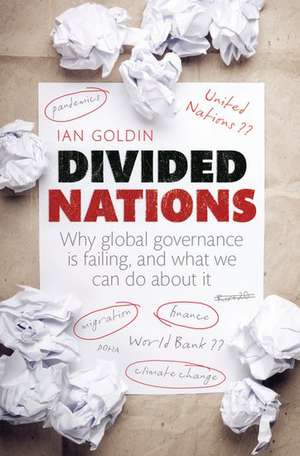
Divided Nations: Why global governance is failing, and what we can do about it
Autor Ian Goldinen Limba Engleză Paperback – 24 apr 2014
Preț: 72.87 lei
Preț vechi: 91.79 lei
-21%
Puncte Express: 109
Carte disponibilă
Livrare economică 06-11 noiembrie
Livrare express 22-28 octombrie pentru 39.88 lei
Livrare prin curier în România Termenul estimat este afișat lângă disponibilitate.
Transport gratuit de la 400.00 lei Plată online sau ramburs, în funcție de opțiunile comenzii.
Retur gratuit în 14 zile Comandă securizată și suport în română.
Specificații
ISBN-13: 9780199689033
ISBN-10: 0199689032
Pagini: 224
Ilustrații: 12 black and white illustrations
Dimensiuni: 129 x 196 x 18 mm
Greutate: 0.24 kg
Editura: Oxford University Press
Colecția OUP Oxford
Locul publicării:Oxford, United Kingdom
ISBN-10: 0199689032
Pagini: 224
Ilustrații: 12 black and white illustrations
Dimensiuni: 129 x 196 x 18 mm
Greutate: 0.24 kg
Editura: Oxford University Press
Colecția OUP Oxford
Locul publicării:Oxford, United Kingdom
V-ar putea interesa
-
 -21%Preț: 374.04 lei471.36 lei
 -
 NGO DiplomacyMichele M. BetsillPreț: 238.47 lei
 -
 In Europe's ShadowRobert D. Kaplan-20%Preț: 65.48 lei81.85 lei
 -
 The End of the Eurocrats' DreamDamian ChalmersPreț: 304.81 lei
 -
 Corruption and Government 2edSusan Rose-AckermanPreț: 377.93 lei
 -
 The Kremlin Strikes BackSteven RosefieldePreț: 250.60 lei
 -
 Opting Out of the European UnionRebecca Adler-NissenPreț: 299.03 lei
 -
 Preț: 345.41 lei
 -
 Hybrid WarfareWilliamson MurrayPreț: 264.59 lei
 -
 Research Methods for PostgraduatesTony GreenfieldPreț: 448.94 lei
 -
 Global Turning PointsMauro F. GuillénPreț: 364.95 lei
 -
 Media and the Ukraine CrisisMervi PanttiPreț: 473.66 lei
Recenzii
Divided Nations is an absolutely remarkable book, which provides fresh and particularly useful theoretical as well as necessarily practical insights given the present challenges facing humanity.
Goldin is dead right. This could be the best century ever. Or the worst. As we shrink inexorably into a global village, the biggest challenge is how we manage global village governance. Goldin offers clear-headed analysis and practical, pragmatic solutions. A must-read.
Ian Goldin stylishly describes the Gordian knot of international governance and makes some sensible suggestions on how it might be cut.
Ian Goldin has been in the kitchen, at a senior level, of national and international policymaking. It is a messy place. But, as he argues clearly and convincingly, our ability to co-operate across nations is crucial to the stability and growth of our economies. It is crucial too for the protection of our environment and reducing the grave risks of climate change. The necessary co-operation will not be easy but Goldin sets out clear principles and sketches out real possibilities. The world should listen.
Goldin offers clear-headed analysis and practical, pragmatic solutions. A must-read.
At a time when, as Ian Goldin argues, global politics is gridlocked, we need greater international co-operation than ever before - and the institutions to sustain it - in order to cope with the sort of problems from economic imbalances to the environment which individual nation states cannot overcome on their own. Ian Goldin shows why this is imperative and how it could be done.
Goldin is dead right. This could be the best century ever. Or the worst. As we shrink inexorably into a global village, the biggest challenge is how we manage global village governance. Goldin offers clear-headed analysis and practical, pragmatic solutions. A must-read.
Ian Goldin stylishly describes the Gordian knot of international governance and makes some sensible suggestions on how it might be cut.
Ian Goldin has been in the kitchen, at a senior level, of national and international policymaking. It is a messy place. But, as he argues clearly and convincingly, our ability to co-operate across nations is crucial to the stability and growth of our economies. It is crucial too for the protection of our environment and reducing the grave risks of climate change. The necessary co-operation will not be easy but Goldin sets out clear principles and sketches out real possibilities. The world should listen.
Goldin offers clear-headed analysis and practical, pragmatic solutions. A must-read.
At a time when, as Ian Goldin argues, global politics is gridlocked, we need greater international co-operation than ever before - and the institutions to sustain it - in order to cope with the sort of problems from economic imbalances to the environment which individual nation states cannot overcome on their own. Ian Goldin shows why this is imperative and how it could be done.
Notă biografică
Professor Ian Goldin is the Director of the Oxford University's Oxford Martin School, Oxford University Professor of Globalisation and Development and Professorial Fellow at Balliol College, Oxford. From 2001 to 2006 he was at the World Bank, first as Director of Policy and then as Vice President. He has published over fifty articles and fifteen books, including ^iGlobalisation for Development: Meeting New Challenges^r (OUP, 2012) and ^iExceptional People: How Migration Shaped our World and Will Define our Future^r (PUP, 2011).